- A bilingual answering service answers your calls in English plus Spanish (and, in Canada, often French), and sends you every message in English.
- Many US live services include Spanish at no extra charge as of November 2026 (MAP, PATLive, Posh, Ruby, Abby Connect); Smith.ai charges $1 per call for a Spanish line.
- In Quebec, businesses with five or more employees must be able to serve customers in French, so French coverage isn't optional there.
- Test with native speakers before you sign: ask how names, addresses and numbers are captured and translated.
A bilingual answering service answers your business calls in more than one language, typically English and Spanish in the US, and English and French in Canada, so callers can explain what they need in the language they’re most comfortable with. You still get every message, booking and urgent call summary in English. Many US providers now include Spanish in their standard plans; French coverage is less common and mostly comes from Canadian providers or AI.
This guide covers who needs one, how bilingual call routing works, which providers include Spanish, the Canadian French situation, and how to check quality before you trust it with customers.
Who needs a bilingual answering service?
The short answer: anyone whose customers include people who prefer another language, especially for urgent or detailed calls.
In the US, Spanish is by far the most common language after English. According to the Census Bureau’s 2018 to 2022 American Community Survey, 78.3% of people age 5 and over speak only English at home, and Spanish accounts for 61.1% of everyone who speaks another language at home. Among those Spanish speakers, 61.0% speak English “very well,” so roughly four in ten speak it less than very well, and many of them would rather handle a service call in Spanish.
In Canada, French is the obvious second language. Statistics Canada’s 2021 Census reports that 46.4% of Quebec residents can hold a conversation in both English and French, and that French is the first official language for 30.0% of New Brunswick residents and 3.4% of Ontario residents. Many Canadian businesses also get Spanish, Punjabi, Mandarin or Cantonese callers, depending on the city.
Industries where bilingual answering matters most:
- Home services (HVAC, plumbing, roofing), where emergencies need clear details fast.
- Medical and dental offices, where misunderstanding symptoms or insurance details has consequences.
- Property management, with tenants reporting maintenance issues.
- Law firms, especially immigration, family and personal injury practices.
- Real estate, where buyers and renters call about listings.
How bilingual call routing works
There are three common setups.
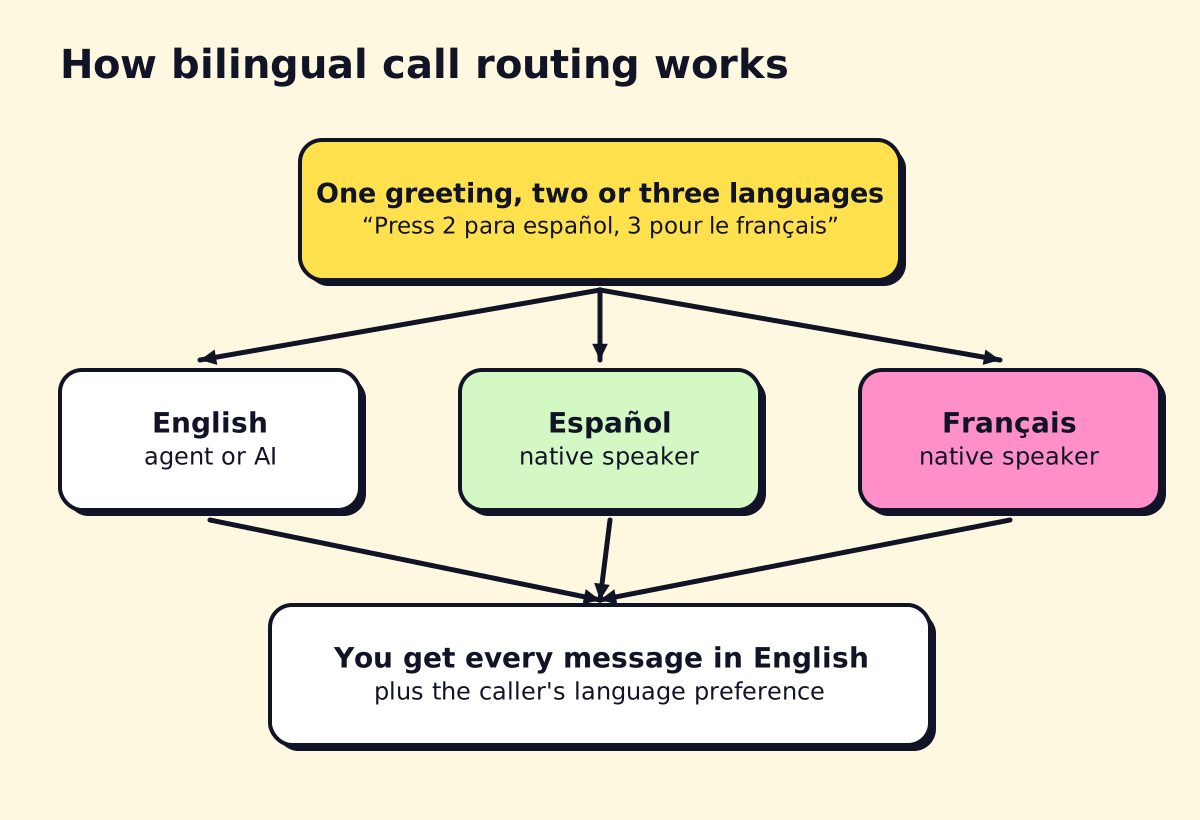
- Language menu. “For English, press 1. Para español, oprima 2.” Calls route to the right agents. Simple and reliable, but it adds a step before the caller reaches anyone. PATLive, for example, includes a free English/Spanish auto attendant for this.
- Bilingual agents answer everyone. The agent greets in English (or both languages) and switches when the caller responds in Spanish or French. Smoother for callers, but it depends on having bilingual agents on every shift.
- AI that detects the language. The AI greets in your main language and switches automatically when the caller speaks another. Some AI tools switch mid-conversation.
Whichever you pick, decide how messages reach you. The norm is a message translated into English, with a note of the caller’s preferred language so your team calls back in the right language, or flags that a Spanish- or French-speaking colleague should handle it.
Spanish answering services in the US: who includes it
Prices and inclusions below are from providers’ pricing pages, as of November 2026.
| Provider | Spanish or bilingual | Extra cost? |
|---|---|---|
| MAP Communications | English and Spanish on every plan | No |
| PATLive | Bilingual, with free language menu | No |
| Posh | Bilingual receptionists on all plans | No |
| Ruby | 24/7 Spanish and bilingual call handling | No |
| Abby Connect | English and Spanish answering | No |
| Smith.ai | Dedicated Spanish line | $1 per call |
“Included” doesn’t tell you how many Spanish-speaking agents are on shift at 2 a.m., or whether they’re native speakers. Those are the questions to ask, and we cover them below. For general pricing across these providers, see how much an answering service costs.
Bilingual virtual receptionists
If you need more than message taking (transfers, booking, intake in Spanish), look at virtual receptionist plans rather than basic answering. Ruby, Posh and Abby Connect all list bilingual receptionists on their plans. Our virtual receptionist services guide compares them in detail.
French and bilingual answering in Canada
The Quebec rule
Quebec’s Charter of the French Language, as amended by Bill 96, gives consumers the right to be informed and served in French. According to Éducaloi, businesses with five or more employees must be able to offer service in French. The rules are enforced by the Office québécois de la langue française. If you serve Quebec customers by phone, an English-only answering service is a compliance problem as well as a customer-service one. Check the details for your situation with the OQLF or a lawyer.
Finding French coverage
Most large US answering services offer English and Spanish, not French. For French, your options are:
- Canadian answering services that advertise English and French coverage. Few publish prices; you’ll typically need a quote, and it’s worth asking whether French is a surcharge.
- AI receptionists with French support. RingCentral AI Receptionist, sold in the US and Canada, lists English, Spanish, French, Italian, German and Portuguese and can switch languages mid-conversation.
- A hybrid: AI in French and English for routine calls, with French-speaking staff or a Canadian service for the calls that need a person.
Ask any provider whether their French speakers are comfortable with Québécois and Acadian French, not only European French. Accents and vocabulary differ, and callers notice.
How to judge the quality of a bilingual service
“Bilingual” on a pricing page can mean anything from native speakers to an agent with high-school Spanish. Check these before you sign:
- Native or fluent speakers? Ask directly, and ask how they test language skills.
- Coverage on every shift. Are Spanish or French speakers available nights, weekends and holidays? Bilingual coverage often thins out overnight, which is exactly when emergencies happen. Our after-hours answering service guide covers night coverage in general.
- Scripts in both languages. Your script should be properly translated by someone fluent, not machine-translated on the fly. Review the translated version with a native speaker you trust.
- Names, addresses and numbers. These are where errors happen. Ask how agents confirm spelling and read numbers back.
- Translated messages. Who translates the message into English, and is the caller’s original wording kept anywhere (for example, in a recording)?
- Hold and transfer. If the caller needs a Spanish-speaking agent and none is free, what happens? A long hold defeats the purpose.
A test you can run in an afternoon
Ask a native Spanish (or French) speaker to call during a trial three times: once as a routine customer, once with an urgent problem, and once with a hard-to-spell name and address. Then compare the messages you receive with what they actually said.
AI and bilingual answering
AI is often stronger at language coverage than at anything else. A single AI receptionist can answer in Spanish, French and English at 3 a.m. without needing three people on shift, and some, like Rosie, include English and Spanish on every plan. The caution is the same as in English: AI handles routine calls well and is weaker with upset callers and exceptions, and errors in names and addresses still happen, so the AI should read details back. We cover the trade-offs in our AI answering service guide.
Setting it up
- Look at who calls you. Ask your team how often callers struggle in English, and in which language.
- Decide the routing: language menu, bilingual agents, or AI language detection.
- Translate your script properly and have a native speaker review it.
- Set callback rules: who on your team calls back Spanish- or French-speaking customers?
- Test with native speakers during the trial, including after hours.
- Review a sample of calls monthly.
If you’d like a bilingual AI receptionist (English with Spanish, or English with French for Canada) connected to your calendar and with a handoff to your team, opsmigo can build and test it with you.
We build a free demo on your own services and hours.
FAQ
What is a bilingual answering service?
It's an answering service whose agents or AI can handle calls in two or more languages, usually English and Spanish in the US, or English and French in Canada. Callers are served in their language and you receive messages in English.
Do answering services charge extra for Spanish?
It varies. As of November 2026, MAP Communications, PATLive, Posh, Ruby and Abby Connect list Spanish or bilingual answering as included, while Smith.ai lists a dedicated Spanish line at $1 per call.
Is there a bilingual virtual receptionist service?
Yes. Ruby, Posh and Abby Connect all list bilingual English and Spanish receptionists on their plans. For French in Canada, you'll usually need a Canadian provider or an AI receptionist that supports French.
Can an AI answering service speak Spanish?
Yes. Many AI receptionists handle Spanish, and some switch languages mid-call. RingCentral's AI Receptionist, for example, lists English, Spanish, French, Italian, German and Portuguese.
Do I need French answering for my Canadian business?
If you serve customers in Quebec and have five or more employees, the Charter of the French Language requires you to be able to serve them in French. Elsewhere it's a business choice, but strongly worth it in New Brunswick and francophone parts of Ontario.