- A virtual receptionist is a remote team (or AI) that runs your front desk by phone: greeting callers, transferring, booking and doing intake.
- Published US plans in November 2026 range from about $2.10 to $3.60 per minute on 200-minute plans, or $8.50 to $11.50 per call at Smith.ai.
- Phone-system 'virtual receptionist' features from Ooma, Vonage or Grasshopper are auto attendants (press 1, press 2), not people.
- Pay receptionist rates only if callers need transfers, booking or intake; for plain messages, a basic answering service costs less.
Virtual receptionist services give you a remote front desk: a trained team (or, increasingly, an AI) that answers your calls in your business’s name, screens and transfers callers, books appointments and asks intake questions, so you don’t need someone sitting at a desk. You pay for the time or calls used rather than a salary. As of November 2026, published US plans cost about $2.10 to $3.60 per minute at 200 minutes a month, depending on the provider.
This guide explains what a virtual receptionist does, how it differs from a basic answering service, what the main providers charge, and how to choose one.
What is a virtual receptionist?
A virtual receptionist is a receptionist who works remotely. Instead of one person at your front desk, you share a team of receptionists with other businesses. Calls forward from your number to them; they answer with your greeting, follow your instructions, and connect callers to you or handle the request themselves.
The term gets used for three different things, which causes confusion:
- Live virtual receptionist services: real people, like Ruby, Posh or Smith.ai. This guide is mainly about these.
- AI virtual receptionists: voice AI that answers and books. We cover them in our AI answering service guide.
- Phone-system “virtual receptionist” features: Ooma, Vonage and Grasshopper use the term for an auto attendant, the recorded “press 1 for sales” menu. Useful for routing; it doesn’t answer questions.
There’s also the virtual lobby receptionist: a screen or kiosk in your reception area that connects visitors to a remote person by video. Different product, same name.
What does a virtual receptionist do?
A good virtual receptionist acts like a front-desk employee, within the limits you set:
- Answers and screens calls, filtering spam and sales pitches.
- Warm-transfers callers: introduces them to you or the right colleague, and takes a message if you don’t pick up.
- Schedules appointments in your calendar or booking tool, reschedules and cancels.
- Runs intake: new-client questions for law firms, new-patient details for clinics, job details for contractors.
- Answers common questions about hours, services, location and pricing you’ve approved.
- Manages your diary: some services handle calendar requests for busy professionals, sometimes called diary management.
- Handles chat and texts: several providers answer website chat and SMS too.
- Makes outbound calls: callbacks, confirmations and lead follow-up on some plans.
Virtual receptionist vs answering service
They overlap, and many providers sell both. The practical difference is how much the person on the phone does.
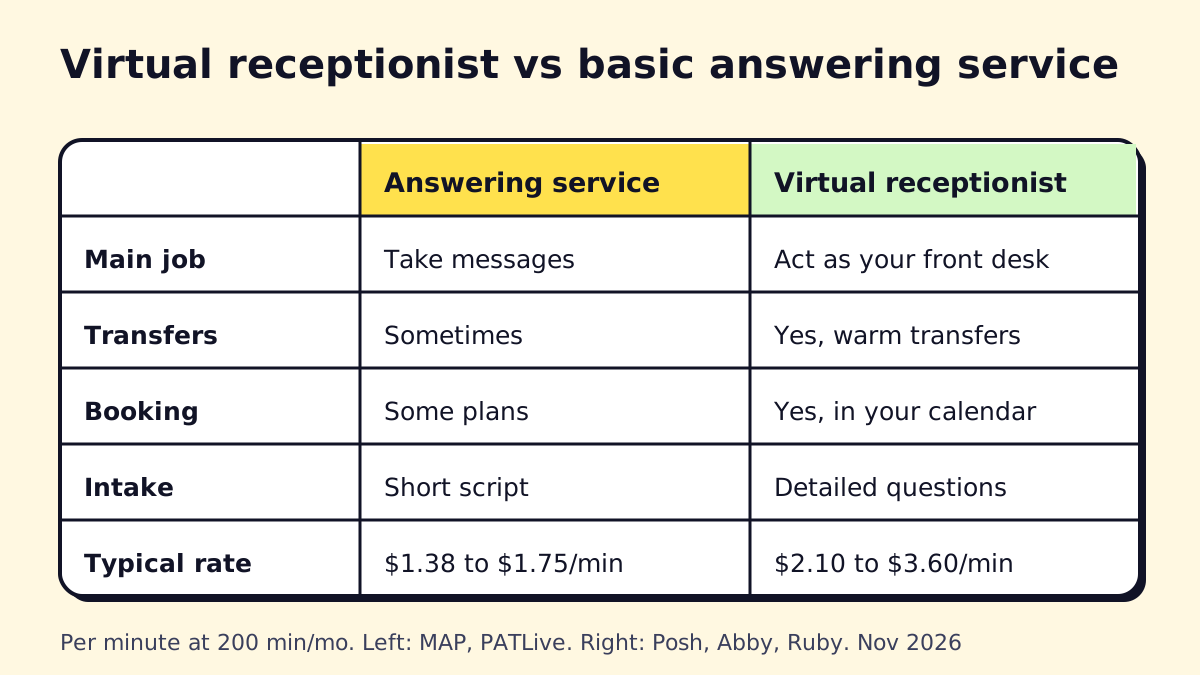
Rates are the effective cost per minute on each provider’s published 200-minute plan, November 2026.
A basic answering service is built to take accurate messages and dispatch urgent calls. A virtual receptionist is built to act as part of your team. If 90% of your callers just need a message taken, a basic service is enough. For the bigger picture on types of answering service, see our answering service guide for small businesses.
Virtual receptionist providers compared (November 2026)
All figures are from each provider’s pricing page, in USD, checked in November 2026.
| Provider | How they bill | Entry price | Spanish |
|---|---|---|---|
| Ruby | Per minute bundles | $250 for 50 min | Included |
| Posh | Per minute bundles | $65 + $2.30/min | Included |
| Smith.ai | Per call | $300 for 30 calls | $1/call add-on |
| Abby Connect | Per minute bundles | $164 for 50 min | Included |
| PATLive | Per minute bundles | $49 + $2.99/min | Included |
Ruby
Ruby is one of the best-known US virtual receptionist companies. Its plans are $250 for 50 minutes, $395 for 100, $720 for 200 and $1,725 for 500 minutes a month. Plans include 24/7 phone coverage and Spanish and bilingual call handling, and Ruby says there are no setup or onboarding fees. It also sells live website chat from $143 a month for 10 chats. Ruby is at the top of the price range; you’re paying for a polished, consistent experience.
Posh
Posh lists seven plans, from $65 a month with no included minutes ($2.30 per minute) to $1,900 for 1,000 minutes. The 200-minute plan is $420. Bilingual receptionists and 24/7 coverage are included, and there’s a free trial of 7 days or 250 minutes, whichever comes first, with no credit card.
Smith.ai
Smith.ai charges per call rather than per minute: $300 a month for 30 calls, $810 for 90 and $2,100 for 300, with extra calls at $8.50 to $11.50. That suits businesses with long intake calls, like law firms. Live coverage is 24/7, and Smith.ai also sells an AI receptionist, so you can mix the two with one vendor.
Abby Connect
Abby plans run from $164 for 50 minutes to $1,380 for 500, with English and Spanish answering, a 24/7 option with no weekend upcharge, and month-to-month terms. AI-answered minutes count as half a minute, which lowers the cost if you let AI take simple calls.
PATLive
PATLive is priced more like an answering service but offers receptionist features such as appointment scheduling. Plans start at $49 a month pay-as-you-go, with 200 minutes at $349. Bilingual answering and 24/7 coverage are included, with a 14-day free trial.
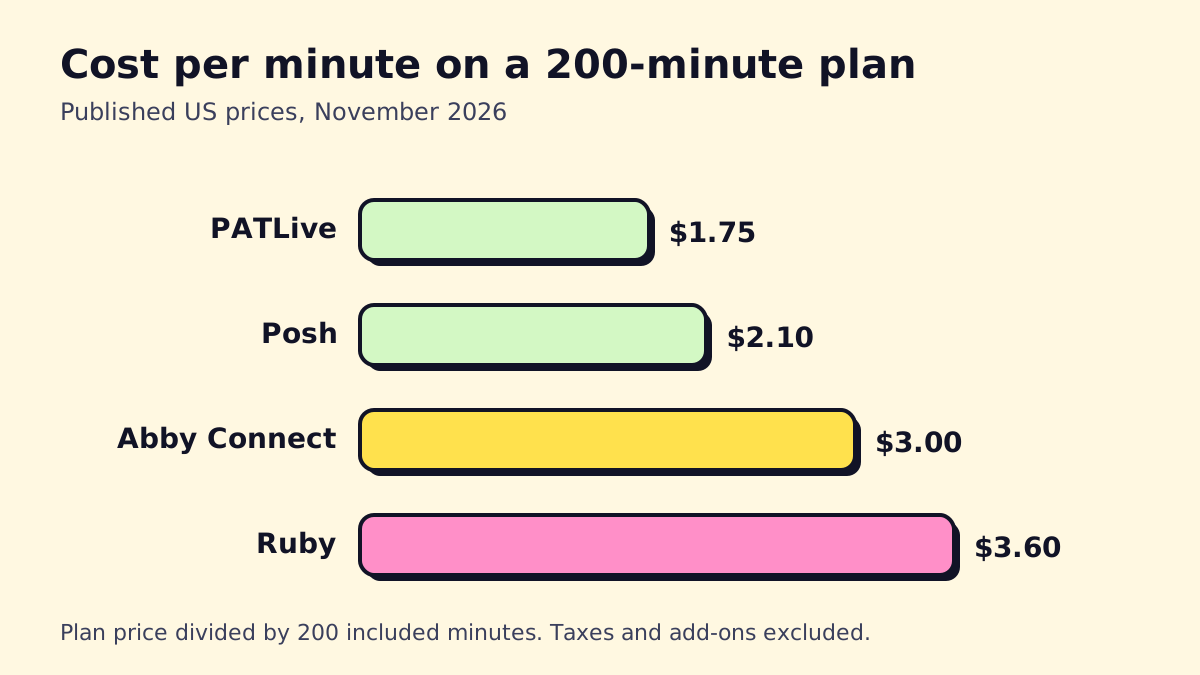
For a full breakdown including pay-as-you-go and AI plans, see how much an answering service costs.
Pay per call, pay as you go or flat rate?
- Pay per call (Smith.ai) is better when calls are long and detailed. You know exactly what each call costs.
- Per-minute bundles (Ruby, Posh, Abby, PATLive) are better when calls are short.
- Pay as you go (Posh, PATLive) suits low or unpredictable volume, at a higher per-minute rate.
- Flat rate virtual receptionist pricing, with unlimited or very large allowances, is mostly offered by AI receptionists. Human services almost always meter usage.
Offshore virtual receptionists (Philippines and others)
Some businesses hire a dedicated remote receptionist through staffing agencies in the Philippines or Latin America, paid hourly. You get one person who learns your business deeply, often for less than a US-based shared service at high volume.
The trade-offs: you manage them like an employee, coverage depends on one person’s schedule, and you need backup for breaks, sick days and nights. It works best for businesses with steady, full-day volume and someone available to manage them.
Virtual receptionist services in Canada
Canadian businesses can use US providers, but check three things:
- French. If you serve customers in Quebec, the Charter of the French Language requires businesses with five or more employees to be able to serve customers in French (Éducaloi). New Brunswick and parts of Ontario have large French-speaking populations too. See our bilingual answering service guide.
- Currency. Most US providers quote in USD.
- Local knowledge. Receptionists should know your time zone, cities and service area.
How to choose a virtual receptionist service
- List your call types and what should happen on each: transfer, book, intake or message.
- Check integrations. Can they book into your actual calendar or practice software, or will they email you requests?
- Ask about consistency. Will the same small team answer your calls, or anyone in a large pool?
- Read the virtual receptionist reviews carefully. Look for complaints about billing and minute counting, as well as friendliness.
- Run a trial with real scenarios. Call as a new client, an existing client and a difficult caller.
- Check what happens when you’re unavailable. If they warm-transfer and you don’t pick up, what’s the fallback?
Where AI fits
AI receptionists now handle much of what a human virtual receptionist does on routine calls (greeting, FAQs, booking, intake) for a flat monthly fee. Human receptionists still win on warmth, judgment and complicated calls. Several providers, including Smith.ai and Abby, now blend both.
If you’re comparing a human virtual receptionist with an AI one for your business, opsmigo can build the AI side and connect it to your calendar and CRM, and we’ll tell you honestly if a human service is the better fit for your callers.
We build a free demo on your own services and hours.
FAQ
What is a virtual receptionist?
A virtual receptionist is a receptionist who works remotely, answering your business calls in your company's name. They greet callers, transfer calls, book appointments, take detailed messages and sometimes handle chat, usually as part of a shared team.
What does a virtual receptionist do?
Typical tasks are answering and screening calls, warm-transferring to the right person, scheduling and rescheduling appointments, asking intake questions, taking messages and answering basic questions about your business.
How much is a virtual receptionist?
As of November 2026, published plans run from $130 a month for 50 minutes (Posh) to $720 for 200 minutes (Ruby), or $300 for 30 calls at Smith.ai. AI receptionists start lower, around $49 to $150 a month.
Is there a flat rate virtual receptionist?
Most human services bill by minute or by call, with monthly bundles. Truly flat, unlimited pricing is mostly found with AI receptionists, which charge a monthly fee for a large allowance of calls or minutes.
Are there virtual receptionist services in Canada?
Yes. Many US providers answer for Canadian businesses, and Canadian providers offer English and French coverage. Check time zones, French-language capability for Quebec and New Brunswick customers, and whether prices are quoted in USD or CAD.