- An answering service is an outside team or AI that picks up your business calls when you can't, in your company's name, and passes on messages, bookings or urgent calls.
- Live services in the US mostly bill per minute; published 200-minute plans run from about $277 to $720 a month as of November 2026.
- AI answering is cheaper per call and never busy, but a human service still handles upset callers and judgment calls better.
- Pick by what callers need on the call (a message, a booking or a person), not by the lowest headline price.
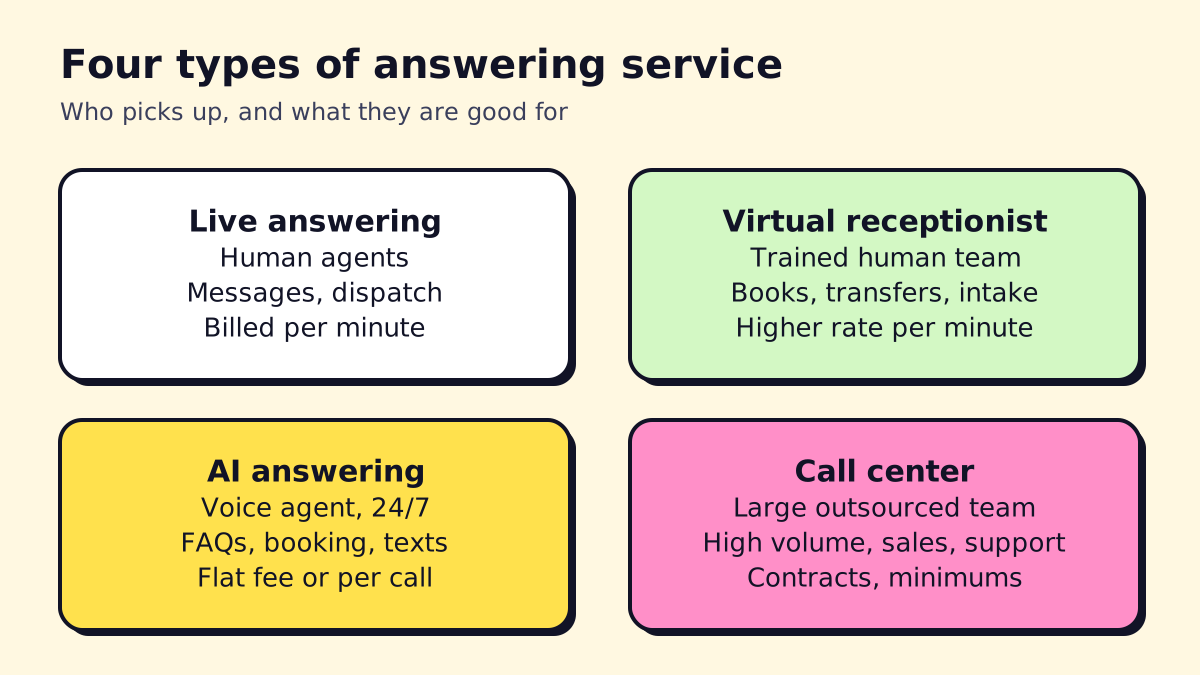
An answering service is an outside team, or an AI system, that answers your business phone when you can’t, using your company name and your script. It takes messages, books appointments, transfers urgent calls and sends you a summary, so callers don’t hit voicemail and try the next business on the list. For a small business, the choice comes down to four types: a live answering service, a virtual receptionist, an AI answering service, or a call center.
This guide explains how each one works, what a small business should expect to pay, which features matter, and how to choose. Where a topic needs more depth (pricing, after-hours rules, AI, bilingual answering, or your specific industry), we link to a dedicated guide.
What is an answering service?
A telephone answering service sits between your callers and you. When a call comes in, your phone system forwards it, either always, only when you’re busy, or only after hours. Someone (or something) answers with a greeting like “Thanks for calling Northside Plumbing, how can I help?”, follows the rules you set, and hands the result back to you.
That result can be:
- A message, sent by text, email or an app, often within a minute of the call ending.
- A booked appointment, placed directly in your calendar.
- A warm transfer, where the agent introduces the caller before passing them to you.
- A dispatch, where an urgent call goes to whoever is on call tonight.
The caller should not be able to tell they’re talking to an outside service. That’s the whole point: your business sounds staffed, even when it’s two people and a van.
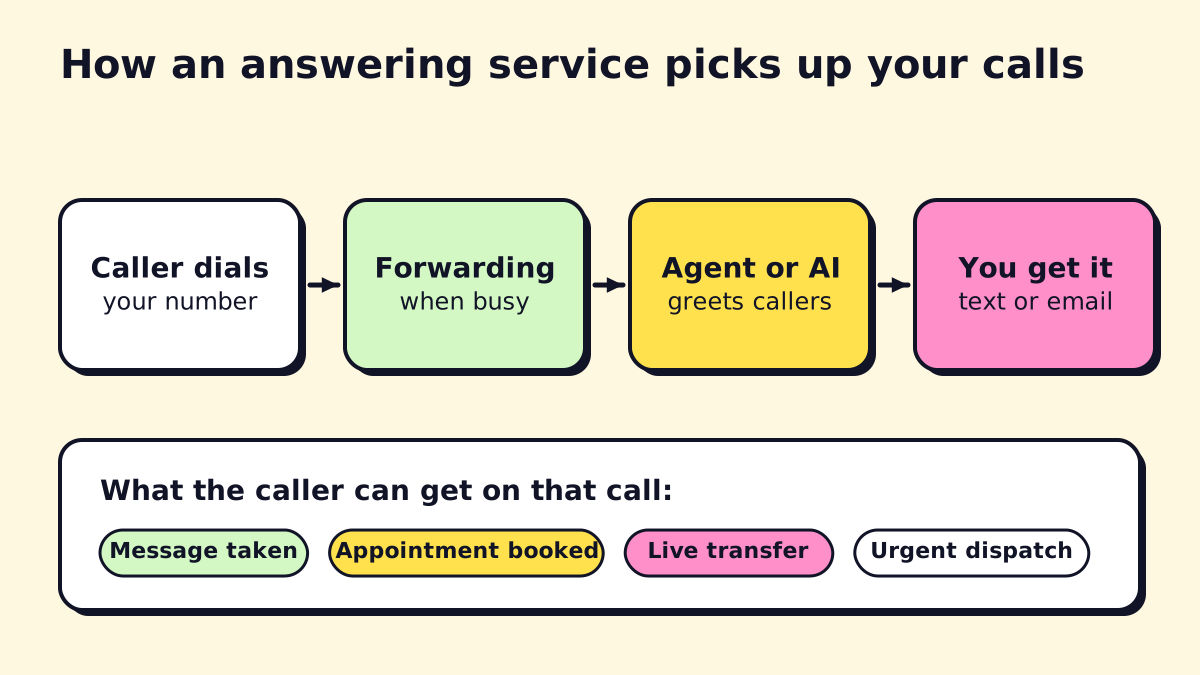
The basic flow is the same for every type of service. What changes is who picks up and how much they can do.
The four types of answering service
The phrase “answering service” covers very different products. Knowing which one you’re shopping for saves you from comparing a $49 voice bot with a $2,000 front-desk team.
Live answering service
A traditional live answering service uses human agents who answer for many businesses at once. They follow a script, take a detailed message and, on most plans, can patch urgent calls through or page an on-call person. Many offer specialty answering service options for medical, legal or trades, with agents trained on that industry’s calls.
Live services are the right fit when callers need a real person, when calls can be emotional or urgent, and when your main need is “don’t let anyone hit voicemail.” Billing is usually per minute.
Virtual receptionist
A virtual receptionist is a step up: a human team that acts like your front desk rather than a message pad. They screen and transfer calls to the right person, book and reschedule appointments, run intake questions and sometimes handle website chat. Providers such as Ruby, Posh and Smith.ai sell this model.
Expect to pay more per minute than a basic message-taking service. Our virtual receptionist services guide compares the main providers and what you get at each price.
AI answering service
An AI answering service uses a voice agent instead of a person. It answers every call at once, around the clock, answers common questions from information you give it, books appointments and texts you a summary. Pricing is usually a flat monthly fee or a per-call rate, which works out far cheaper per call than a live agent.
The trade-off is judgment. AI handles routine calls well and struggles with upset callers, unusual requests and anything outside its instructions. We build these systems, and we cover the honest limits in our AI answering service guide.
Call center
A call center is a larger outsourced operation built for high call volume: product support lines, sales campaigns, order taking for retailers. They’re usually priced by agent hour or seat, with contracts and minimum volumes.
Most small service businesses don’t need one. The usual sign you’ve outgrown an answering service is consistent, high inbound volume during business hours that needs real product knowledge rather than a message taken.
Answering service vs call center at a glance
| Answering service | Call center | |
|---|---|---|
| Built for | Small businesses sharing agents | High volume, one client’s queue |
| Typical work | Messages, booking, transfers | Support, sales, order taking |
| Pricing | Per minute or per call | Per agent hour or seat |
| Commitment | Often month to month | Contracts and minimums |
What an answering service can do for your business
The basic job is answering. The useful extras are what separate a service you keep from one you cancel after a month.
- Message taking and delivery. Every call becomes a structured message (name, number, reason, urgency) sent by text, email or app.
- Appointment scheduling. Phone answering and scheduling service plans book straight into your calendar or practice software, so you don’t have to call people back to find a time.
- Call screening and transfers. Spam and sales calls get filtered out; real customers get warm-transferred to you.
- Dispatch and on-call paging. Urgent calls are routed to whoever is on call, with escalation if they don’t respond. We cover the rules in detail in the after-hours answering service guide.
- Order taking. Phone answering service order taking is common for small retailers, caterers and suppliers who still get orders by phone.
- Lead intake. A short list of qualifying questions (address, budget, timeline, how they found you) asked the same way every time.
- SMS, chat and email answering. Many providers now answer website chat and texts as well as calls, which matters if your customers prefer messaging.
- Bilingual answering. Spanish is widely available in the US, and French matters in Canada. See the bilingual answering service guide.
Two features are easy to overlook. One is integrations: if messages land in your inbox instead of your CRM, someone retypes them. The other is call recordings and transcripts, which let you check quality and settle “but I told your receptionist…” disputes.
What does an answering service cost?
Most live answering services in the US charge a monthly plan with a bundle of minutes, plus a per-minute rate after that. A few charge per call. AI services usually charge a flat monthly fee.
To give a sense of scale, here is what 200 minutes a month costs on published plans, as of November 2026:
| Provider | 200-minute monthly cost | Source |
|---|---|---|
| MAP Communications | about $277 (125-min plan + overage) | MAP pricing |
| PATLive | $349 | PATLive pricing |
| Posh | $420 | Posh pricing |
| Ruby | $720 | Ruby pricing |
The spread is wide because you’re buying different levels of service as well as minutes. For pricing models, free trials, cheap options and a cost table by call volume, read how much an answering service costs.
Who uses answering services (by industry)
Almost any business that makes money from phone calls can use one, but needs differ a lot by industry. A dental office cares about scheduling and recall; a plumber cares about 2 a.m. burst pipes.
| Industry | What matters most on the call |
|---|---|
| Medical clinics | HIPAA handling, on-call physician rules, triage scripts |
| Dental offices | Booking, rescheduling, new-patient intake |
| HVAC, plumbing, contractors | Emergency dispatch, job address, service area |
| Property management | Maintenance emergencies vs routine requests |
| Real estate | Fast lead response, showing requests |
| Law firms | Confidential intake, conflict checks, no legal advice |
| Accounting and financial firms | Seasonal spikes, appointment booking, privacy |
| Insurance agencies | Claims intake, quote requests, policy questions routed |
Healthcare is the strictest case. A service that handles patient information on your behalf is a business associate under HIPAA and needs a signed business associate agreement; see HHS guidance on business associates.
We have dedicated guides for the most common industries:
- Medical answering service
- Dental answering service
- HVAC answering service
- Plumbing answering service
- Contractor answering service
- Property management answering service
- Real estate answering service
- Legal answering service
How to choose an answering service for your business
Skip the “best answering service” lists that rank 25 providers by affiliate payout. Start with your own calls.
Step 1: Look at two weeks of call data
Pull your call log. Count calls per day, average length, what share come after hours, and what callers want. Most phone systems (RingCentral, Google Voice, Ooma, Grasshopper) can export this. If 80% of calls are “are you open Saturday?”, you need something very different from a business where every call is a $3,000 emergency job.
Step 2: Decide what a good call outcome is
Write down the three most common call types and what should happen on each. For example:
- New customer wants a quote: take address and job details, book a site visit.
- Existing customer has an emergency: dispatch the on-call tech.
- Supplier or sales call: take a message, no transfer.
If most outcomes are “take a message,” a basic live service or AI is enough. If they involve booking, transferring and intake, look at virtual receptionists or a well-built AI receptionist.
Step 3: Match the type to your calls
| If your calls are mostly… | Start with |
|---|---|
| Routine questions and bookings, high volume | AI answering service |
| Emotional, urgent or high-value | Live answering or virtual receptionist |
| After hours only | After-hours live service or AI with human escalation |
| Spanish or French speakers | Bilingual service with native speakers |
| Very high volume, product support | Call center |
Mixing is common. Plenty of businesses use AI for routine calls and overflow, with a live service or their own phone for emergencies.
Step 4: Ask these questions before you sign
- How is a minute counted? Do you round up per call, and is hold or transfer time billed?
- Is 24/7 coverage included, or is there a nights-and-weekends surcharge?
- What do you integrate with: my calendar, CRM, practice software?
- Can I change the script myself, and how fast do changes go live?
- Can I hear call recordings?
- Is there a contract, setup fee or minimum term?
- For healthcare: will you sign a BAA?
Step 5: Test before you commit
Most providers offer a free trial or money-back period. Use it properly: call your own number as five different customer types, including one awkward caller, and listen to how each call is handled.
Answering service software vs a full service
Some businesses don’t need an outside team at all. Answering service software (auto attendants, voicemail transcription, call routing apps) can solve part of the problem cheaply. For example, Google Voice includes voicemail transcription on every plan and adds a multi-level auto attendant from its $20-per-user Standard plan, as of November 2026 (Google Voice).
An auto attendant (“press 1 for sales”) routes calls but doesn’t answer questions or book anything. It’s a good fit if your problem is routing, and a poor fit if your problem is that nobody picks up.
Can you use Google as an answering service?
People search for a “Google answering service” because they want something cheap and familiar. Google doesn’t sell a live answering service for businesses. What it offers is phone system software: Google Voice for business lines, with spam blocking and voicemail transcription. That reduces interruptions but still leaves callers talking to voicemail.
If you want calls actually answered without hiring, the realistic options are a live service, a virtual receptionist, or an AI agent connected to your existing number.
Starting an answering service business
A smaller group of readers searches for how to start an answering service business. The short version: you’ll need call center software with call recording and scripting, trained agents across shifts (24/7 is what clients pay for), and a niche, because generic message-taking competes on price with large national providers. Specializing in one industry, such as medical or trades, and one language market is how smaller services win clients.
Our view
For most small service businesses, the right answer is a mix: an AI receptionist for routine calls and overflow, and a clear rule for when a human (you, your on-call tech or a live service) takes over. That gives you fast answers on every call without paying per-minute rates for “what are your hours?”
If you’d like help working out which setup fits your calls, opsmigo builds and connects AI answering for service businesses, and we’re happy to look at your call log with you.
We build a free demo on your own services and hours.
FAQ
What is an answering service?
An answering service is a company, team or AI system that answers your business phone when you can't. It greets callers in your business name, follows your script, and sends you messages, books appointments or transfers urgent calls.
What are two advantages of an answering service?
First, callers reach a person or a capable AI instead of voicemail, so fewer leads go to a competitor. Second, you and your staff stop being interrupted, because routine calls get handled and only the ones that need you come through.
What is the difference between an answering service and a call center?
An answering service handles calls on behalf of many small businesses, usually taking messages, booking and transferring. A call center is a larger operation built for high volume, often running sales or support campaigns, and usually needs contracts and minimum volumes.
Is there an answering service near me, or does location matter?
Location rarely matters, because calls are forwarded over the phone network. What matters is that agents know your area's time zone, service area and, if needed, language, such as Spanish in Texas or French in Ontario and Quebec.
How do I start using an answering service?
Write a one-page call script, choose a provider, set up call forwarding from your phone system, and test it with five or six realistic calls before you go live. Most providers can switch you on within a few days.
Can an answering service schedule appointments?
Yes. Most virtual receptionist and AI services can book into calendars like Google Calendar, Outlook or industry tools. Check which calendar or practice software they support before you sign up.