- Most property management calls after hours are maintenance. The service's main job is to tell a true emergency from a work order that can wait.
- Write an emergency list (active water, no heat in winter, sewage, fire, gas, security) and an approved vendor call order, then make the service follow it.
- Work orders should land in your software. AppFolio has its own AI maintenance coordinator and contact center; Buildium has an API for creating tasks.
- Leasing scripts must give every caller the same information to stay on the right side of the Fair Housing Act.
A property management answering service answers your tenants’, prospects’ and owners’ calls when the office is closed or the lines are full. Most after-hours calls are maintenance, so the service’s main job is triage. It dispatches the on-call tech for a burst pipe at midnight and logs the dripping faucet as a normal work order. The best services also create the work order in your property management software, so nothing gets re-keyed in the morning.
This guide covers apartment communities, single-family portfolios and small landlords. It walks through the calls you get, the emergency rules, software links, Fair Housing on leasing calls, and how to choose a provider.
What a property management answering service handles
Property managers get three kinds of callers, and each needs a different outcome.
| Caller | Typical calls | Outcome |
|---|---|---|
| Tenants | Maintenance, lockouts, noise, rent questions | Triage, work order, or message |
| Prospects | Availability, rent, pets, showings | Answer from script, book a showing |
| Owners and vendors | Statements, invoices, job updates | Message to the right manager |
Tenant maintenance is the volume driver. Prospects are the revenue opportunity: a vacant unit costs you rent every day, and someone calling about a listing on a Saturday afternoon may sign elsewhere by Monday. Owners are the relationship. They should never feel like they reached a call center that doesn’t know who they are.
After-hours maintenance triage
The difference between a good and a bad maintenance answering service is a clear emergency list. “Call us if it’s urgent” leads to the on-call tech getting woken for a dishwasher at 2 a.m., or worse, a flooded unit waiting until Monday.
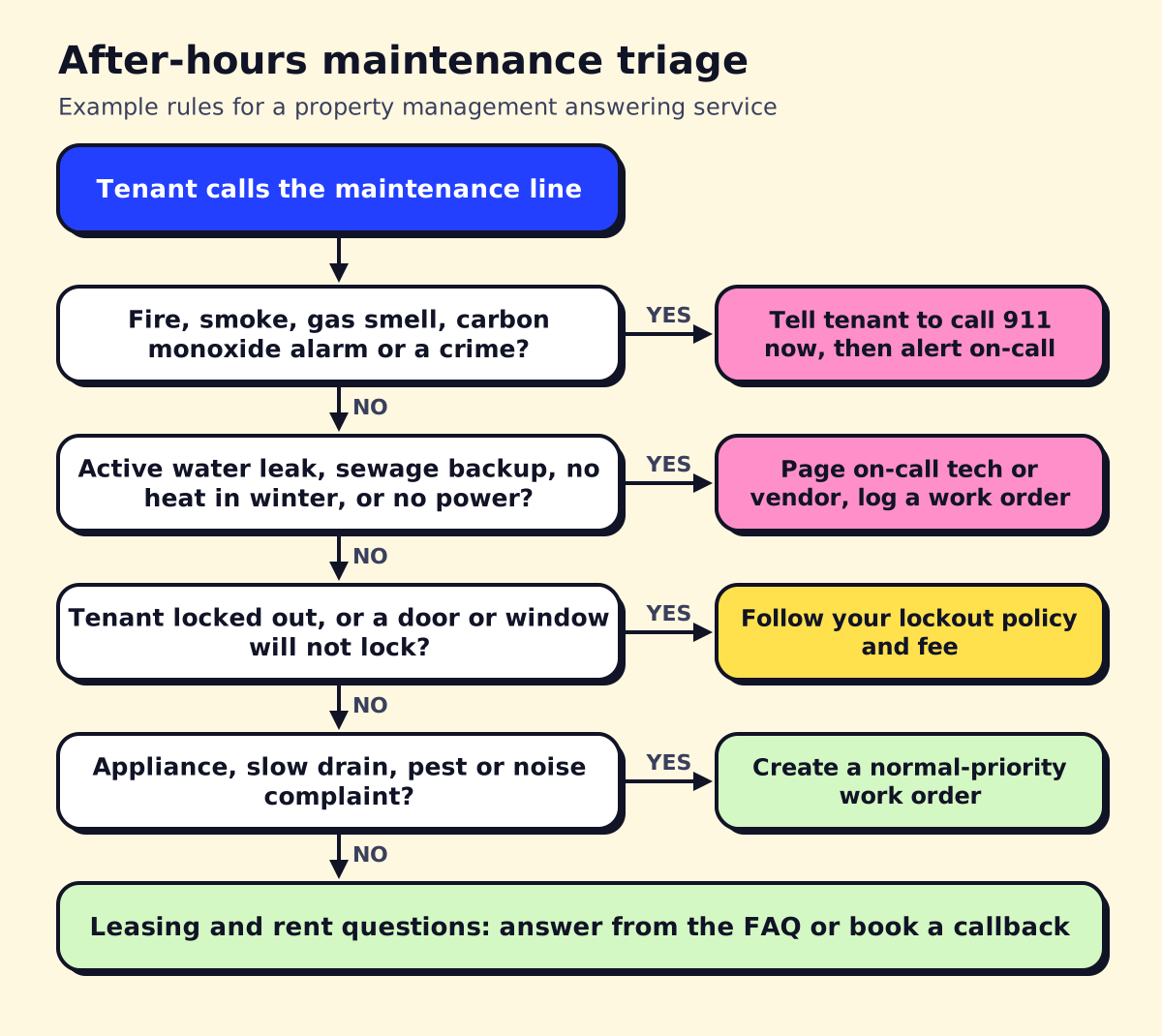 Example maintenance triage. Adjust to your leases, local codes and climate.
A typical list looks like this:
Call 911 first, then alert on-call: fire, smoke, gas smell, carbon monoxide alarm, a crime in progress.
Dispatch now: active water leak or flooding, sewage backup, no heat when it’s cold, no power to the unit (after the tenant checks the breaker), a door or window that won’t lock, an elevator with someone stuck in it.
Next business day: appliances, slow drains, a single non-working outlet, pests, cosmetic damage, a running toilet once the supply valve is off.
Give the service troubleshooting steps that save truck rolls. Ask the tenant to check the breaker panel before reporting no power, find the shutoff valve under the sink or behind the toilet, or check that the thermostat has batteries. Each one can turn an emergency dispatch into a morning work order.
Also give it a vendor call order. For a water leak at a given property, who gets called first, second and third? What’s the not-to-exceed amount they can approve? Who is the on-call manager for anything above that? Write it per property or per portfolio, and update it when vendors change.
Scripts for tenant maintenance calls
Give the service exact wording for the calls it will get most. A few examples:
Greeting: “Thank you for calling [Company] maintenance. Is this an emergency, like a leak, no heat or a safety issue?”
Leak: “Can you tell me where the water is coming from? Is it still running? There’s usually a shutoff valve under the sink or behind the toilet; turn it clockwise. Is any water near outlets or light fixtures? What’s your unit number, and is it OK for maintenance to enter if you’re not home?”
No heat: “Let’s check a couple of things first. Is the thermostat set to heat and higher than the room temperature? Does it have power or a screen showing? Can you check the breaker panel for a switch that’s tripped?” If it’s still out and it’s cold outside, dispatch per your rules.
Non-emergency: “I’ll create a work order for that now, and maintenance will contact you during business hours to schedule. You’ll get a confirmation in your resident portal.”
Unclear: If the tenant can’t tell whether it’s an emergency, the service should lean toward calling the on-call manager rather than guessing. One unnecessary call is cheaper than one flooded unit.
Each call should end with a reference number or work order number the tenant can quote later. That alone cuts down on “I called three times” arguments.
Lockouts, noise and the gray-area calls
Some calls aren’t maintenance emergencies but still can’t wait for Monday.
- Lockouts: follow your policy. Some managers send staff with a fee, some give a locksmith number, some do nothing after hours. The service needs to verify the caller is on the lease before anyone opens a door.
- Noise complaints: usually logged for the manager, with a suggestion to call the police non-emergency line if there’s a safety concern.
- Rent and payment questions: answered from your FAQ (portal link, late fee dates) or logged for the office. The service shouldn’t negotiate payment plans.
- Move-outs and notices: logged, with a reminder that notices must be given in writing per the lease.
Software: AppFolio, Buildium and others
Your answering service should feed your property management software, not a pile of emails.
AppFolio has the most built-in option. Its maintenance product includes a Realm-X Maintenance Performer, an AI coordinator that AppFolio says is built into its resident portal and Contact Center, can prioritize emergencies and dispatch work (AppFolio maintenance features). If you’re on AppFolio, compare that against an outside service before buying separately.
Buildium offers an open API that exposes maintenance tasks and work orders, which lets some answering services or a custom automation create requests directly. Check with Buildium which plan includes API access before you plan around it.
Yardi, Rent Manager, Propertyware and others vary. Ask each answering service whether it creates work orders directly, uses an email-to-work-order address, or simply emails your team. Email-only isn’t a dealbreaker for a small portfolio but gets messy past a few hundred units.
Other property management tools like Property Meld focus on maintenance coordination and can sit between the answering service and your accounting software. If you want to wire these together yourself, our workflow automation guide covers the basics.
Leasing calls and Fair Housing
Leasing calls are where answering services can create legal risk. The federal Fair Housing Act prohibits discrimination in housing based on race, color, religion, sex, national origin, familial status and disability. Many states and cities add more protected classes, such as source of income.
For an answering service, that means:
- One script for every prospect. Same availability, rent, deposit, application criteria and showing options for everyone.
- No steering. The service shouldn’t suggest a property or unit is “better for families” or “quieter, mostly older residents.”
- No questions about protected traits. It can ask how many people will live in the unit if your occupancy policy requires it, not about children’s ages or anyone’s disability.
- Reasonable accommodation requests (for example, an assistance animal) are logged and passed to a manager, never answered on the spot.
This applies to AI receptionists too. Test an AI leasing agent with a few tricky questions before it goes live, and review transcripts regularly.
Answering service for landlords and small portfolios
If you own or manage a handful of units, a full-service answering company may be more than you need. Options that work at small scale:
- AI receptionist with your emergency list, sending emergencies to your cell by call and text and everything else to email.
- Live answering for nights and weekends only, with daytime calls coming to you.
- A dedicated maintenance line printed on leases and in the tenant portal, separate from your personal number.
Whichever you pick, keep a record of every maintenance request with a date and time. That log helps if a tenant later claims they reported a problem you ignored.
Property management answering service pricing
Property management answering services usually price per minute or per call, sometimes per unit. As of November 2026, general receptionist plans give a benchmark: Ruby lists $250 a month for 50 minutes up to $1,725 for 500 minutes, and Smith.ai lists $300 a month for 30 calls and $2,100 for 300 calls. Property-specialist services often charge extra for dispatching vendors or patching calls to on-call staff.
Price your real volume: how many maintenance calls you get after hours, how many become dispatches, and how many leasing calls you miss. Our answering service cost guide explains per-minute versus per-call billing, and our after-hours answering service guide covers overnight coverage in general.
Checklist: the best answering service for property management
- Written emergency list per portfolio, with troubleshooting steps.
- Vendor call order and not-to-exceed amounts per property.
- Work orders created in AppFolio, Buildium or your system, shown live.
- Tenant verification before lockout help or account details.
- Fair Housing-safe leasing script, tested.
- Showing booking into your calendar or leasing software.
- Owner calls recognized and routed to their manager.
- Spanish or other languages your residents speak.
- Searchable call log with recordings for disputes.
- Monthly review of dispatches to catch false emergencies.
If you want an AI layer that triages maintenance calls and creates work orders in your software, opsmigo builds those for property managers. Either way, the emergency list and vendor call order come first.
We build a free demo on your own services and hours.
FAQ
What does a property management answering service do?
It answers tenant, prospect and owner calls when your office is closed or busy. It triages maintenance requests, dispatches on-call staff or vendors for emergencies, creates work orders, and handles leasing inquiries and showings.
What counts as a maintenance emergency for property management?
Typically fire, gas smell, carbon monoxide alarms, active water leaks or flooding, sewage backups, no heat in cold weather, no power to the unit, and doors or windows that won't lock. You define the final list.
Do small landlords need an answering service?
Landlords with a few units can often use an AI receptionist or a forwarding rule that routes only emergencies to their phone. Once you manage dozens of doors or hire staff, a dedicated service saves sleep and keeps a record of every request.
Can an answering service create work orders in AppFolio or Buildium?
It depends on the service. AppFolio offers its own maintenance contact center and AI coordinator. Buildium has an open API, so some services and custom automations can create tasks directly; others email a request your team re-enters.
How should an answering service handle leasing calls?
Use one approved script for every prospect: availability, rent, deposit, pet policy, application steps and showing times. Consistent answers help with Fair Housing compliance and make leads easy to compare.