- An after hours answering service picks up when your office is closed, takes routine messages and sends real emergencies to whoever is on call.
- The quality of after-hours coverage depends on your rules: a written emergency list, an on-call schedule and an escalation path if nobody answers.
- Many US providers include 24/7 coverage in the base price (PATLive, Posh, Smith.ai), but confirm there's no night or holiday surcharge.
- AI handles routine overnight calls cheaply; keep a human in the loop for emergencies.
An after hours answering service answers your business phone when you’re closed (evenings, overnight, weekends and holidays), takes messages from routine callers and sends genuine emergencies to whoever is on call. It’s the difference between a homeowner with a flooded basement reaching your technician at 11 p.m. and that homeowner calling your competitor.
The service itself is easy to buy. What makes it work is the rulebook you give it: what counts as an emergency, who’s on call, and what happens if they don’t pick up. This guide covers both.
When you need after-hours coverage
You need an after-hours or overnight answering service if any of these are true:
- Your customers have emergencies. HVAC, plumbing, restoration, locksmiths, property management, medical practices and veterinary clinics all get calls that can’t wait until morning.
- Leads call in the evening. Homeowners and small business owners often make calls after their own workday. If they reach voicemail, many simply try the next search result.
- You’re on call yourself and it’s wearing you out. A service filters the 2 a.m. “what time do you open?” calls so your phone only rings for real problems.
- You have obligations to be reachable. Physicians, property managers and some trades have professional or contractual duties to respond to urgent calls.
If none of these apply, a good voicemail greeting with your hours and a promise to call back by 9 a.m. may be enough. Be honest with yourself about which group you’re in.
Your options for after-hours call answering
| Option | Best for | Weak spot |
|---|---|---|
| Live 24/7 answering service | Emergencies, emotional callers | Per-minute cost adds up |
| AI answering, human escalation | High volume of routine calls | Needs careful rules and testing |
| On-call staff forward | Very small teams | Burnout, missed calls when asleep |
| Voicemail with callback | Rare after-hours calls | Callers hang up |
A hybrid is common and usually the best value: an AI agent or live service answers everything, and only calls matching your emergency rules reach a person. Our AI answering service guide explains how the AI side works and where it falls short.
Emergency call rules: what counts as urgent
The biggest mistake in emergency answering service setups is leaving “urgent” to the agent’s judgment. Agents (and AI) need a list.
Write your emergency list as yes/no questions the agent can ask. Examples by industry:
Plumbing and restoration
- Is water actively leaking right now?
- Is there sewage backing up into the home?
- Is there no water to the whole property?
HVAC
- Is there no heat, and is it below a set outdoor temperature?
- Is there a gas smell? (Tell the caller to leave and call the gas utility or 911 first.)
- Is a vulnerable person in the home (elderly, infant, medical condition) without heating or cooling?
Property management
- Is there flooding, fire damage, a break-in or no heat?
- Is a tenant locked out? (Decide whether this is an emergency for you.)
Medical and dental
- Is the patient describing symptoms on your clinical escalation list?
- Any life-threatening symptoms get the instruction to call 911, every time.
Anything that isn’t on the list becomes a message for the morning. Our industry guides go deeper: HVAC, plumbing, property management and medical.
Dispatch and on-call rules that work
Once a call is flagged as an emergency, answering service dispatch needs three things written down.
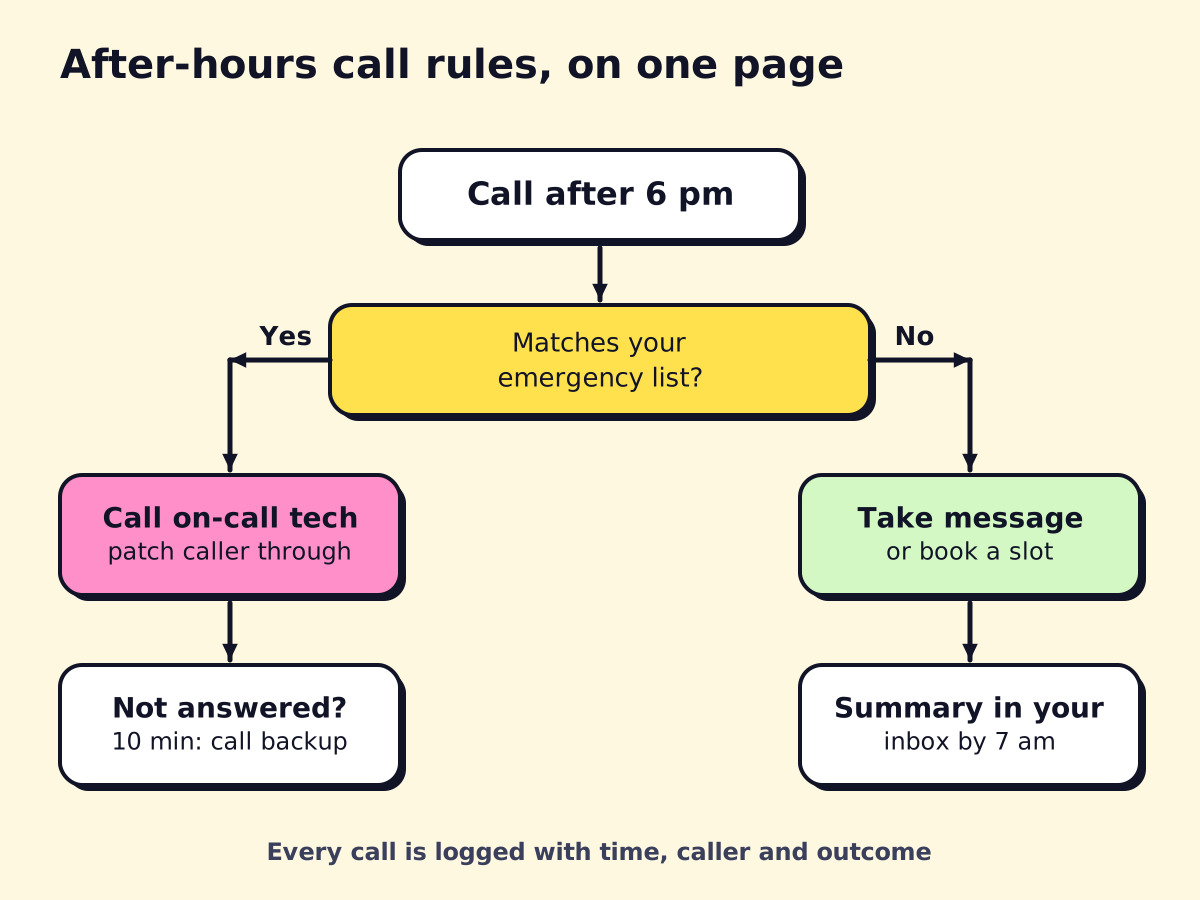
Keep the whole rulebook short enough to fit on one page. If agents need to scroll, they’ll improvise.
1. An on-call schedule the service can read
The service needs to know who is on call tonight, with a mobile number. Options, from simplest to best:
- A weekly email or shared calendar the service checks.
- An online on-call calendar in the provider’s portal that you update.
- A rotation the service pulls from your scheduling or field service software.
Whatever you use, make one person responsible for updating it before each rotation changes. Stale on-call schedules are the most common reason emergency calls go to the wrong person.
2. How to reach the on-call person
Decide whether the service should patch the caller through (live transfer), call the tech and relay details, or text details and have the tech call back. Patching is fastest for the customer. Texting gives the tech a moment to wake up and read the address before calling.
3. An escalation path
Write it as a timed sequence, for example:
- Text and call the on-call tech.
- No response in 10 minutes: call again.
- No response in 20 minutes: call the backup tech.
- No response in 30 minutes: call the owner.
- Tell the caller what’s happening at each step.
Ask the service to log every attempt with a time. When a customer complains that nobody came, the log tells you whether the problem was the service or your team.
A simple after-hours script
Your script should be short. Every extra question costs money on per-minute plans and patience for a stressed caller.
- “Thanks for calling [Business], this is the after-hours line. Is this an emergency?”
- Name and callback number (repeat it back).
- Service address (repeat it back).
- What’s happening, in the caller’s words.
- Emergency questions from your list.
- If emergency: “I’m contacting our on-call technician now. You should hear back within [number] minutes.”
- If not: “I’ve passed this on. Someone will call you after [opening time]. Would you like me to book a time?”
Booking routine jobs overnight is worth setting up. A caller who already has a 9 a.m. slot is far less likely to keep shopping around.
24 hour answering service vs after hours only
A 24 hour (or 24/7) answering service can pick up any time. “After hours” usually just means you only forward calls to it when you’re closed. Most providers sell the same plans either way; the difference is your call forwarding schedule.
Many businesses end up using a 24/7 business answering service for overflow during the day too: when your office line is busy or nobody picks up within four rings, the call rolls over. Daytime overflow is often where the extra jobs come from.
Weekends and holidays deserve their own line in your rules. Your on-call schedule, opening hours and emergency list may all differ on a holiday weekend.
What 24/7 and after-hours coverage costs
Most US answering services price nights and weekends the same as daytime, but check. As of November 2026:
- PATLive lists 24/7 answering on every live plan, starting at $49 a month plus $2.99 per minute on pay-as-you-go.
- Posh lists 24/7 coverage on all plans, from $65 a month plus $2.30 per minute.
- Smith.ai includes live 24/7 staffing at no extra cost on its per-call plans.
- Abby Connect offers a 24/7 option with no weekend upcharge.
Because after-hours calls are usually a fraction of total volume, after-hours-only coverage tends to sit on the smaller plans. For a full breakdown by provider and volume, see how much an answering service costs.
How to choose among after hours answering service companies
Rankings of the “best after hours answering service” are mostly affiliate lists. Use these questions instead:
- Who answers at 3 a.m.? Their own staff, a subcontracted overflow center or an AI?
- How fast do they answer overnight? Ask for their average speed of answer at night, not the daytime figure.
- How do they handle dispatch? Ask them to walk you through your escalation path on the sales call.
- Can you update the on-call schedule yourself? And does it take effect immediately?
- Do they record calls? You’ll want recordings for disputes and training.
- Do they handle your industry? Medical answering requires a HIPAA business associate agreement; trades need people who can collect an address and describe a leak.
- Bilingual coverage overnight? If you serve Spanish or French speakers, check that bilingual agents are on the night shift too. Our bilingual answering service guide covers this.
For Canadian businesses, check whether the provider’s agents know your region’s time zone and geography. A service in Florida answering for a Calgary furnace company needs to know that “no heat” in January is an emergency.
Testing before you rely on it
Before your first real weekend, run a test night:
- Call as a routine customer: is the message accurate and delivered on time?
- Call as an emergency: does the on-call tech get it, and how fast?
- Have the on-call tech ignore the call: does the backup get called on schedule?
- Call during a shift change, around 5 or 6 p.m.: does forwarding switch over cleanly?
Fix what breaks, then test again. It takes an evening and saves a lot of angry Monday-morning calls.
Where AI fits overnight
Overnight volume is often mostly routine: hours, “can I book for next week?”, billing questions. An AI agent can handle those at a fraction of a live per-minute rate, and it can text your on-call tech instantly when a caller describes an emergency. What it shouldn’t do is make the final call on borderline cases or comfort a panicked caller for ten minutes.
If you want help setting up an AI after-hours line with human escalation for emergencies, opsmigo builds these for service businesses. We start from your call log and your emergency list.
We build a free demo on your own services and hours.
FAQ
What is an after hours answering service?
It's a service that answers your business phone when you're closed, usually evenings, overnight, weekends and holidays. It takes messages, books appointments and routes urgent calls to your on-call staff using rules you set.
What's the difference between an after hours and a 24 hour answering service?
A 24 hour answering service can answer any time; an after hours setup is the same service switched on only when you're closed. Many businesses buy a 24/7 plan and forward calls only outside office hours.
How does an emergency answering service decide what's urgent?
It follows your written emergency list. Agents or the AI ask set questions, such as whether water is actively leaking, and if the answer matches your list, the call goes to the on-call person right away.
What happens if my on-call technician doesn't answer?
A good service follows an escalation path you define, such as retrying after five minutes, then calling a backup, then the owner. Every attempt should be logged with a timestamp.
Do after hours answering services charge more for nights and weekends?
Some do, many don't. As of November 2026, PATLive and Posh list 24/7 coverage on every plan, Smith.ai includes 24/7 at no extra cost, and Abby Connect states there's no weekend upcharge.