- An HVAC answering service earns its fee by booking jobs and dispatching real emergencies, not by taking messages.
- Write dispatch rules around safety first (gas smell, CO alarms), then comfort risk (no heat below freezing, no AC for vulnerable people), then everything else.
- ServiceTitan, Housecall Pro and Jobber now sell their own AI call answering. Jobber's Receptionist is a $29/month add-on as of November 2026; the others quote on request.
- Seasonal spikes break small answering services. Ask how they staff the first heat wave and the first cold snap.
An HVAC answering service answers your phones after hours and during overflow, books service calls into your schedule, and pages the on-call technician when a customer has a real emergency. The good ones sound like your own dispatcher: they know a heat pump from a furnace, quote your after-hours fee before dispatching, and tell anyone who smells gas to get out and call 911. The bad ones take a name and number, and that customer calls the next company on Google.
HVAC is a high-ticket trade. One missed call can be a diagnostic fee, a maintenance agreement, or a system replacement. This guide covers what HVAC companies should expect from a service, how to write dispatch rules, which software integrations matter, and what it costs.
What an HVAC answering service should handle
Most HVAC call volume falls into a handful of buckets. Each one needs a different outcome:
| Call | Value to you | What the service should do |
|---|---|---|
| No heat / no cooling | Service call, possible replacement | Triage, then dispatch or book first slot |
| Maintenance tune-up | Recurring revenue | Book, mention membership plan |
| Replacement or new install quote | Highest ticket | Capture details, book a comfort advisor visit |
| Membership / agreement questions | Retention | Answer from FAQ or log for office |
| Warranty or callback on recent job | Reputation | Log with job number, alert service manager |
| Thermostat and filter questions | Low | Approved tips, offer a visit |
Replacement leads deserve special handling. The service should collect the age of the system, the type (central air, heat pump, furnace, boiler, ductless), the home’s size, and whether the caller has a quote from someone else. That gives your comfort advisor a head start.
Dispatch rules for after-hours HVAC calls
Your answering service is only as good as the rules you give it. Here’s a simple ladder that works for most residential HVAC companies.
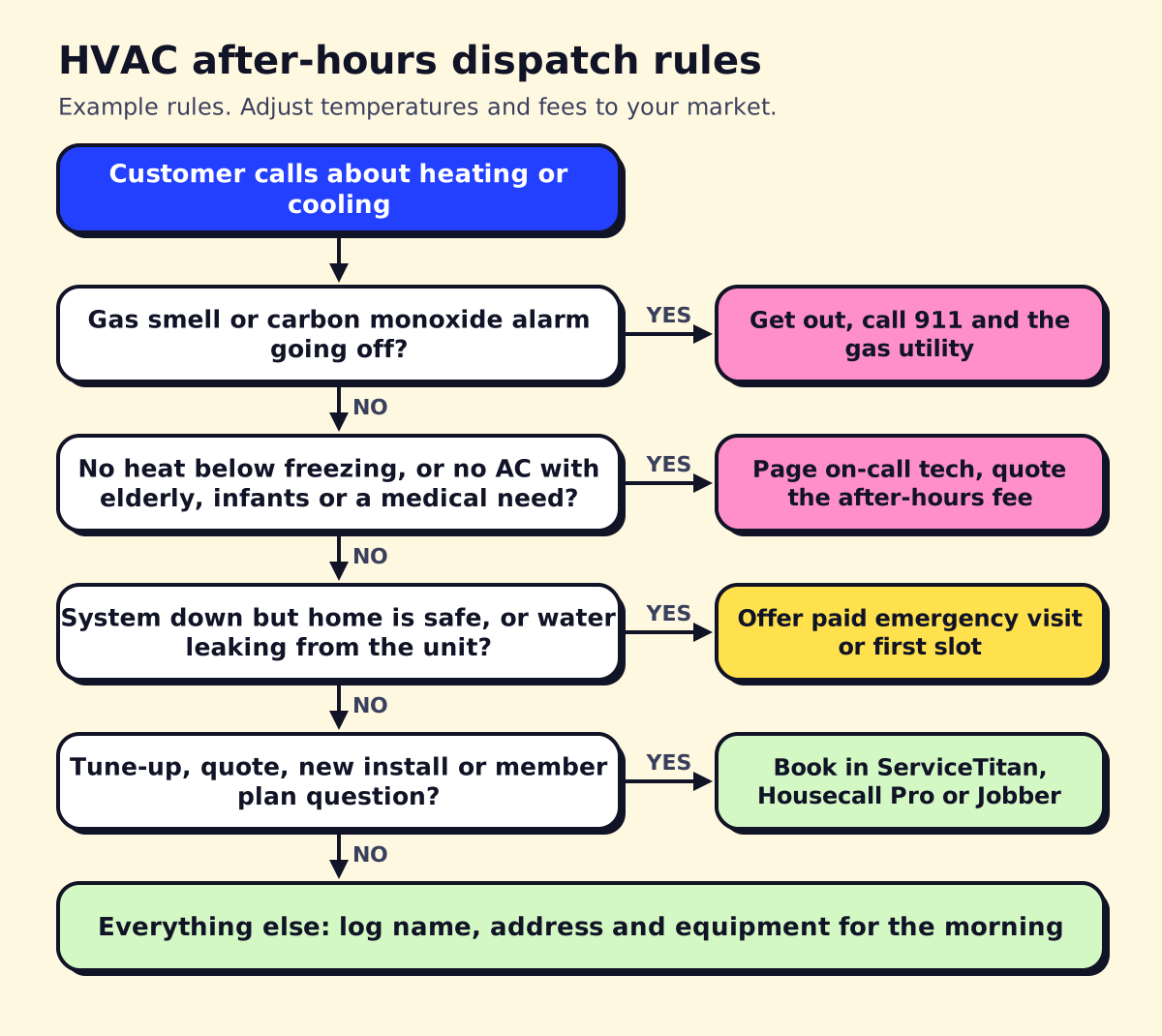 Example dispatch rules. Set your own temperature thresholds and fees.
Safety first. If the caller smells gas or a carbon monoxide alarm is sounding, the service tells them to leave the home and call 911 and their gas utility from outside. The U.S. Consumer Product Safety Commission advises getting to fresh air and calling 911 when a CO alarm sounds (CPSC carbon monoxide guidance). Your tech can follow up once responders have cleared the home.
Comfort risk second. No heat when it’s below freezing, or no cooling during a heat wave in a home with elderly residents, infants or someone with a medical condition, gets the on-call tech paged. Many companies also include frozen-pipe risk here.
Paid emergency option third. System down but the home is safe? Offer the after-hours visit at your posted fee, or the first slot in the morning. Let the customer choose. A good operator states the fee before dispatching so there’s no argument at the door.
Everything else is booked into normal hours.
Write down the on-call rotation, how long the tech has to call back, and who gets paged next if they don’t. Also decide what happens with commercial accounts. A restaurant with a dead walk-in cooler or a server room overheating usually gets dispatched regardless of time.
ServiceTitan, Housecall Pro and Jobber integrations
Your field service software decides how much of the call the service can finish. In 2026, all three of the big platforms sell their own AI call answering, which changes the comparison.
ServiceTitan. ServiceTitan’s AI Voice Agent answers inbound calls and books jobs natively. Its help documentation shows an admin setting that lets the agent book jobs outside business hours, and the agent can escalate to a team member, a cell phone or a third-party answering service. ServiceTitan doesn’t publish the price. Several outside AI and live services also write jobs into ServiceTitan; ask them to show a booked job appearing on your dispatch board during the demo.
Housecall Pro. Housecall Pro offers CSR AI, which handles customer conversations and booking inside the platform. The phone product is sold separately and the price isn’t published, so get a written quote.
Jobber. Jobber’s pricing page lists its AI Receptionist as a $29/month add-on as of November 2026, included in the Plus plan. It answers calls and texts, takes requests and can book into your Jobber calendar, within the limits you set.
Native tools have a real advantage: no syncing, no double entry. Their limits show up in the tough calls (an angry customer, a gas smell, a commercial account with special terms) and in after-hours dispatching across an on-call rotation. Many HVAC companies run a native AI for booking and keep a live answering service for escalations. Our guide to AI answering services explains how that hybrid setup works.
Live HVAC specialty answering service vs. AI
An HVAC specialty answering service staffs operators trained on home service calls. They know common symptoms (short cycling, frozen coil, blowing warm air), read your fee sheet aloud, and work inside your field service software. You pay more per minute than a general service, and the trade-off is fewer bad bookings.
AI receptionists are strong at the repetitive work: booking tune-ups, confirming appointment windows, answering “do you service Trane?” and capturing replacement leads at 11 p.m. They struggle with panicked callers and messy situations. A sensible split for most shops:
- AI first for booking, reschedules, FAQs and replacement lead capture.
- Live operators for emergencies, angry customers and anything the AI flags as uncertain.
- On-call tech paged only through clear rules, never “use your judgment.”
Scripts to give your HVAC answering service
Hand the service your own words for the calls that matter most. These are starting points.
Greeting: “Thanks for calling [Company] Heating and Air, this is [name]. Is your system not working right now, or are you looking to schedule service?”
No heat: “I’m sorry, let’s get that sorted. Is anyone in the home elderly, an infant, or have a medical condition? Roughly what’s the temperature inside right now? Is your thermostat showing anything, and have you checked that it has fresh batteries and is set to heat?” Then follow the dispatch ladder.
After-hours fee: “Our after-hours service call is [$X], which covers the trip and diagnosis. The technician will give you a price for the repair before doing any work. Would you like me to send someone tonight, or book the first opening tomorrow at [time] at our regular rate?”
Replacement lead: “Happy to set up a free estimate with one of our comfort advisors. How old is your current system, if you know? Is it a furnace with central air, a heat pump, a boiler or a ductless system? About how big is the home?”
Membership plan: “Members get [benefits]. Would you like me to add a tune-up and have the office send the membership details?”
Include your service area by ZIP code, the brands you do and don’t service, and whether you work on commercial rooftop units. Update the script before each season, since your fees and availability usually change.
Seasonal spikes: the test most services fail
HVAC call volume isn’t steady. The first hot week of summer and the first cold snap of winter can multiply your calls overnight. A small answering service that’s fine in April can leave callers on hold for ten minutes in July.
Ask every vendor:
- How do you staff for weather spikes, and what were your hold times last July or January?
- Is there a cap on simultaneous calls, and what happens to the overflow?
- Can we change the script that day (for example, “we’re booked through Thursday, we’ll add you to the cancellation list”)?
AI has an edge here: it doesn’t run out of people. That alone is a reason many HVAC companies add an AI layer before peak season.
HVAC answering service cost
Pricing falls into three models. As of November 2026:
| Model | Example published price | Watch for |
|---|---|---|
| Per minute (live) | Ruby: $250/month for 50 minutes, $720 for 200 | Long dispatch calls eat minutes |
| Per call (live or hybrid) | Smith.ai: $300/month for 30 calls, $11.50 per extra call | Spam and wrong numbers count as calls unless filtered |
| Software add-on (AI) | Jobber Receptionist: $29/month add-on | Limits on usage and what it can book |
HVAC specialty answering services usually quote per minute and add charges for dispatching or patching calls to techs. Price your real scenario: how many calls a month, what share after hours, and how many become dispatches. Our answering service cost guide has a worksheet for that.
Checklist: the best answering service for an HVAC company
- Books into your software (ServiceTitan, Housecall Pro, Jobber or other) and you’ve seen a test job land on the board.
- Safety script for gas and CO, word for word.
- Your fee sheet read to every after-hours caller before dispatch.
- On-call rotation with backup paging and callback deadlines.
- Replacement lead fields captured: system age, type, home size.
- Peak season staffing answered in writing.
- Call recordings you can review, especially for disputed dispatches.
- Spanish coverage if your market needs it.
- Month-to-month terms or a trial through at least one busy week.
If you want an AI receptionist that books into your field service software and hands emergencies to people, opsmigo builds those for home service companies. For the overnight side specifically, see our after-hours answering service guide.
We build a free demo on your own services and hours.
FAQ
What does an HVAC answering service do?
It answers your company's calls when the office can't, books service visits and maintenance, captures replacement leads, and pages the on-call technician for emergencies such as no heat in freezing weather.
Should an HVAC answering service dispatch technicians directly?
It can, if you give it clear rules and your on-call schedule. Most contractors let the service page the on-call tech for defined emergencies and book everything else into the next available slot.
Can an HVAC answering service book into ServiceTitan?
Yes, in several ways. ServiceTitan's own AI Voice Agent books jobs natively and can escalate calls to a third-party answering service, and some outside AI and live services also write jobs into ServiceTitan through its integrations.
What is an HVAC specialty answering service?
It's an answering service that only or mainly serves HVAC and home service companies. Its operators know the vocabulary (heat pump, condenser, short cycling), quote your diagnostic and after-hours fees, and work inside field service software.
Is AI good enough to answer HVAC calls?
For booking, rescheduling and common questions, yes. For panicked callers, gas smells and messy situations, have a person or a strict safety script take over.