- A contractor answering service mostly earns its keep by capturing estimate requests while you're on a job site, not by handling emergencies.
- Emergency rules differ by trade: storm leaks for roofers, sparks for electricians, active water for restoration, stranded callers for towing and locksmiths.
- Ask every vendor how they handle storm and seasonal surges. That's when contractors lose the most leads.
- The cheapest setup that works for most small contractors is an AI receptionist that books estimates, with emergencies forwarded to the owner's phone.
A contractor answering service answers your business line while you’re on a roof, in a crawl space or driving between jobs, and turns callers into booked estimates instead of voicemails. For most contractors that’s the main job: capture the lead with enough detail to quote, book the site visit, and pass supplier and subcontractor messages along. Emergencies matter too, but what counts as one depends heavily on your trade.
This guide covers construction and remodeling companies, roofers, electricians, restoration companies, pest control, landscapers, locksmiths and towing. For plumbing and HVAC, we have separate guides: plumbing answering service and HVAC answering service.
Why contractors miss so many calls
Contractors have an unusual phone problem. The person who answers the phone is often the person doing the work. You can’t take a call from a 30-foot ladder, in a noisy demolition, or while you’re walking a client through a kitchen. By the time you call back, the homeowner may have booked someone else.
Your calls also come from very different people:
- Homeowners wanting an estimate or reporting a problem
- Property managers and businesses with service requests or contracts
- Insurance adjusters on roofing and restoration claims
- Suppliers confirming deliveries
- Subcontractors and crews with schedule questions
- Inspectors confirming appointments
A good answering service for construction companies routes each of these differently. Leads get qualified and booked. Suppliers and subs get a message to the right person. Inspectors get transferred or the PM gets a text right away, because a missed inspection can stall a job for days.
Emergency rules by trade
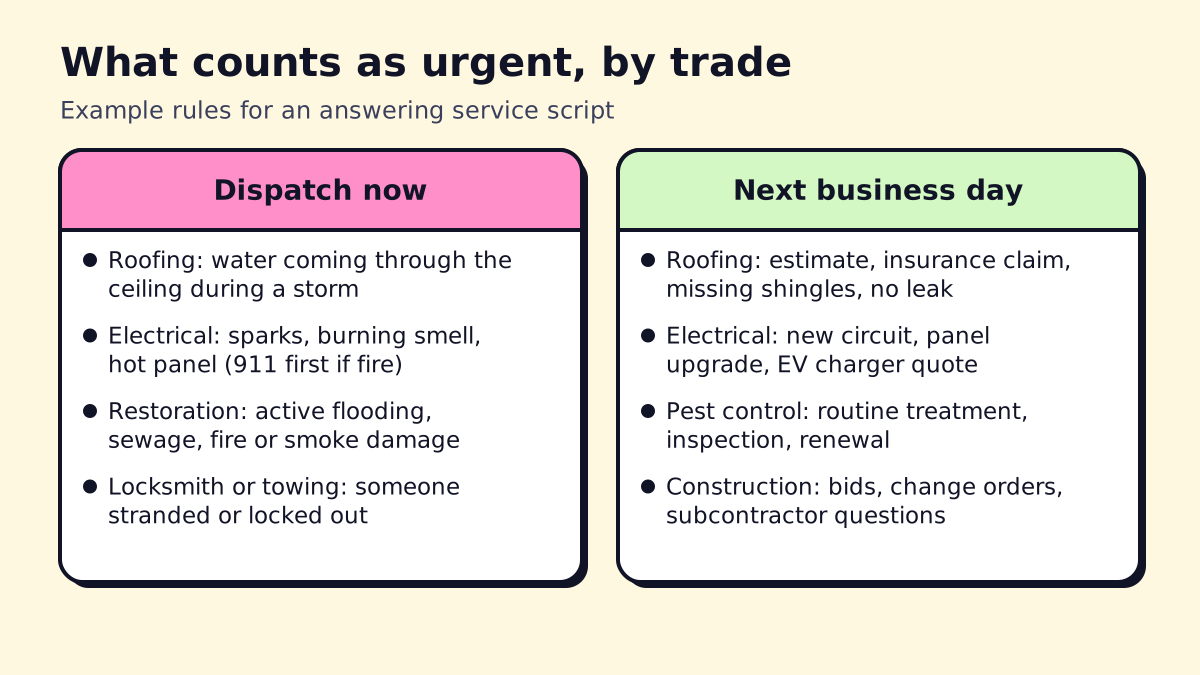 Example rules. Your script should list your own trade’s emergencies.
Roofing. Water coming through the ceiling during or after a storm is the main emergency. The service should collect the address, where the water is entering, whether there’s any sagging in the ceiling (which can mean it’s about to give way), and whether the caller has filed an insurance claim. Missing shingles with no leak is a next-day estimate.
Electricians. Sparks, burning smells, a hot panel or a partial power outage in one part of the house are urgent. If there’s fire or smoke, the script sends the caller to 911 first. If a power line is down, it tells them to stay well away and call the utility and 911. Panel upgrades, EV charger installs and new circuits are routine leads.
Restoration. Water, fire and mold restoration companies run true 24/7 operations. The script needs safety checks (is there standing water near outlets or the panel? any gas smell? is the structure safe to stay in?), the source of the water and whether it’s stopped, the insurance carrier and claim number if they have one, and whether the caller owns the property. Speed matters because water damage gets worse with time.
Pest control. Few true emergencies. The exceptions are stinging insect nests near people, especially anyone allergic, and rodent or bed bug problems in a business that’s about to open. Most calls are scheduling, renewals and new service.
Locksmiths and towing. Here the emergency is a person: locked out of a car with a child inside, stranded on a highway at night. The service collects the exact location (cross streets, mile marker, or a texted map pin), vehicle details, and a callback number, then dispatches. For a child or pet locked in a hot car, the script tells the caller to call 911 first.
Landscaping. Seasonal, not urgent. The service should qualify estimate requests (property size, services wanted, one-time or recurring) and book them in batches.
Estimate requests: the details to collect
The answering service’s real value for most contractors is a clean lead. Give it a short intake list for your trade:
| Trade | Collect on the first call |
|---|---|
| Remodeling / general contractor | Project type, rough size, timeline, budget range, owner or tenant, photos link |
| Roofing | Roof age, material, leak or no leak, insurance claim or not, stories |
| Electrical | Job type, home age, panel size if known, permit needed |
| Pest control | Pest type, where seen, home or business, one-time or recurring |
| Landscaping | Lot size, services, one-time or recurring, start date |
Don’t let the service quote prices beyond any fixed fees you approve. Ballpark numbers from a receptionist turn into “but your office said…” arguments later.
Scripts for contractor calls
Write a short script for each caller type so the service sounds like part of your company.
Greeting: “Thanks for calling [Company], this is [name]. [Owner] is out on a job right now. Are you looking for an estimate, or calling about a project we’re already working on?”
Estimate request: “Great. Can I get your name, the project address and the best number to reach you? What kind of work are you thinking about, and roughly when would you like it done? If you have photos, I’ll text you a link to upload them.” Then book a site visit or a callback from the owner.
Current customer: “Which project is this about? I’ll pass this straight to [project manager] and let them know it’s from a current customer.” Current customers get flagged differently from new leads so they don’t sit in a sales queue.
Supplier or delivery: “Which job site is the delivery for, and what time window? I’ll text [site lead] now.”
Inspector: “Thanks. Let me try [project manager] right away.” Then transfer or text immediately. A missed inspection can push a schedule back days.
Job seeker or subcontractor looking for work: “I’ll take your name, trade and number and pass it to [owner].” This keeps your phone line from turning into a hiring line.
Keep your service area, licensing details, the kinds of jobs you don’t take, and your typical lead time on a single page the service can read from.
Software: where the leads should land
Contractors use a wide range of software, and the integration options vary. Common platforms include Jobber and Housecall Pro for home services, Buildertrend for construction and remodeling, AccuLynx and JobNimbus for roofing, and PestPac, FieldRoutes or GorillaDesk for pest control. Ask each answering service how it gets leads into yours: a native integration, a Zapier connection, or just an email. Then ask to see a test lead arrive.
Some field service platforms now include AI call answering themselves. Jobber lists its AI Receptionist as a $29/month add-on as of November 2026, and ServiceTitan, used by many electrical and roofing contractors, has a native AI Voice Agent. If your software has one, test it before paying for an outside service.
If your software has no direct link, a small automation can create the lead, text the customer a photo-upload link and notify you. Our CRM workflow automation guide shows how those pieces fit together.
Storm and seasonal surges
Roofers after a hailstorm, restoration companies after a freeze, pest control in spring, landscapers in March: contractor call volume comes in waves. That’s exactly when an under-staffed answering service puts callers on hold and you lose the leads that pay for the whole year.
Ask vendors:
- What were your average hold times during the last major storm in our region?
- Can we switch to a “storm script” the same day, for example collecting claim numbers and promising a callback within 24 hours?
- Is there a cap on concurrent calls?
AI receptionists handle surges well because they don’t run out of staff. Many roofing and restoration companies use AI to absorb the spike and live operators for the emotional calls.
The cheapest answering service that still works
“Cheapest answering service” is a common search, and it’s a fair question for a small contractor. Here’s how the low end looks as of November 2026:
| Option | Published starting price | Trade-off |
|---|---|---|
| AI receptionist in your field service app | Jobber: $29/month add-on | Limited to that app; check usage limits |
| Live per-minute plan | Ruby: $250/month for 50 minutes | Minutes run out fast in busy months |
| Live per-call plan | Smith.ai: $300/month for 30 calls | $11.50 per extra call |
The cheapest option is the one that books jobs. A $29 AI that loses half your leads costs more than a live service that books them. Run a month-long trial, count booked estimates, and compare. Our answering service cost guide covers the hidden fees to watch for.
Checklist for choosing a contractor answering service
- Trade-specific intake fields for your estimates.
- Emergency rules for your trade, with safety lines word for word.
- Lead delivery into your software, shown live.
- Different routing for homeowners, suppliers, subs and inspectors.
- Surge plan for storms and peak season, in writing.
- No price quotes beyond fees you approve.
- Photo upload link texted to callers.
- Spanish coverage if your customers or crews need it.
- Monthly report of calls, booked estimates and missed calls.
- Short contract until the numbers prove out.
If you’d like an AI receptionist that captures estimate details and books site visits into your calendar, opsmigo can build one around your trade and software. For a broader look at options, start with our guide to answering services for small businesses.
We build a free demo on your own services and hours.
FAQ
What does a contractor answering service do?
It answers your business line when you're on a job site or after hours, captures estimate requests with the details you need, books site visits, handles supplier and subcontractor messages, and routes real emergencies to whoever is on call.
Do roofing companies need a 24/7 answering service?
Roofers who take storm and leak work benefit most, because calls spike during and right after storms. Roofers who only do planned replacements can usually get by with daytime coverage and an after-hours message capture.
What's the cheapest answering service for contractors?
An AI receptionist is usually the lowest-cost option per call. Some field service apps include one as a low-cost add-on, such as Jobber's $29/month Receptionist as of November 2026. Live services cost more but handle upset or complicated callers better.
Should an answering service give construction estimates?
No. It should collect project details, photos and budget range, then book a site visit or a call with you. Ballpark numbers given by a receptionist tend to create disputes later.
Can an answering service handle restoration emergencies?
Yes, if the script covers safety (electricity near water, gas, structural damage), collects insurance details and pages the on-call crew. Restoration companies usually need true 24/7 coverage.