- A plumbing answering service should stop the damage first (coach the caller to the main shutoff), then dispatch or book.
- Separate active water and sewage from everything else. Those are the calls worth waking a plumber for.
- Price shoppers are a big share of plumbing calls. Give the service an approved answer about trip and diagnostic fees.
- Small shops can start with AI answering inside Jobber or Housecall Pro and forward true emergencies to the owner's cell.
A plumbing answering service picks up when you’re under a sink, on a ladder or asleep, and turns the call into a booked job, a dispatched emergency or a qualified lead. For plumbing, the first job on an emergency call is to help the caller stop the water. The service should coach them to the main shutoff before it does anything else. After that, it follows your rules: page the on-call plumber for active leaks and sewage, book everything else, and answer price questions the way you would.
This guide is for plumbing companies from one-truck shops to multi-crew outfits. It covers the call types, emergency rules, scripts for the tricky calls, software integrations and cost.
The calls a plumbing company gets
Plumbing calls split into two groups: things that are getting worse by the minute, and things that can wait for the morning.
| Getting worse | Can wait |
|---|---|
| Burst or frozen pipe | Dripping faucet |
| Failed water heater leaking | Running toilet |
| Sewage backing up into the house | Slow drain |
| No water to the whole house | Quote for water heater replacement |
| Toilet overflowing that won’t stop | Remodel or fixture install |
| Water coming through a ceiling | Water pressure questions |
Add the callers who aren’t homeowners: property managers with a tenant’s leak, restaurants with a backed-up grease line, general contractors scheduling rough-in work. Each needs its own handling, and commercial accounts often have contracts that promise a response time.
Plumbing emergency rules for your service
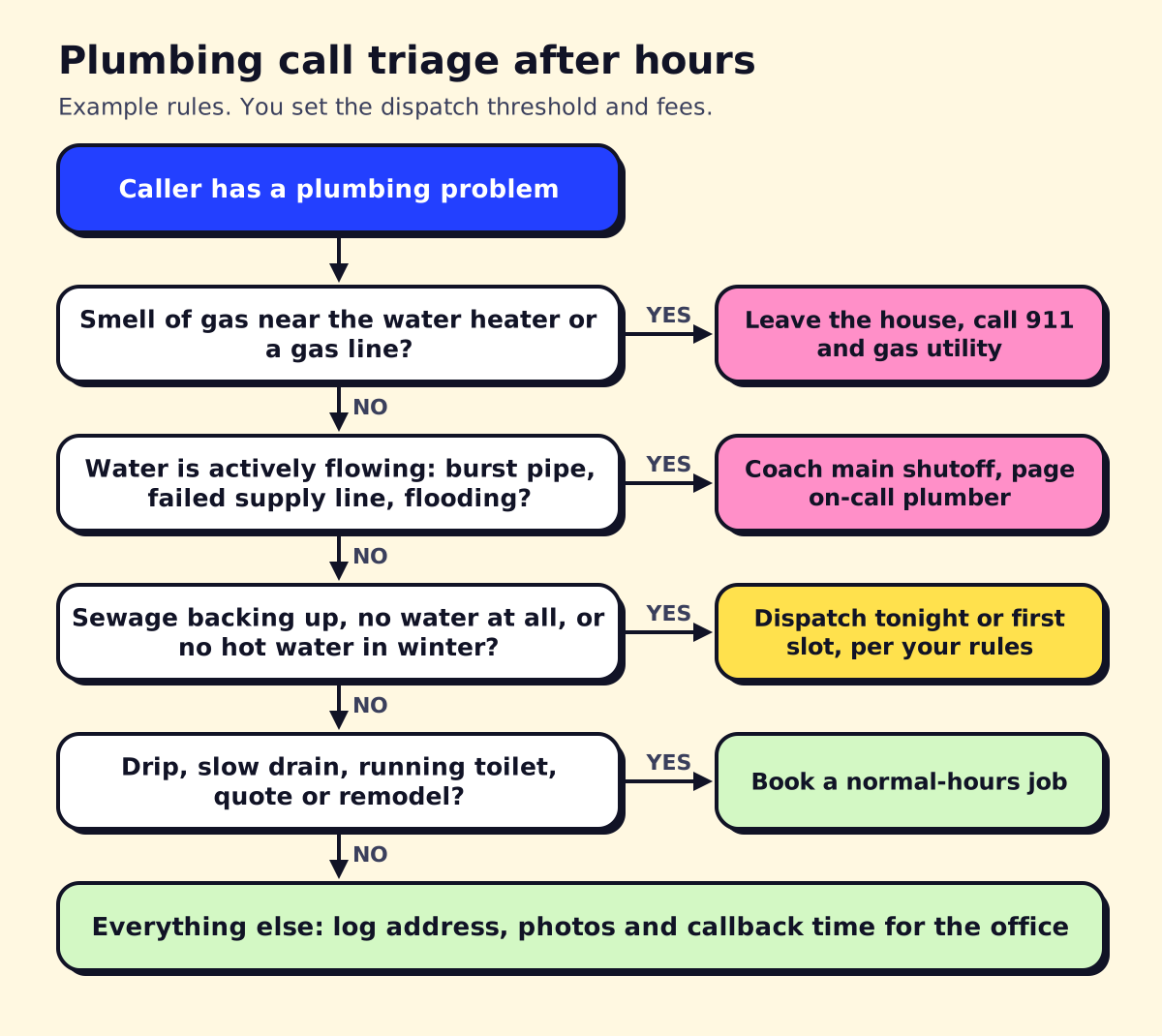 Example plumbing triage rules. You decide the dispatch threshold and after-hours fee.
Gas first. Plumbers work on gas water heaters and gas lines, so some callers will smell gas. The script says: leave the house now, don’t flip switches, and call 911 and the gas utility from outside. The service doesn’t try to troubleshoot.
Active water second. If water is flowing where it shouldn’t, the operator walks the caller to the main shutoff valve (often where the line enters the house, near the meter, or in the basement or garage) or the shutoff on the water heater supply. Once the water’s off, the urgency often drops, and the customer may choose a morning slot over an after-hours fee. That saves your on-call plumber a trip and the customer money.
Sewage and no water third. Sewage backing up is a health problem and can’t wait days. No water to the house is usually urgent for families. Your rules decide whether these are dispatched tonight or booked first thing.
Everything else is a normal booking.
Give the service a short list of questions for every emergency: Is water still flowing? Where is it coming from? Did you find the shutoff? Any water near electrical outlets or the panel? Is it a house, apartment or business? Who owns the property? That last one matters, because a tenant may not be authorized to approve work.
Scripts for the tricky plumbing calls
The price shopper. “How much to unclog a drain?” is one of the most common calls a plumber gets. A service that guesses creates trouble; one that refuses sounds evasive. Approve a line like:
“Our plumber quotes the job on site before starting any work. The trip and diagnostic fee is [$X], and it’s applied to the repair if you go ahead. After 6 p.m. there’s an after-hours rate of [$Y]. Would you like the first available time?”
The tenant. “I’ll take your details and the property manager’s or owner’s name and number. We’ll need their approval before the plumber can start. Is the water still running, and did you find the shutoff?”
The out-of-area caller. Give the service your ZIP codes or a map. “I’m sorry, we don’t cover [town]. I’d suggest searching for a licensed plumber closer to you.” This is better than booking a job you’ll cancel.
The warranty callback. “I’m sorry it’s acting up again. Can I get the address and roughly when we were out? I’ll flag it to our service manager so it’s handled first thing.” Warranty callbacks shouldn’t be billed as new emergencies, so they need a separate tag.
The replacement lead. For water heater replacements: tank or tankless, gas or electric, age, size if known, where it’s installed, and whether it’s leaking now. For repipes and sewer lines: age of the house and pipe material if the caller knows it.
Plumbing virtual receptionist software and integrations
The service needs to book into whatever you use to run jobs. Most plumbing companies run on Jobber, Housecall Pro or ServiceTitan, and each now offers its own AI phone answering:
- Jobber lists its AI Receptionist at $29/month as an add-on as of November 2026, included in the Plus plan. It handles calls and texts and can book into your Jobber schedule within the limits you set.
- Housecall Pro offers CSR AI for customer conversations and booking. The phone product is sold separately without a published price.
- ServiceTitan has a native AI Voice Agent that books jobs and can pass calls to a human or a third-party answering service.
For a one-truck plumber, a native AI receptionist plus “forward emergencies to my cell” can be the cheapest workable setup. Larger shops usually add a live service for emergencies, so the on-call plumber isn’t the one screening calls at 2 a.m.
One feature worth asking about: photo requests. A service that texts the caller a link to upload photos of the leak or the water heater label saves your plumber a lot of guessing. Some AI tools do this; you can also build it with a simple automation (see our n8n workflow examples).
Answering service for plumbers: live, AI or both
The trade-off is the same one every trade faces, with one plumbing-specific wrinkle: emergency callers are often standing in water and stressed. A calm human voice walking them to the shutoff is worth paying for. Booking a drain cleaning for Thursday is not.
| Setup | Monthly cost level | Good for |
|---|---|---|
| AI receptionist only | Lowest | Solo plumbers, mostly routine work, owner takes emergencies |
| Live service only | Highest per call | Shops with high emergency share and older customers |
| AI first, live for emergencies | Middle | Most multi-truck plumbing companies |
We explain how AI and live services split the work in our AI answering service guide.
On-call setup that doesn’t burn out your plumbers
An answering service can make on-call better or much worse. If every after-hours call wakes a plumber, your best people will eventually quit the rotation. A few rules keep it sustainable:
- Screen before paging. The service runs the emergency questions and the shutoff coaching first. Only calls that still meet the dispatch rules reach the plumber.
- Send a summary with the page. Address, what’s leaking, whether the water is off, the customer’s approval of the after-hours fee, and a callback number. The plumber shouldn’t have to re-interview the customer.
- Set a callback deadline. For example, 15 minutes. If the on-call plumber hasn’t responded, the service pages the backup, then the owner or service manager.
- Let the customer choose the morning. When the water is off and the fee is quoted, many customers will happily wait. Make that option part of the script.
- Review dispatches weekly. Look at every after-hours dispatch: was it a real emergency, did the customer pay, did it lead to bigger work? Tighten the rules if too many were avoidable.
Track one number in particular: the share of after-hours calls that became paid dispatches. If it’s very low, your screening is too loose. If you’re turning away people with active leaks, it’s too strict.
What a plumbing answering service costs
As of November 2026, published general plans give a baseline: Ruby lists live receptionist plans from $250 a month for 50 minutes to $1,725 for 500 minutes, and Smith.ai lists $300 a month for 30 calls and $810 for 90 calls. Specialist home-service answering companies mostly quote per minute and add fees for dispatching or patching calls through.
A quick way to estimate: take last month’s calls you missed or sent to voicemail, multiply by your average call length (emergency calls run longer because of the shutoff coaching), and price that against each model. For an illustrative example, 120 calls a month at 3 minutes each is 360 minutes on a per-minute plan, or 120 calls on a per-call plan. Our answering service cost guide walks through the comparison.
Checklist for choosing a plumbing answering service
- Shutoff coaching is part of the emergency script, word for word.
- Gas script sends callers outside and to 911 and the utility.
- Approved price line for trip, diagnostic and after-hours fees.
- Service area by ZIP code, with a polite out-of-area answer.
- Tenant and property manager handling, including who approves work.
- Books into your software, shown live in the demo.
- Photo upload link sent to callers, if possible.
- On-call paging with a backup if the plumber doesn’t call back.
- Commercial accounts flagged with their contracted response times.
- Recordings for every dispatched call.
If you want an AI receptionist that books routine plumbing work into your software and forwards real emergencies to your on-call plumber, opsmigo can set that up. For overnight coverage options in more detail, see our after-hours answering service guide.
We build a free demo on your own services and hours.
FAQ
What is a plumbing answering service?
It's a live or AI phone service that answers a plumbing company's calls when nobody in the office can. It books jobs, captures leads and pages the on-call plumber for emergencies such as burst pipes and sewer backups.
Do plumbers need a 24/7 answering service?
If you offer emergency service, yes. Burst pipes and sewage backups don't wait for business hours, and a caller who reaches voicemail will usually call the next plumber.
What should a plumber's answering service say about price?
Give it an approved line: your trip or diagnostic fee, that the plumber quotes the job on site, and any after-hours surcharge. Avoid letting it guess at job prices.
Is a plumbing virtual receptionist the same as an answering service?
Mostly. A plumbing virtual receptionist often covers daytime overflow and books jobs into your software, while an answering service is often associated with nights and weekends. Many providers offer both.
How much does an answering service for plumbers cost?
As of November 2026, published plans start around $250 a month for 50 live minutes (Ruby) or $300 for 30 calls (Smith.ai), and Jobber's AI Receptionist is a $29/month add-on. Specialist services quote per minute.