- A medical answering service takes messages, pages the on-call provider and books routine visits. A medical virtual receptionist does the same during office hours as an extension of your front desk.
- Any service that hears patient details is a HIPAA business associate. Get a signed BAA before the first call is forwarded.
- Your physicians, not the vendor, should write the triage rules: what goes to 911, what pages the on-call provider and what waits for morning.
- Published general plans run from about $250 a month for 50 minutes (Ruby) to $300 for 30 calls (Smith.ai) as of November 2026. Medical specialists usually quote per minute.
A medical virtual receptionist answers your practice’s calls when your front desk is busy or closed: it books and reschedules visits, takes refill and billing messages, and pages the on-call provider when a patient needs a clinician tonight. A medical answering service is the after-hours version of the same job, and many vendors now sell both as one plan. What separates a good one from a risky one is three things: physician-approved triage rules, a signed HIPAA business associate agreement, and messages that land somewhere secure.
This guide is for doctors’ offices, clinics, chiropractic and therapy practices that want to stop sending patients to voicemail. If you want the general picture first, read our guide to answering services for small businesses.
What a medical office answering service does
A medical office answering service sits between the patient and your phone line. When staff can’t pick up (lunch, a full waiting room, nights, weekends), calls roll over to the service. Operators or an AI voice agent follow a script you approve and do one of four things with each call:
- Send it to emergency care. Callers describing emergency symptoms are told to hang up and call 911.
- Page the on-call provider. Urgent clinical calls go to whoever is on call, with the patient’s callback number and a short summary.
- Handle it. Book, cancel or reschedule an appointment, or answer a simple question (hours, address, which insurance you take).
- Log it for the morning. Refill requests, billing questions, records requests and anything non-urgent go into a secure message queue.
A medical virtual receptionist does the same work during the day, usually as overflow: if your front desk doesn’t answer within a few rings, the call rolls to the service instead of voicemail. Some practices use one vendor for both, so patients hear the same greeting at 10 a.m. and 10 p.m.
The calls a medical practice actually gets
Before you talk to vendors, pull two weeks of call logs from your phone system and sort them. Most practices find the mix looks something like this:
| Call type | Who usually calls | What the service should do |
|---|---|---|
| New appointment or reschedule | Patients, parents | Book directly or collect a request |
| Prescription refill | Patients, pharmacies | Log for clinical staff, never approve |
| Test results question | Patients | Take a message, never read results |
| Symptoms or a new problem | Patients, caregivers | Run your triage script |
| Hospital, ER or lab | Other clinicians | Connect or page per physician rules |
| Billing and insurance | Patients | Log for billing staff |
| Records and forms | Patients, employers, lawyers | Log, verify identity later |
Two lines in that table cause most of the trouble: test results and symptoms. Your script should say plainly that the service never interprets results or gives clinical advice. The service’s job is to get the right information to the right person quickly.
Triage rules: 911, on-call provider, or morning
Medical answering services fail when the triage rules are vague. “Page the doctor for anything urgent” means a different thing to every operator. Write the rules as a short decision list and have your physicians sign off.
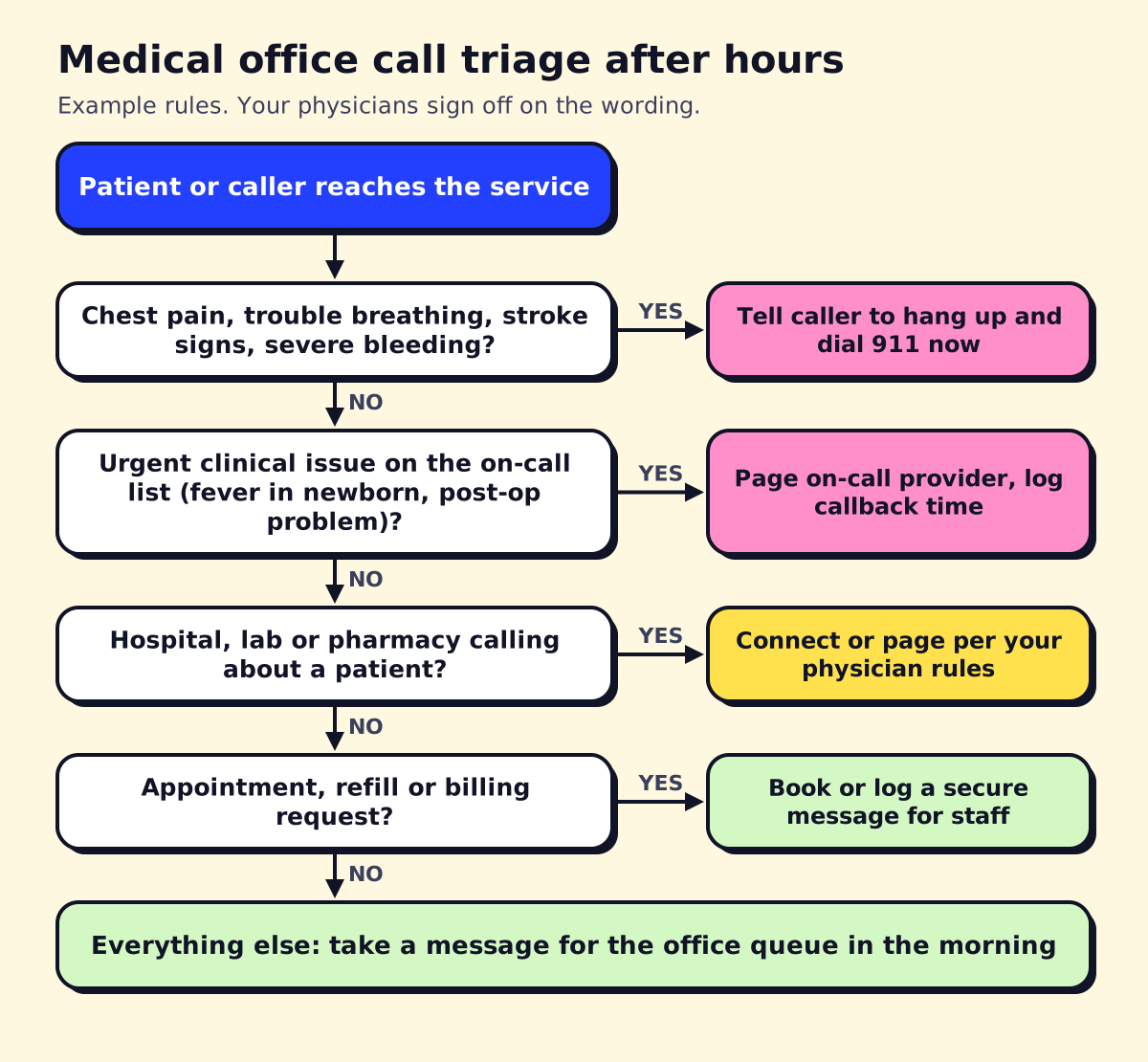 An example triage flow. Your clinical team decides the actual symptom list.
A few rules make the list work in practice:
- Name the 911 symptoms. Chest pain, trouble breathing, stroke signs, severe bleeding, suicidal statements. The service tells the caller to hang up and dial 911, then logs the call for your team.
- List what pages the on-call provider. For a pediatric practice that might include a fever in a baby under three months; for a surgical practice, post-op bleeding or a wound that looks infected. Specific beats general.
- Set paging times and escalation. If the on-call provider doesn’t call back in 15 minutes (or whatever you choose), who gets paged next? Write it down.
- Decide what the service may say. Most practices allow only scripted lines (“The doctor on call will call you back within 30 minutes”) and no clinical opinions.
- Keep a nurse line separate if you have one. If you use a nurse triage service, the answering service should transfer to it rather than ask clinical questions itself.
Physician answering services that handle hospital and ER calls need one more rule: who may be connected live versus paged. Many physicians want a live transfer for another clinician and a page for everyone else.
HIPAA compliant answering service: what to check
Any answering service that hears patient names, symptoms or phone numbers on your behalf handles protected health information. Under HIPAA that makes it a business associate, and the U.S. Department of Health and Human Services says covered entities need a written contract with business associates that limits how they use and protect that information (HHS business associate guidance). HHS also publishes sample business associate agreement provisions you can compare against the vendor’s contract.
Some vendors argue they’re a “conduit”, like the phone company, and don’t need a BAA. HHS describes the conduit exception as narrow: it covers transmission services that store information only temporarily (HHS FAQ on conduits). A service that writes messages, keeps call recordings or stores transcripts is doing more than transmitting. If a vendor won’t sign a BAA, move on.
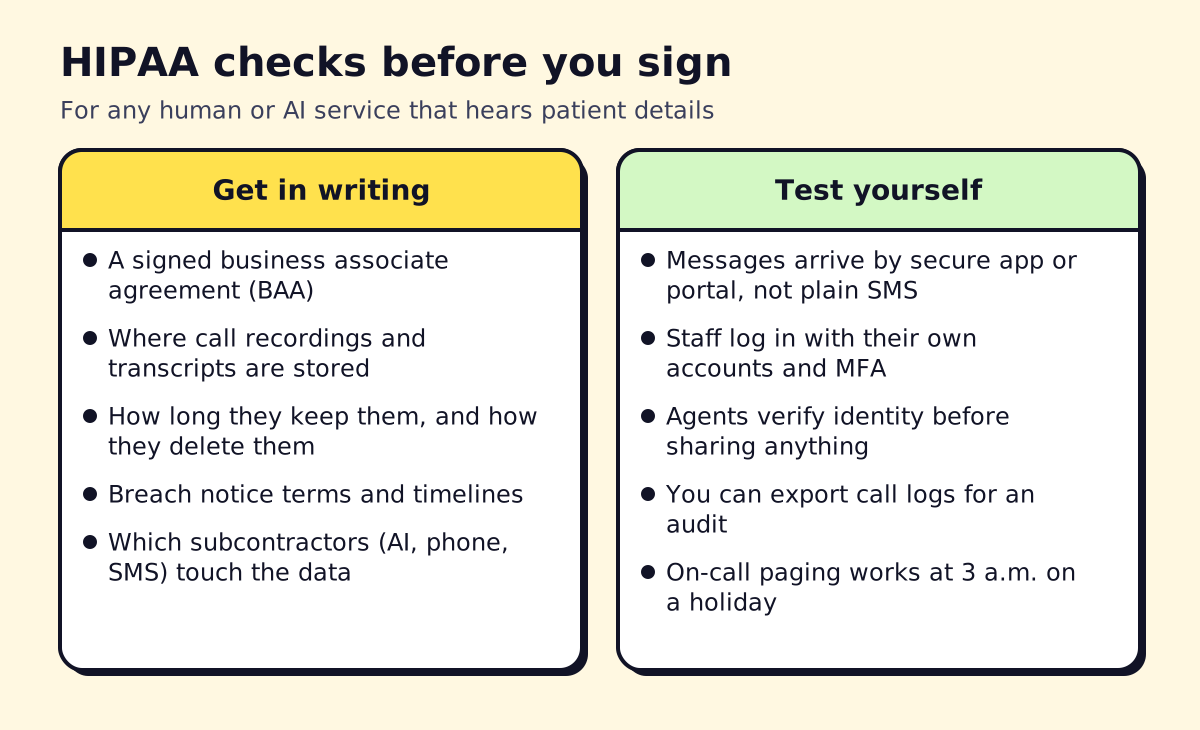
A BAA is the minimum. Also check how messages reach you. Plain SMS with a patient’s name and symptoms is a common weak spot; a secure messaging app or portal with individual logins is better. For an AI medical virtual receptionist, ask which subcontractors process the audio (speech-to-text, the language model, the phone carrier) and whether each is covered by the vendor’s own BAAs.
Live, AI or hybrid medical virtual receptionist?
You have three realistic options in 2026. Each one fits a different kind of practice.
| Option | Good at | Weak at | Fits |
|---|---|---|---|
| Live operators (medical specialist) | Distressed callers, unclear symptoms, on-call paging | Cost per minute, hold times at peak | Multi-provider practices, pediatrics, OB-GYN |
| AI virtual receptionist | Booking, reschedules, FAQs, 24/7 at low cost per call | Emotional or confusing calls, accents and bad lines | High-volume clinics with routine scheduling |
| Hybrid (AI first, human backup) | Handles routine calls cheaply, passes hard ones to people | Two systems to configure and audit | Most small and mid-size practices |
An automated medical answering service works best when it can read and write your schedule. If you run athenahealth, eClinicalWorks, SimplePractice, Jane or another practice management system, ask each vendor whether it books directly into that system or just emails you a request. A request your staff must re-key in the morning saves less time than it seems. Our explainer on AI answering services covers how the AI side works, and AI agents in healthcare goes into scheduling and intake automation beyond the phone.
Specialty notes: chiropractic, therapy, pediatrics and more
The same service can cover very different practices if the script reflects the specialty.
Chiropractic answering service. Chiropractic offices get mostly scheduling calls: new patients, adjustments, cancellations, and personal injury or workers’ comp questions. The win is booking straight into your scheduling software and collecting insurance or claim details up front. Real emergencies are rare, so a simple “if this is an emergency, hang up and call 911” line usually covers it.
Therapy and counseling practices. Calls are often sensitive. The script needs a crisis path: if a caller mentions self-harm, the service gives the 988 Suicide & Crisis Lifeline and 911 and alerts the clinician per your policy. Many therapists prefer that the service never asks why someone is calling, only for contact details and preferred times.
Pediatric and OB-GYN answering services. These are the most triage-heavy. Parents and pregnant patients call at night with real questions, and many practices pair the answering service with a nurse triage line so clinical questions reach a nurse quickly.
Veterinary answering service. Vet clinics have the same after-hours split (emergency, urgent, routine), but the emergency route is usually a nearby 24-hour animal hospital rather than 911. HIPAA doesn’t apply to animal records, though state rules on client records may.
Hospitals and hospice. Larger organizations often need a medical exchange: a service that routes calls among many physicians on rotating schedules. That needs on-call calendar management, which smaller vendors may not offer.
Medical answering service cost
Medical-only answering services rarely publish prices; most quote per minute after a call with sales. General virtual receptionist companies do publish theirs, which gives you a benchmark. As of November 2026:
| Provider | Plan | Monthly price | Included |
|---|---|---|---|
| Ruby | Startup | $250 | 50 minutes |
| Ruby | Small business | $720 | 200 minutes |
| Smith.ai | Starter (virtual receptionists) | $300 | 30 calls |
| Smith.ai | Basic | $810 | 90 calls |
Two things push medical quotes higher than these general plans: on-call paging with escalation rules, and HIPAA-ready secure messaging. Ask every vendor to price the same scenario, for example “400 calls a month, 60% after hours, average call 2 minutes, two on-call providers”, so you can compare like for like. Our answering service cost guide explains per-minute versus per-call billing and the fees that hide in contracts (holiday surcharges, patch fees, minimum terms).
How to choose a medical answering service: checklist
Use this list when you talk to vendors. Ask them to show you, not just tell you.
- BAA signed before any calls are forwarded, with the subcontractors named.
- Secure message delivery (app or portal with individual logins), not plain SMS or email with patient details.
- Triage built from your rules, with a test call you can listen to.
- On-call calendar that handles rotating providers, holidays and backup paging.
- Scheduling integration with your actual system, demonstrated live.
- Recordings and logs you can export for complaints or audits.
- Bilingual coverage if your patients need it. We cover this in our bilingual answering service guide.
- Clear pricing for minutes or calls, after-hours rates, holidays and overages.
- Month-to-month or a short trial so you can leave if quality drops.
Setting it up in a week
A clean setup takes about a week of your time spread over a few short sessions.
- Day 1: Export two weeks of call logs and list your call types.
- Day 2: Write the triage rules with your physicians, including the 911 list and on-call escalation.
- Day 3: Sign the BAA, set up secure messaging logins for staff and providers.
- Day 4: Load the on-call calendar, scheduling access and the FAQ sheet (hours, locations, insurance, parking).
- Day 5: Make ten test calls covering every branch of the triage list. Fix what fails.
- Week 2: Review every after-hours message each morning, then weekly once the script settles.
If you’d like a hybrid setup where an AI receptionist books routine visits and hands clinical calls to people, opsmigo can build and configure it around your scheduling system. Either way, start with the triage rules: they matter more than the vendor you pick.
We build a free demo on your own services and hours.
FAQ
What is an answering service for a doctor's office?
It is a team of operators, an AI voice agent, or both, that answers the practice's phone when staff can't. It takes messages, pages the on-call provider for urgent clinical calls, and books or logs routine requests for the morning.
Does a medical answering service need to be HIPAA compliant?
Yes. A service that records patient names, symptoms or call recordings on your behalf is a business associate under HIPAA, so you need a signed business associate agreement and proof of safeguards such as encrypted messaging and access controls.
Can an AI medical virtual receptionist give medical advice?
It shouldn't. Set it up to follow your scripted triage questions, send emergencies to 911, page the on-call provider for urgent issues and leave clinical judgment to licensed staff.
How much does a medical answering service cost?
As of November 2026, Ruby lists plans from $250 a month for 50 minutes and Smith.ai from $300 a month for 30 calls. Medical-only services usually quote per minute, so ask for a quote based on your real call volume.
Do chiropractors and therapists need the same setup as a medical clinic?
They need the same HIPAA safeguards but simpler triage. Most calls are scheduling, insurance and cancellations, so the priority is booking into your calendar and a clear crisis script for therapy practices.