- A real estate answering service is a lead-capture tool. Its job is to qualify the caller, book a showing or call, and log the lead in your CRM before they ring another agent.
- Route hot leads (ready to tour or list now) to you live; book or log everyone else.
- Give the service listing sheets and an approved answer for every common question, and keep neighborhood talk to facts to avoid Fair Housing steering.
- Check that leads land in your CRM (Follow Up Boss, for example) with the source, not just in an email.
A real estate answering service answers your calls when you’re in a showing, at a closing table or off for the night, and turns each caller into a qualified lead in your CRM. For agents, that’s the whole point: a buyer who calls a sign at 7 p.m. and gets voicemail will often call the next number. The service’s job is to answer quickly, find out whether the caller wants to tour, list or just ask a question, and either transfer the hot ones to you or book the next step.
This guide is for solo agents, teams, brokerages and mortgage brokers. It covers the calls you get, routing rules, scripts, CRM integration, Fair Housing and cost.
The calls agents get (and which ones matter most)
Real estate calls come from a few predictable sources:
| Source | Caller | What they usually want |
|---|---|---|
| Yard sign or listing ad | Buyer, neighbor, other agent | Price, details, showing |
| Portal (Zillow, Realtor.com and others) | Buyer | Tour a specific home |
| Your website or Google profile | Buyer or seller | Consultation, home value |
| Past clients and referrals | Seller, buyer, friend | Talk to you |
| Industry | Lender, title, inspector, other agents | Deal updates |
Two callers are worth interrupting you for: a buyer ready to see a home soon, and a seller ready to list. Everyone else can be booked, answered or logged. That’s the core of a good routing plan.
Routing rules for a real estate answering service
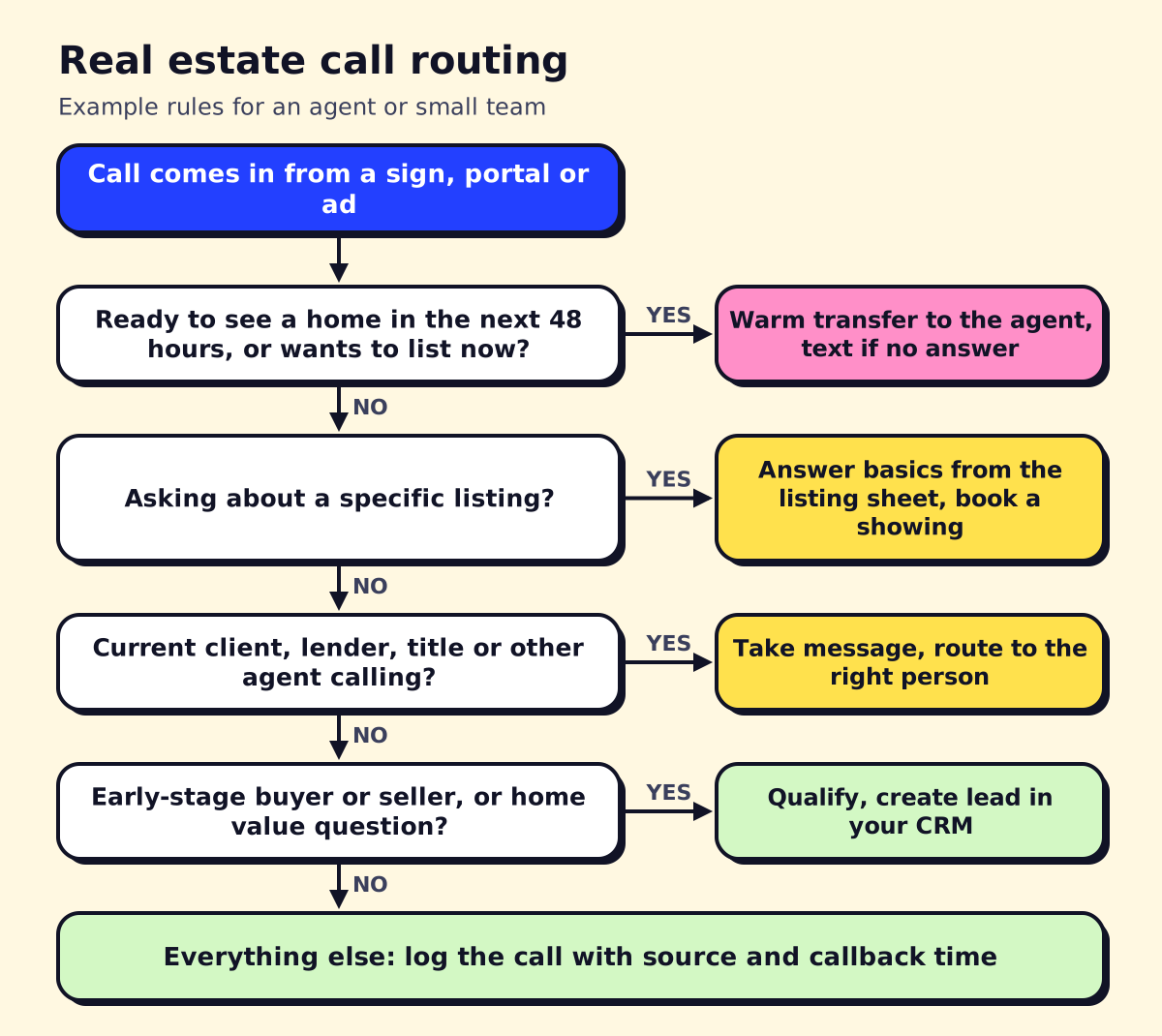 Example routing. Set your own definition of a hot lead.
- Hot buyer or seller: wants to tour within 48 hours, or wants to list in the next month. The service warm-transfers to you. If you don’t pick up, it texts you the lead’s details and tells the caller when to expect your call.
- Listing question: the service answers from your listing sheet (price, beds, baths, square footage, HOA, taxes, open house times) and offers a showing.
- Clients and industry: messages go to you or your transaction coordinator, tagged by deal.
- Early-stage leads: the service qualifies (timeline, pre-approval, area, price range, selling first?) and creates the lead in your CRM for follow-up.
Decide how you want to be reached in each case: call, text, or a CRM notification. Agents who are in showings all day often prefer a text with a one-line summary over a live transfer.
Scripts for real estate calls
Greeting: “Thanks for calling [Name] with [Brokerage]. [Name] is with a client right now. I can help you. Are you calling about a specific property?”
Sign call: “That’s [address], listed at [price]. It has [beds/baths] and [one standout feature]. Would you like to see it? I have [times] available. Are you working with an agent already?”
That last question matters. If the caller already has a buyer’s agent, the service should take their agent’s details and pass along showing instructions rather than book them as your lead.
Seller lead: “Great, [Name] would love to talk with you about selling. Can I get the property address, when you’re hoping to move, and whether you’re also buying? I’ll set up a call or a visit for a home value review.”
Home value question: “[Name] prepares a market analysis for that. I can book a short call or a visit. What’s the address?” The service shouldn’t guess at a value or quote online estimates.
Mortgage question: “That’s a great question for a lender. Would you like [Name]’s preferred lender to contact you, or do you have one already?”
CRM integration: where leads should land
A lead that arrives as an email gets lost. A lead that lands in your CRM with the source, timeline and notes gets followed up.
Follow Up Boss is common with teams, and several answering services connect to it. Smith.ai, for example, offers a Follow Up Boss integration, and others connect through Zapier. Lofty, BoldTrail (formerly kvCORE), Sierra Interactive and other real estate CRMs have their own options. Ask each service:
- Does the lead appear as a new contact with the right source (sign, portal, website)?
- Does it trigger your action plan or follow-up sequence, or can we turn that off for certain calls?
- Are call recordings or transcripts attached to the contact?
- Is the lead assigned to the right agent on a team, by area or round-robin?
If the answering service doesn’t integrate directly, an automation can bridge it. Our guide to AI for real estate covers lead follow-up beyond the phone, and AI for sales and lead generation explains how speed-to-lead automations work.
Fair Housing and texting rules
Real estate answering services need two compliance guardrails.
Fair Housing. The Fair Housing Act bars discrimination based on race, color, religion, sex, national origin, familial status and disability. For a phone service, the risk is steering: describing a neighborhood as “great for young families,” “safe,” or “a good fit for you” based on who the caller seems to be. Keep answers to facts about the property, and send school and crime questions to official sources the caller can check themselves.
Texting and calling leads. If the service or an AI follows up by text or automated call, consent rules under the Telephone Consumer Protection Act apply. The FCC’s guidance on telemarketing and robocalls is the place to start. When in doubt, have the service ask “Is it OK if we text you at this number?” and note the answer in the CRM.
Live answering service for real estate vs. AI
| Live receptionist | AI receptionist | |
|---|---|---|
| Seller conversations | Better with nuance and nerves | Fine for collecting basics |
| Listing questions | Good if the sheet is current | Good, instant, any hour |
| Showing requests | Good | Good with calendar access |
| Cost | Higher per minute or call | Lower |
| Peak times (Sunday open houses) | Can queue | Doesn’t queue |
Many agents run AI first and transfer hot leads to a person (themselves or a live service). See our virtual receptionist guide for how live receptionists are usually priced and staffed.
Answering service for mortgage brokers
Mortgage brokers and loan officers have similar lead-capture needs with stricter limits on what the service can say:
- No rate quotes. Rates depend on the borrower and change daily. The service books a call with a loan officer.
- No sensitive data by phone. Social Security numbers, income documents and account numbers belong in your secure application portal, not an answering service message.
- Collect the basics: loan purpose (purchase, refinance, cash-out), property state, rough timeline, whether they’re working with an agent, and the best time to call.
- Licensing: if you’re licensed only in certain states, give the service that list so it can politely decline others.
Real estate answering service cost
Real estate-focused services often price per call or per minute. As of November 2026, general benchmarks: Ruby lists live plans from $250 a month for 50 minutes, and Smith.ai lists $300 a month for 30 calls, $810 for 90 calls. Smith.ai charges an extra $0.50 per call for each CRM integration beyond the first, per its pricing page. AI receptionists cost less but vary widely by vendor and features.
For an agent, the useful math is per closed deal, not per call. If the service books one extra listing appointment a quarter that becomes a sale, it has likely paid for itself. Our answering service cost guide has a fuller breakdown.
Setting it up in a weekend
You don’t need weeks of onboarding. A solo agent or small team can be live in a couple of days.
- List your numbers. Office line, sign rider numbers, portal call-tracking numbers, website. Decide which forward to the service and when (always, after hours, or after a few rings).
- Write the hot-lead rule. One or two sentences: who gets transferred live, who gets texted to you, who gets booked.
- Build the listing sheet pack. One page per active listing with price, specs, HOA, taxes, showing instructions, and anything the seller doesn’t want shared.
- Connect your calendar and CRM. Test that a fake lead arrives with the right source and agent assignment.
- Make five test calls. Pretend to be a sign caller, a seller, a buyer with an agent, a lender and someone asking about schools. Listen to the recordings.
- Review weekly for a month. Check how many leads the service created, how many you converted to appointments, and any calls it handled poorly.
Update the listing pack every time a price changes or a listing goes pending. Stale information is the most common complaint about real estate answering services, and it’s always fixable on your side.
Checklist: choosing a real estate answering service
- Hot-lead definition written down, with a live transfer or text rule.
- Listing sheets for every active listing, updated when prices change.
- Asks about existing agents before booking a showing.
- CRM integration with the right lead source, shown live.
- Calendar or showing tool access with booking rules.
- Fair Housing-safe script with no neighborhood characterizations.
- Texting consent captured and noted.
- Weekend coverage for open house traffic.
- Recordings you can review for quality.
- Short commitment until you’ve seen a month of leads.
If you’d like an AI receptionist that answers listing questions, books showings and pushes leads into your CRM, opsmigo builds those for agents and teams.
We build a free demo on your own services and hours.
FAQ
What does a real estate answering service do?
It answers your calls when you're showing homes, in closings or off for the night. It qualifies buyers and sellers, answers listing questions, books showings or consultations, and logs each lead in your CRM.
Should real estate agents use a live answering service or AI?
Live receptionists handle nuanced seller conversations and nervous first-time buyers better. AI is cheaper, answers instantly at any hour and is good at listing questions and showing requests. Many agents use AI first with a live transfer for hot leads.
Can an answering service schedule showings?
Yes, if it can see your calendar or your showing tool. Give it rules for how far ahead it can book, which listings need the seller's approval and how long each showing slot is.
Can a mortgage broker use an answering service?
Yes, for capturing leads and booking calls with a loan officer. The service shouldn't quote rates or take Social Security numbers by phone; it collects contact details and the loan type and books a callback.
How much does a real estate answering service cost?
As of November 2026, published live plans start around $250 a month for 50 minutes (Ruby) or $300 for 30 calls (Smith.ai). AI-only receptionists usually cost less but vary by vendor.