- The best AI agent is usually the one built into the software your team already lives in: Copilot Studio for Microsoft 365, Gemini Enterprise for Google Workspace, Agentforce for Salesforce, Zendesk AI agents for Zendesk.
- For connecting many small-business apps, n8n, Zapier Agents and Make are the most flexible. n8n is cheapest at volume; Zapier is easiest.
- OpenAI's Agent Builder shuts down on November 30, 2026 and custom GPTs are being retired, so build new OpenAI-based agents on ChatGPT workspace agents or the Agents SDK.
- Pricing is shifting to usage (credits, conversations, resolutions). Estimate your monthly volume before comparing.
The best AI agents for most businesses in 2026 are the ones built into software you already use: Microsoft Copilot Studio for Microsoft 365, Gemini Enterprise for Google Workspace, ChatGPT or Claude for teams already on those assistants, Agentforce for Salesforce and Zendesk AI agents for support teams. If your work spans many separate apps, n8n, Zapier Agents or Make let you build agents that connect them.
Below we compare the main options, their prices as of November 2026, who each one suits, and the big changes you should know about before choosing (two OpenAI products are going away). New to the topic? Read what AI agents are first.
Quick picker: which AI agent should you start with?
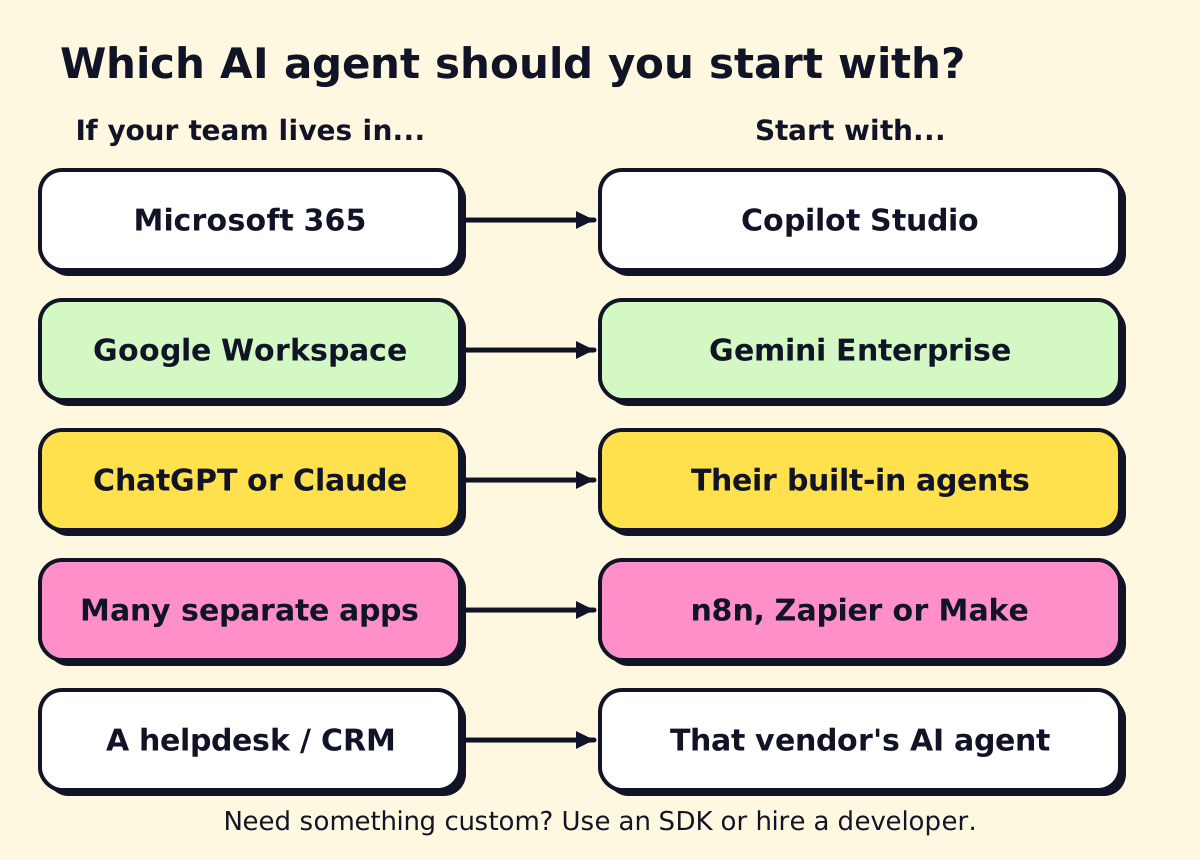
The logic is simple: an agent is only as useful as the data and tools it can reach. The agent that already has secure access to your email, files, CRM or helpdesk will beat a cleverer one that can’t see anything.
Best AI agents compared (as of November 2026)
| Agent / platform | Best for | Starting price | How you build |
|---|---|---|---|
| Microsoft Copilot Studio | Microsoft 365 and Teams users | $200/month per 25,000 credits | Low-code |
| ChatGPT workspace agents | Teams already on ChatGPT | ChatGPT Business seat + agent credits | No-code |
| Claude (Team, Cowork, Managed Agents) | Document-heavy and analytical work | Team from $20/seat/month (annual) | No-code to code |
| Gemini Enterprise | Google Workspace users | Per user, by edition | No-code |
| Salesforce Agentforce | Salesforce CRM users | $2 per conversation | Low-code |
| Zendesk AI agents | Support teams on Zendesk | $1.50 to $2.00 per resolution | No-code |
| ServiceNow AI Agents | Large IT and HR service desks | Quote only | Low-code |
| n8n | Custom workflows, high volume | From €20/month; free self-hosted | Low-code |
| Zapier Agents | Fast setup across 8,000+ apps | Free; Pro from ~$33/month | No-code |
| Manus | One-off research and autonomous tasks | Free tier and paid plans | Prompt only |
| Agent SDKs (OpenAI, Claude, LangGraph) | Custom products | Free code + model usage | Code |
Prices change often and many vendors bill by usage, so treat this as a starting point and check each linked pricing page.
Business AI agent platforms
Microsoft Copilot Studio
Best for companies on Microsoft 365, Teams, SharePoint and Dynamics. You build agents in a visual editor, ground them in SharePoint and OneDrive files, connect them to 1,000+ connectors and MCP servers, and publish them in Teams or on your website.
Pricing (as of November 2026): usage is billed in Copilot Credits. A capacity pack is $200 per month for 25,000 credits, pay-as-you-go is also available, and users with a Microsoft 365 Copilot licence ($30 per user per month, paid yearly) can build internal agents at no extra cost (Copilot Studio pricing). Our Copilot for Microsoft 365 guide covers the licence side.
Watch out for: credit consumption is hard to predict. Agents that search files and reason through several steps use far more credits per answer than simple ones.
ChatGPT workspace agents
OpenAI launched workspace agents in April 2026 for ChatGPT Business, Enterprise and Edu. They are shared agents a team builds once and reuses, with connections to apps like Slack and Google Workspace. OpenAI positions them as the successor to custom GPTs for teams.
Pricing: a ChatGPT Business seat (OpenAI cut it to $20 per user per month billed annually, or $25 monthly, in April 2026, according to Eesel’s pricing breakdown) plus credit-based billing for agent usage. Check your admin console for current credit rates.
Claude
Anthropic’s Claude is strong at long documents, careful writing and following detailed instructions. Business teams use Claude Team or Enterprise with Cowork (an agent that works with your files and desktop apps), connectors to apps like Google Drive and Slack, and MCP for custom tools. Developers can use the Claude Agent SDK or Claude Managed Agents, a hosted runtime billed at $0.08 per session-hour plus tokens.
Pricing (as of November 2026): Team standard seats are $20 per month billed annually or $25 monthly; Enterprise starts at $20 per seat with usage billed at API rates and a 20-seat minimum (Claude pricing).
Gemini Enterprise (formerly Vertex AI Agent Builder)
Google merged its agent tools in April 2026. Gemini Enterprise is the employee-facing app where teams use and build agents, including no-code agents with Agent Designer. Gemini Enterprise Agent Platform is the developer side, which replaced Vertex AI and absorbed Vertex AI Agent Builder. If you searched for “Google Vertex AI Agent Builder”, that is where it went.
Pricing: per user per month by edition (Gemini Enterprise). Google’s published figures vary by region and agreement, so get a quote; third-party guides put the entry Business edition around $21 per user per month on an annual plan.
Salesforce Agentforce
Agentforce runs inside Salesforce and acts on CRM data: answering customers, qualifying leads, updating cases. It makes sense if Salesforce is already your system of record.
Pricing (as of November 2026): $2 per conversation, or Flex Credits at $500 per 100,000 credits (a standard action uses 20 credits), or per-user add-ons from $125 per user per month (Agentforce pricing).
Zendesk AI agents
Built into Zendesk Suite for support teams. AI agents answer and resolve tickets across chat, email and messaging, and hand off to human agents with context.
Pricing (as of November 2026): Suite Team is $55 per agent per month billed yearly, with 5 automated resolutions per agent included; extra resolutions cost $1.50 committed or $2.00 pay-as-you-go (Zendesk pricing). You pay only when the AI resolves a ticket, which makes ROI easy to measure. More options in our AI customer service guide.
ServiceNow AI Agents
ServiceNow’s AI Agents and AI Agent Studio target large IT, HR and customer service operations already running on ServiceNow, along with its workflow automation. ServiceNow does not publish list prices for these add-ons; expect an enterprise quote. Not a fit for most small businesses.
Automation platforms with AI agents
n8n
Open-source workflow automation with an AI Agent node, memory, tool calls and MCP support. Best when you want full control, self-hosting or high volume at low cost.
Pricing (as of November 2026): cloud plans from €20 per month billed annually for 2,500 executions; the Community Edition is free to self-host (n8n pricing). See our full n8n pricing breakdown.
Zapier Agents
The easiest way for non-technical teams to give an agent access to thousands of apps. You describe the agent in plain language and pick the apps it can use.
Pricing (as of November 2026): free plan with 400 activities per month; Pro from about $33 per month billed annually for 1,500 activities (Zapier Agents pricing). Agents are billed separately from regular Zapier tasks. Compare platforms in Zapier vs Make vs n8n.
Make
Visual scenario builder with AI agent features, often cheaper than Zapier for complex multi-step flows. See our Make guide.
Autonomous agents: Manus and ChatGPT agent mode
What can Manus do? Give it one instruction (“research the top 20 property managers in Austin and put them in a spreadsheet with contact pages”) and it plans, browses, runs code and returns a finished file. Its capabilities include web research, data analysis, slide and document creation, and building simple websites. Meta acquired Manus at the end of 2025 and said it would keep selling the service (TechRadar).
ChatGPT’s agent mode does similar work inside ChatGPT. Both are excellent for one-off research and prep work. Neither is built to run your daily operations with your business data and rules; for that, use one of the platforms above.
What happened to OpenAI Agent Builder and custom GPTs?
If you searched for “OpenAI Agent Builder” or “how to create a custom GPT”, note two changes:
- Agent Builder (OpenAI’s visual workflow canvas launched in 2025) is scheduled to shut down on November 30, 2026. OpenAI points users to the Agents SDK or ChatGPT workspace agents (OpenAI deprecations).
- Custom GPTs are being retired. OpenAI’s help center describes the migration path and a shutdown date in December 2026. Workspace agents are the closest replacement for team use.
How custom GPTs worked, for reference: in ChatGPT you opened Explore GPTs, chose Create, described the assistant, added instructions and knowledge files, and optionally connected “actions” (API calls described with an OpenAPI schema). If you have GPTs your team relies on, export their instructions and files now and rebuild them as workspace agents, testing that any custom actions still work.
Developer frameworks
If you are building an agent into your own product or need integrations no platform offers:
- OpenAI Agents SDK: lightweight, with handoffs, guardrails, sessions and tracing.
- Claude Agent SDK: the agent loop behind Claude Code, strong with files and documents.
- LangGraph: model-agnostic graphs for complex, branching flows.
- Google ADK: Google’s open-source framework for the Gemini Enterprise Agent Platform.
Our how to build an AI agent guide includes a code example, and AI agent architecture explains how the pieces fit.
Custom AI agent tools: best practices
Whichever platform you choose, the same practices separate agents that work from ones that get switched off:
- One job per agent. Narrow agents are easier to test and trust.
- Describe tools precisely. Say what each tool does, when to use it and when not to.
- Least privilege. Separate credentials per agent, read-only where possible.
- Human approval for irreversible actions: refunds, cancellations, bulk messages.
- Test set before launch. 20 to 50 real examples, re-run after every change.
- Log everything and review transcripts weekly in the first month.
- Cap spend and steps so a runaway loop cannot surprise you.
- Keep your logic portable. Instructions, tool specs and test cases in your own documents, so you can switch platforms (as Agent Builder users now must).
Best AI for real estate agents
For real estate, the highest-value agents are an assistant (ChatGPT, Claude or Gemini) for listing descriptions, market summaries and client emails, and an always-on agent that answers enquiries, qualifies buyers and books showings. AI virtual staging tools are popular for listing photos too; check your MLS rules on disclosing edited images. Our AI for real estate guide goes deeper.
How to choose
- List the systems your team uses every day. Shortlist the agents built into them.
- Estimate monthly volume (conversations, tickets, actions) and price each option on that number.
- Run a two-week pilot on one job with real data.
- Check data handling, admin controls and any industry agreements you need (for example, a HIPAA business associate agreement in healthcare; see AI agents in healthcare).
If none of the off-the-shelf options fits your process, a custom build may be cheaper than forcing it; our guide to AI agent development services explains what that costs. opsmigo is happy to run that comparison with you before you sign anything.
We build a free demo on your own services and hours.
FAQ
What are the top AI agent platforms in 2026?
For business teams: Microsoft Copilot Studio, ChatGPT workspace agents, Claude, Gemini Enterprise, Salesforce Agentforce, ServiceNow AI Agents and Zendesk AI agents. For connecting apps: n8n, Zapier Agents and Make. For developers: the OpenAI Agents SDK, Claude Agent SDK and LangGraph.
What is the OpenAI Agent Builder?
Agent Builder was OpenAI's visual canvas for designing agent workflows, launched in 2025. OpenAI announced its deprecation in June 2026 and plans to shut it down on November 30, 2026, recommending the Agents SDK or ChatGPT workspace agents instead.
How do I create a custom GPT?
Custom GPTs were built in ChatGPT under Explore GPTs, then Create, by describing the assistant and adding instructions, files and actions. OpenAI is retiring custom GPTs, so for new work use workspace agents on ChatGPT Business or Enterprise.
What can Manus AI do?
Manus is a general-purpose autonomous agent that browses the web, runs code and produces finished outputs such as research reports, spreadsheets and simple websites from a single instruction. Meta acquired it at the end of 2025 and said it would keep the service running.
What is Google Vertex AI Agent Builder called now?
In April 2026 Google renamed Vertex AI to Gemini Enterprise Agent Platform, and Agent Builder became part of it. Business users build no-code agents in Gemini Enterprise with Agent Designer.
What is the best AI for real estate agents?
Most agents get the most from a general assistant (ChatGPT, Claude or Gemini) for listings and emails, plus an AI that answers and qualifies leads around the clock. Your CRM's built-in AI is worth checking first.