- AI agent development services cover discovery, design, integrations with your systems, testing, guardrails, launch and ongoing tuning. Integrations and testing are most of the work.
- Published ranges from development firms put custom agents at roughly $20,000 to $60,000 for focused builds and $100,000+ for enterprise systems, plus running costs.
- Budget for ongoing costs too: model usage, platform fees and maintenance, which one firm estimates at 15 to 20% of the build cost per year.
- Buy off-the-shelf when your process is standard; build when the agent must work inside your own systems and rules.
AI agent development services design, build and maintain AI agents that work inside your business: answering customers, booking appointments, processing documents or updating your CRM. A typical engagement covers discovery, a prototype, integrations with your systems, testing and guardrails, launch and ongoing improvement. Published ranges from development firms put a focused custom agent at roughly $20,000 to $60,000, with enterprise systems above $100,000, plus monthly running costs.
This guide explains what you get for that money, how projects run, when to buy instead of build, and how to choose a developer without getting burned. If you want to try building one yourself first, read our how to build an AI agent guide.
What AI agent development services include
A complete AI agent development engagement usually includes:
- Discovery: mapping the process, picking the job for the agent, defining success metrics and what must always go to a human.
- Design: choosing the platform, model and architecture (single agent or several), and writing the agent’s instructions and tool specs. Our AI agent architecture guide explains these parts.
- Integration: connecting the agent to your phone system, CRM, calendar, helpdesk, accounting or industry software.
- Knowledge setup: turning your FAQs, policies and price lists into something the agent can search reliably.
- Testing and evaluation: building a set of real examples and edge cases and scoring the agent against them.
- Guardrails and compliance: permissions, human approvals, logging, data retention and any industry rules (HIPAA, privacy laws).
- Launch and training: a staged rollout and training for the staff who handle handoffs.
- Maintenance: monitoring, monthly tuning, model updates and fixes when connected apps change.
Be wary of quotes that cover only “build the bot”. The first three months after launch are when most of the improvement happens.
How an AI agent development project runs
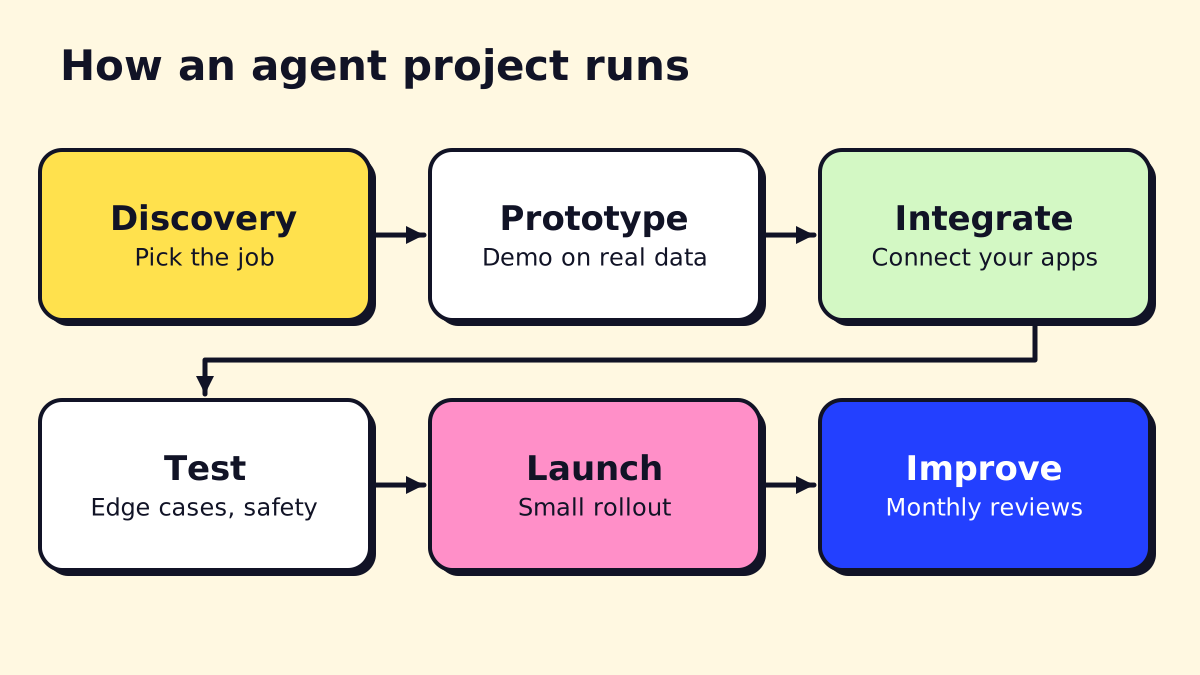
- Discovery. Workshops and recordings of how the job is done today. Output: a one-page spec with the agent’s job, rules, tools and success metrics.
- Prototype. A working demo on your real data, often within days on a no-code platform. This is where you find out if the idea works before paying for integrations.
- Integrate. Connect the systems, with separate limited credentials for the agent.
- Test. Run the evaluation set, fix failures, repeat. Include adversarial tests (people trying to make it misbehave).
- Launch. Start with a slice: after-hours only, one location, one service line.
- Improve. Review transcripts and metrics, tune instructions and knowledge, add capabilities one at a time.
Biz4Group puts total timelines at 4 to 6 weeks for a simple agent and 10 to 14 weeks for an advanced one (Biz4Group). A big variable on your side is how quickly your team can provide access to systems and answer process questions.
How much AI agent development costs
There is no public price list for custom agents, so we compared ranges published by two development firms. Both sell these services, so treat the numbers as market signals rather than quotes.
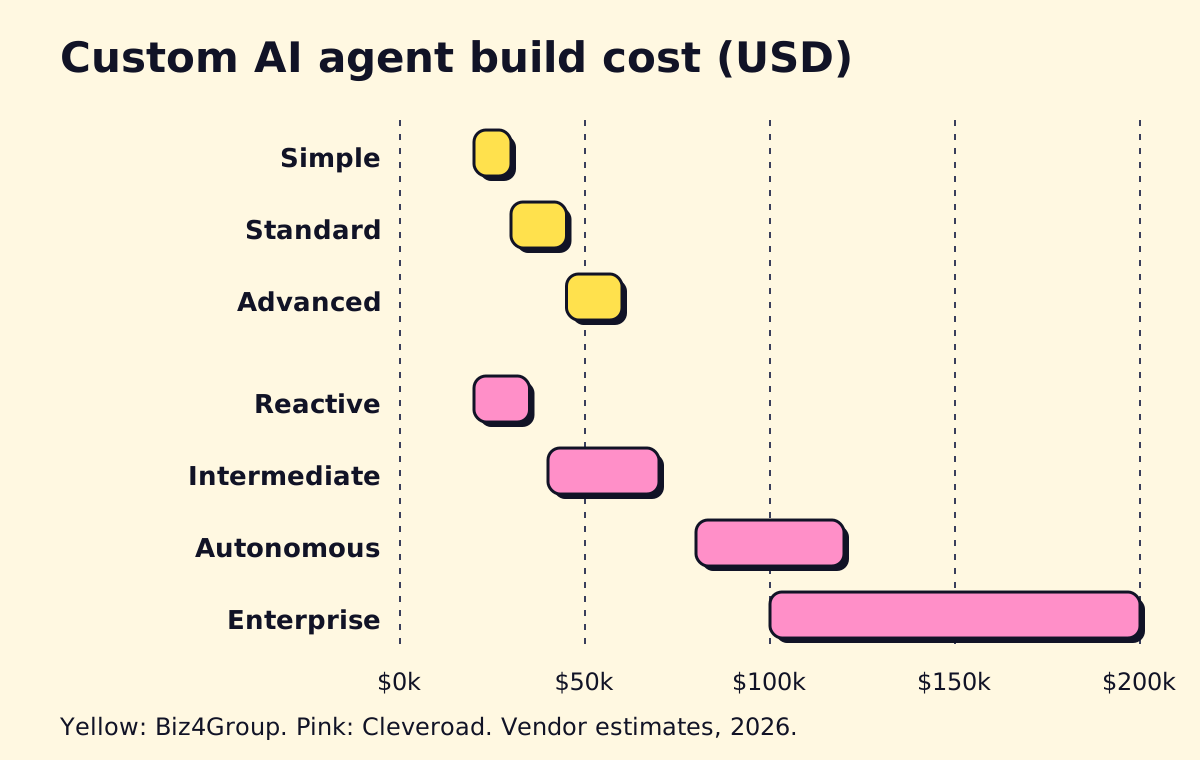 Ranges from Biz4Group and Cleveroad, 2026. Vendor estimates, not quotes.
| Complexity | Biz4Group | Cleveroad |
|---|---|---|
| Simple / reactive | $20,000 to $30,000 | $20,000 to $35,000+ |
| Standard / intermediate | $30,000 to $45,000 | $40,000 to $70,000+ |
| Advanced / autonomous | $45,000 to $60,000 | $80,000 to $120,000 |
| Enterprise / multi-agent | $50,000 to $60,000 (multi-agent) | $100,000 to $200,000+ |
Sources: Biz4Group and Cleveroad, accessed November 2026.
What pushes cost up:
- Number and type of integrations. Modern apps with good APIs are quick; older on-premise software, practice management systems and anything without an API take much longer.
- Channels. Voice agents cost more than chat because of telephony, latency and call-handling edge cases.
- Risk level. Customer-facing and regulated use cases need more testing, guardrails and documentation.
- Custom code vs platform. Building on n8n, Copilot Studio or Zapier is faster and cheaper than a fully custom application, at the price of some flexibility.
Running costs after launch
Every agent has monthly costs on top of the build:
- Model usage: priced per token. As of November 2026, Anthropic lists Claude Haiku 5.5 at $0.10 per million input tokens and Claude Sonnet 5.5 at $2 (Claude pricing). Illustrative example: 1,000 conversations a month at about 5,000 input and 500 output tokens each comes to roughly $15 a month on Sonnet 5.5 ($2 and $10 per million tokens). Agents that loop through many tool calls or load long documents into every step can use ten times that, so ask for an estimate at your volume.
- Platform fees: for example n8n cloud from €20 a month billed annually (n8n pricing) or Copilot Studio at $200 per 25,000 credits.
- Telephony and messaging for voice and SMS agents.
- Maintenance and tuning: Biz4Group estimates 15 to 20% of the initial build cost per year; many agencies sell this as a monthly retainer.
Build vs buy: when custom development is worth it
| Situation | Buy off-the-shelf | Build custom |
|---|---|---|
| Your process is standard (FAQ, basic booking) | Yes | No |
| Your data lives in one platform with built-in AI | Yes, use that platform’s agent | Rarely |
| The agent must use several of your systems | Sometimes | Usually |
| You have unusual rules or pricing logic | No | Yes |
| You handle regulated data | Only with the right agreements | Often |
| Volume is high and per-use fees add up | Compare | Often cheaper long term |
Before paying for custom work, check the agents built into your existing tools. Our best AI agents comparison covers Copilot Studio, Agentforce, Zendesk, n8n, Zapier and others.
AI agents for customer service: the most common project
Customer service is where most businesses start, because the volume is high, the questions repeat and the value is easy to measure. A typical customer service agent:
- Answers calls, chats, WhatsApp or SMS around the clock.
- Resolves routine questions from your knowledge base.
- Books, reschedules and confirms appointments.
- Collects details and creates a ticket or CRM record for anything it cannot resolve.
- Hands off to staff with a summary, so customers don’t repeat themselves.
For the full picture, including off-the-shelf options, see our guides to AI customer service and chatbot development services.
AI agent integration: the part that decides success
An agent that cannot read your calendar or write to your CRM is just a chatbot. Integration work includes:
- APIs and connectors: most cloud apps (HubSpot, QuickBooks, Google Workspace, Microsoft 365, ServiceTitan, Jobber) have APIs the agent can call.
- MCP servers: a growing number of apps publish servers for the open Model Context Protocol, which lets any compatible agent use them without custom code.
- Older systems: when there is no API, developers use database access, file exports, RPA or browser automation. Slower and more fragile, so budget for it.
- Identity and permissions: separate service accounts for each agent, with only the access it needs.
Developers increasingly use AI coding agents (such as Claude Code or OpenAI Codex) to write these integrations faster, for example generating API client code from documentation. That speeds up the work but doesn’t replace testing: ask how integrations are reviewed and tested before they touch live data.
How to choose an AI agent developer
Questions to ask
- Can you show a live agent you built (not a slide deck) and explain what went wrong during that project?
- How will you test it? Look for a real evaluation set and a plan to re-run it after changes.
- What happens when it doesn’t know? You want clear escalation rules and human handoff.
- Who owns what? You should own instructions, workflows, code and test sets, with accounts in your company’s name.
- What will it cost per month to run at our volume? Ask for a written estimate of model, platform and telephony fees.
- What does maintenance include and how fast do you respond when something breaks?
- How do you handle our data? Where is it stored, which model providers see it, and will they sign the agreements we need (for example a HIPAA BAA)?
Red flags
- Guaranteed percentages (“cut costs by 70%”) before they have seen your process.
- No mention of testing, guardrails or human handoff.
- Everything built in their own accounts, with no export plan.
- A quote with no discovery phase.
- Promising full autonomy for customer-facing work on day one.
Freelancer, agency or in-house?
- Freelancer: good value for a small internal agent on a standard platform. Check references and make sure someone else could maintain the work.
- Agency: better for customer-facing agents, multiple integrations or regulated data, where you need testing, documentation and ongoing support.
- In-house: makes sense once you run several agents and AI is core to how you operate. Many companies start with an agency and bring the work in-house later. Our AI strategy consulting guide covers that planning.
What to prepare before you contact a developer
- A short description of the job and why it matters (missed calls, slow lead response, hours of data entry).
- Rough monthly volume: calls, chats, emails or documents.
- A list of the systems involved and who has admin access.
- Ten to twenty real examples of the work, with personal data removed.
- Your must-never-happen list (things the agent must never say or do).
With that in hand, any good developer can give you a realistic estimate in one conversation. opsmigo builds and maintains AI agents for service businesses; if you want a scoped quote, send us the list above.
We build a free demo on your own services and hours.
FAQ
How much does AI agent development cost?
Development firms publish ranges of about $20,000 to $60,000 for a focused custom agent and $100,000 to $200,000+ for enterprise systems (Biz4Group and Cleveroad, 2026). Smaller builds on no-code platforms can cost less, and every agent adds monthly model and platform costs.
How long does it take to develop an AI agent?
Biz4Group estimates 4 to 6 weeks for a simple agent and 10 to 14 weeks for an advanced one. Timelines depend mostly on how many systems the agent must connect to and how much testing the use case needs.
What is AI agent integration?
Integration is connecting the agent to the systems it needs to read from and act in, like your CRM, calendar, phone system or accounting software, through APIs, connectors or MCP servers. It is usually the largest part of a custom agent project.
Should I hire a freelancer or an agency to build an AI agent?
A freelancer can be a good fit for a small internal agent on a standard platform. For customer-facing agents, regulated data or several integrations, an agency gives you testing, documentation and someone accountable for maintenance.
Do I own the AI agent an agency builds for me?
You should. Make sure the contract gives you ownership of the instructions, workflows, code and test sets, and that accounts for platforms and model providers are in your company's name.