- AI strategy consulting gives you a ranked list of AI use cases, a business case for each, a data and risk check, and a 90-day plan to test the best one or two.
- Published 2026 rate guides put independent AI consultants at roughly $150–$350 an hour and small strategy projects at about $5,000–$25,000.
- Most AI projects stall because of a fuzzy problem, missing data or no owner, not because the model is weak. A good consultant fixes those first.
- Small businesses rarely need a big strategy deck. Ask for a short roadmap tied to one or two pilots you can measure within a quarter.
AI strategy consulting is paid help deciding where AI will actually save time or make money in your business, in what order to try it, and how to keep it safe. For a small or mid-sized company, a good engagement ends with a ranked list of use cases, a simple business case for each, and a 90-day plan to pilot one or two of them. Independent consultants typically charge about $150–$350 an hour in 2026, with small strategy projects in the $5,000–$25,000 range (sources below).
This guide covers what you should get for that money, how to judge consultants and firms, and a sample roadmap you can use with or without outside help.
What AI strategy consulting includes
Strip away the jargon and most engagements cover five things.
- Discovery. Interviews and shadowing to see how work really flows: who answers the phone, where quotes get stuck, which reports someone rebuilds every Monday.
- Use-case inventory. A list of 10–30 tasks where AI or automation could help, from answering calls to drafting proposals.
- Prioritization. Each use case scored on value, effort, data readiness and risk, so you know what to try first.
- Data and systems check. Can your CRM, inbox, shared drive and accounting tool feed an AI system? Who owns each one? What can’t leave the building?
- Roadmap and governance. The order of work, budget ranges, who owns each pilot, and basic rules for staff use of AI.
Bigger firms add change management, training programs and vendor selection. Those matter at 500 employees. At 25 employees, they often turn into slideware.
Typical deliverables
| Deliverable | What it should contain | Red flag if… |
|---|---|---|
| Use-case list | Specific tasks with time spent today | It lists “customer experience” instead of tasks |
| Business case | Hours or dollars saved, cost to build and run | It has no baseline numbers |
| Data readiness note | Systems, owners, gaps, privacy limits | It skips who has access to what |
| 90-day roadmap | 1–2 pilots, owners, success metrics | It spans three years with no pilot |
| AI usage policy | What staff may and may not paste into AI tools | There isn’t one |
The last row matters more than people think. Our guide to AI governance and a usage policy template has a version you can adapt.
How much AI strategy consulting costs
Prices vary a lot because “AI consulting” covers everything from a two-hour call with a freelancer to a seven-figure enterprise program. As of November 2026, two published rate guides line up reasonably well:
- Leanware’s 2026 guide lists independent experts at $150–$350 an hour, boutique AI specialists at $250–$450 and Big 4 or strategy firms at $350–$500+. It puts small AI strategy assessments at $5,000–$25,000 and enterprise strategy work at $100,000–$250,000.
- Ryan Doser’s 2026 breakdown lists independents at $150–$350, boutiques at $250–$500 and Big 4 or MBB firms at $500–$1,000+ an hour. It prices a small project or readiness assessment at $5,000–$25,000 and a company-wide strategy and roadmap at $25,000–$75,000.
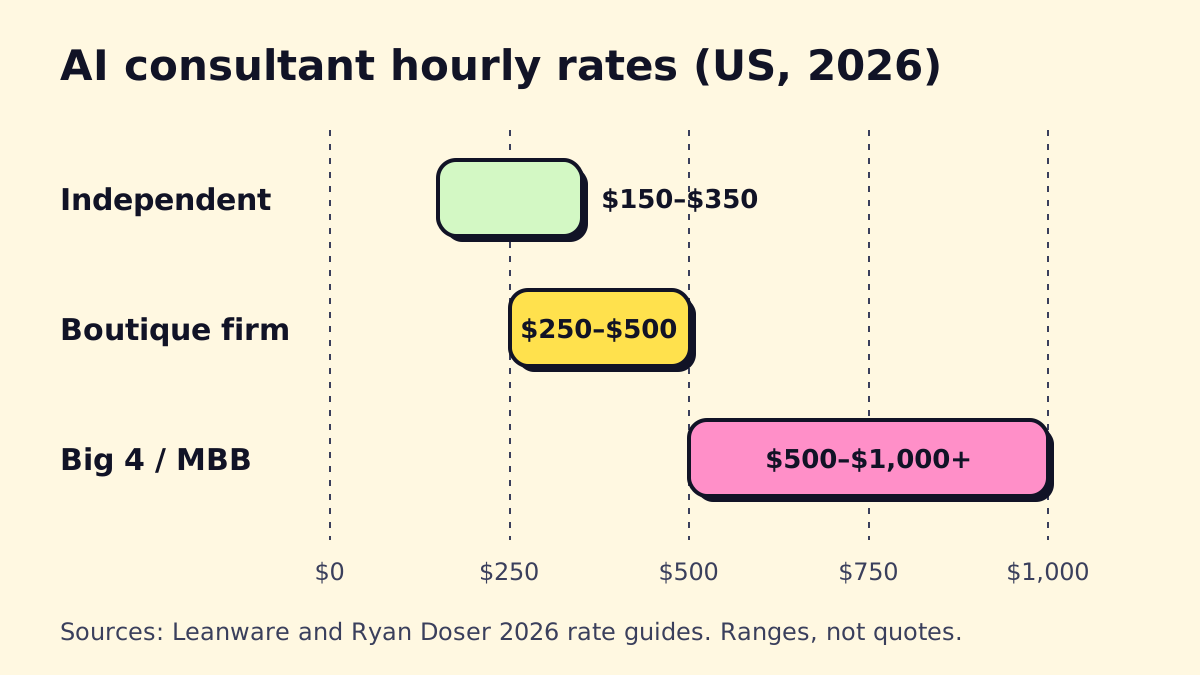 Ranges from two published 2026 rate guides. Your quote will depend on scope and seniority.
Common pricing models
| Model | Typical range (2026 guides) | Good for |
|---|---|---|
| Hourly advice | $150–$350/hr (independent) | Second opinions, vendor reviews |
| Fixed assessment | $5,000–$25,000 | A first roadmap for a small business |
| Strategy + roadmap | $25,000–$75,000 | Multi-location or 50–250 staff |
| Advisory retainer | $2,000–$5,000/month for 5–10 hrs | Ongoing guidance while you build |
Both guides above list advisory retainers of 5–10 hours a month at $2,000–$5,000. Neither price includes building anything. Implementation is usually a separate quote, often from an AI automation agency.
What drives the price up
- Number of departments in scope. One department is a week of discovery; five is a month.
- Data mess. If customer data lives in five spreadsheets and two inboxes, someone has to map it.
- Regulated data. Health, legal and financial records need extra review.
- Deliverable format. A board-ready deck takes far longer than a working document.
AI consulting for small businesses
Small businesses need a different shape of engagement. Your constraint is not budget approval or committee politics. It is the owner’s time and the fact that nobody on staff owns “AI”.
AI adoption is now common enough that waiting has a cost. The US Census Bureau’s business survey found that 19.8% of US businesses were using AI as of May 2026. In Canada, Statistics Canada reported 19.2% of businesses using AI to produce goods or deliver services in Q2 2026, up from 12.2% a year earlier.
What works for a 5–50 person service business:
- A short engagement. Two to four weeks, not three months.
- Tasks, not themes. “Answer after-hours calls and book jobs” beats “improve customer experience”.
- One pilot you can measure. Missed calls, hours spent on data entry, time to send a quote.
- Tools you already pay for. Microsoft 365, Google Workspace, your CRM and an automation tool before anything custom.
- A builder in the room. Someone who can tell you whether the idea takes two days or two months to build.
If you want to see which tasks usually come up first, our AI use cases by industry guide lists them for clinics, contractors, law firms and others.
AI consulting vs. AI/ML consulting
“AI/ML consulting” usually means data science work: training or tuning your own models on your own data, forecasting, computer vision. Most small service businesses don’t need that. They need someone who can apply existing models (ChatGPT, Claude, Copilot, Gemini) to their workflows. Ask which kind a firm actually does before you book a call.
How to evaluate an AI consultant or firm
Lists of “top AI consulting firms” mostly rank large firms that won’t take a 20-person client. A better approach is to sort by tier and then test fit.
| Tier | Who they serve | Strength | Weakness |
|---|---|---|---|
| Big 4 / strategy firms | Enterprises | Scale, change programs | Price, slow, junior staff do the work |
| Boutique AI firms | Mid-market | Depth, hands-on | Varies a lot by firm |
| Independent consultants | SMBs | Price, speed, direct access | Capacity, bus risk |
| Agencies with a strategy phase | SMBs | Strategy and build in one team | May favor what they sell |
Questions to ask before you sign
- What will I have in my hands at the end? Ask to see a redacted sample deliverable.
- Who does the work? The person on the sales call, or someone else?
- How do you pick use cases? Look for a scoring method that includes data readiness and risk.
- What have you built yourself? A consultant who has never shipped an automation will underestimate effort.
- Which tools do you resell or earn commission on? Fine if disclosed, a problem if not.
- How will we measure the pilot? You want a baseline and a target, written down.
- What happens to my data? Ask which AI tools they will paste your documents into.
Red flags
- Promised ROI percentages before they have seen your numbers.
- A roadmap that starts with buying a platform.
- No mention of data access, privacy or a usage policy.
- “AI transformation” language with no named tasks.
Why enterprise AI projects fail (and how strategy prevents it)
The failure numbers get quoted a lot, so it helps to know where they come from.
- A 2024 RAND report, based on interviews with 65 data scientists and engineers, notes estimates that more than 80% of AI projects fail, about twice the rate of IT projects without AI. It names five root causes: the problem is misunderstood, the data isn’t there, teams chase new technology instead of a user problem, the infrastructure can’t support deployment, and the problem is too hard for current AI.
- MIT NANDA’s 2025 study “The GenAI Divide” reported that about 95% of organizations it studied saw no measurable P&L return from generative AI pilots. The sample was limited (interviews, a survey and public deployments), so treat it as a warning sign, not a universal rate. The authors blamed brittle workflows and poor fit with daily work, not model quality.
- Gartner predicted in June 2025 that over 40% of agentic AI projects will be canceled by the end of 2027 because of rising costs and unclear business value.
The common thread: the AI usually works in a demo. The project fails at the boundaries, where it has to fit into real work, real data and real accountability.
Common AI implementation challenges, and the strategy fix
| Challenge | What it looks like | What a good strategy does |
|---|---|---|
| Fuzzy problem | “Use AI in sales” | Names the task, the person and the metric |
| Missing data | Answers live in people’s heads | Picks use cases with data you already have |
| No owner | Pilot drifts after week three | Assigns one owner with time set aside |
| Tool-first thinking | Buys a platform, then looks for uses | Starts from tasks and costs |
| Brittle workflow | Breaks on the first odd case | Plans human review and fallbacks |
| No baseline | Can’t prove it worked | Measures the “before” first |
The business case for AI: a simple template
You don’t need a financial model. For each use case, fill in five numbers:
- Volume. How many times does this happen a month? (Calls, invoices, quotes.)
- Time per item today. In minutes.
- Cost per hour. The loaded cost of the person doing it.
- Share AI can handle. Be conservative: 50–70% for a first version.
- Cost to build and run. One-time build plus monthly tools and maintenance.
Monthly savings = volume × minutes ÷ 60 × hourly cost × share handled. Subtract the monthly running cost, then divide the build cost by what’s left to get your payback in months. Our business process automation guide walks through a full worked example.
Revenue use cases (answering more calls, faster quotes) are harder to estimate. Use your own close rate and average job value, and keep the assumptions visible.
A sample 90-day AI roadmap
Here is a roadmap we would use for a 10–100 person service business. It assumes one owner on your side with about two hours a week.
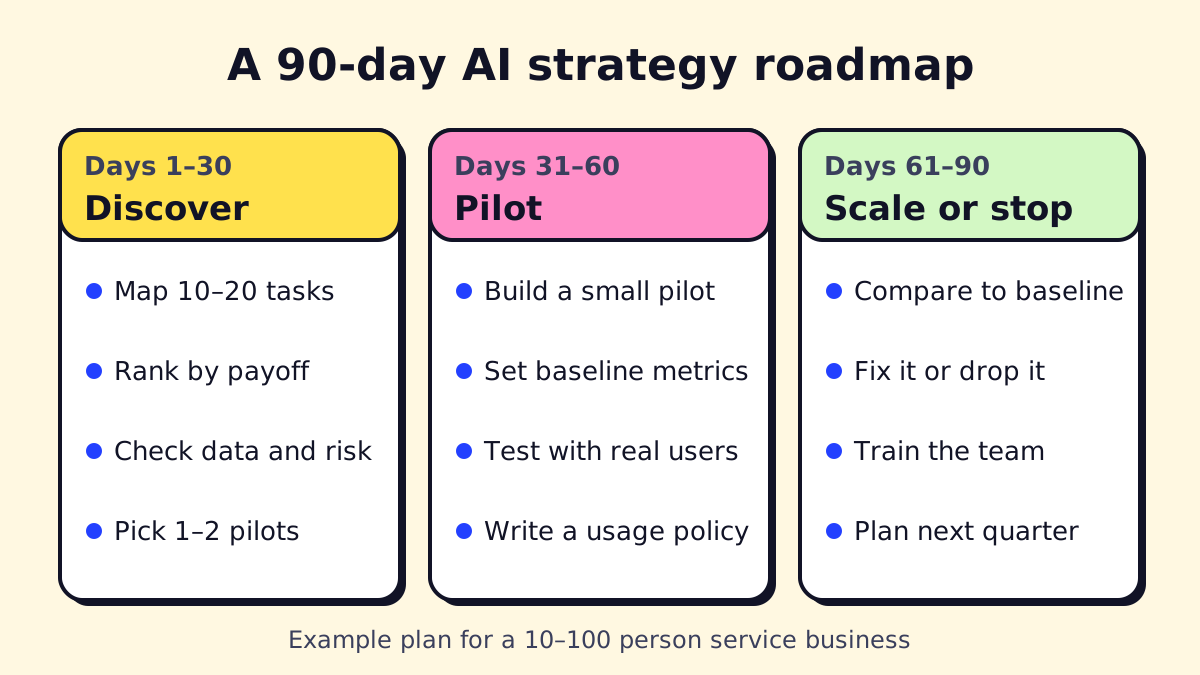
Days 1–30: Discover
- Interview 4–8 people and list 10–20 repetitive tasks with rough volumes.
- Score each on value, effort, data readiness and risk (1–5 each).
- Check which systems hold the data and who controls access.
- Pick one or two pilots. Good first pilots: missed-call handling, intake forms, invoice entry, proposal drafts.
- Publish a one-page AI usage policy so staff know what’s allowed now.
Days 31–60: Pilot
- Measure the baseline for two weeks (calls missed, hours spent, turnaround time).
- Build the smallest version that does the job, usually with an automation tool and an AI model rather than custom software. See our guide to generative AI integration for the options.
- Run it with real users and keep a human in the loop for anything sent to customers.
- Log every error and every “I had to fix this by hand”.
Days 61–90: Scale or stop
- Compare results to the baseline. Decide: expand, fix, or drop.
- Write a short runbook: what it does, who to call when it breaks, what it costs.
- Train the people who use it, in 30 minutes, with their real examples.
- Pick the next one or two use cases for the following quarter.
Stopping a pilot is a good outcome when the numbers say so. It costs far less than scaling something nobody uses.
Roles you may hear about
- AI strategy consultant: decides what to do and in what order.
- AI solutions architect: designs how the systems connect (models, data, security). Often part of a build team.
- Data and AI consultant: focuses on data pipelines, reporting and models.
- AI automation specialist: builds the workflows in tools like n8n, Make, Zapier or Power Automate. Our workflow automation guide explains that layer.
A small business rarely needs all four. One person or firm who can do strategy and build is usually the better deal.
Doing it yourself vs. hiring help
You can run the discovery and scoring steps yourself with the template above. Outside help pays off when you need a builder’s judgment on effort, when data or privacy is tricky, or when nobody internal has the time to own it.
If you’d like a second pair of eyes on your shortlist, opsmigo runs short discovery sessions that end in a ranked list and one pilot we can build with you.
We build a free demo on your own services and hours.
FAQ
How much does an AI consultant charge per hour?
2026 rate guides from Leanware and Ryan Doser put independent AI consultants at about $150–$350 an hour, boutique firms at $250–$500, and Big 4 or top strategy firms at $500 to over $1,000. Treat these as ranges, not quotes.
Is AI consulting worth it for a small business?
It is worth it when the engagement is short, tied to specific tasks in your business, and ends with a pilot you can measure. It is rarely worth paying for a generic 'AI transformation' deck.
What is the difference between an AI consultant and an AI automation agency?
A consultant mainly tells you what to do and in what order. An automation agency mainly builds and maintains the workflows and agents. Many small businesses use one firm that does a short strategy phase and then builds.
Will consulting be replaced by AI?
AI already does parts of consulting work, such as research, first drafts and data analysis. The parts that remain human are understanding how your business actually runs, getting people to change habits and taking responsibility for decisions.
How do I become an AI consultant?
Most working AI consultants combine deep knowledge of one industry or function with hands-on skill in current AI and automation tools. Building real automations for a few businesses, and documenting the results honestly, is the usual way in.