- In almost every industry, the best first AI project is the intake step: claims, orders, inquiries, invoices or requests that arrive all day in the same few formats.
- AI in insurance is strongest in claims intake, policy servicing and document extraction, and about half of US states now expect insurers to have an AI governance program.
- Manufacturing and construction get quick wins from paperwork (invoices, RFIs, takeoffs) before anything on the shop floor or job site.
- Nonprofits and churches can use discounted business AI plans for grants, donor letters and volunteer communication.
AI in insurance, healthcare, manufacturing, retail and other industries looks different on the surface, but the best first project is usually the same: the intake step, where requests, claims, orders or invoices arrive all day in a few predictable formats. AI reads them, asks for anything missing, routes them to the right person and drafts the reply. Below are concrete AI use cases for each industry, with the first project we’d suggest and the rules to watch.
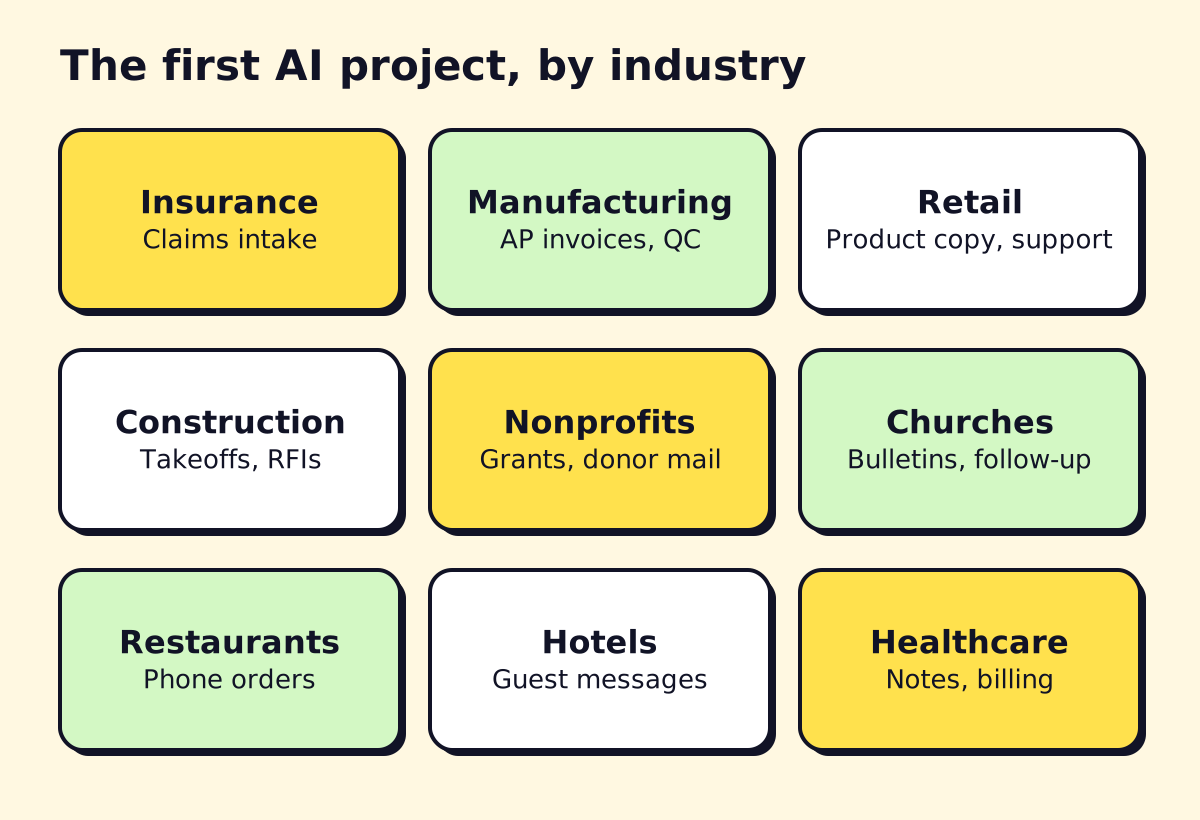 Start where requests pile up. That’s usually intake.
AI in insurance
Insurance runs on documents, forms and phone calls, so AI fits well. Agencies and carriers use it in four main places.
| Use case | What AI does | Who it fits |
|---|---|---|
| First notice of loss (FNOL) | Takes the claim by phone, chat or form 24/7, collects photos and details, opens the claim | Carriers, MGAs, agencies that handle claim intake |
| Quote and application intake | Reads applications, loss runs and ACORD forms, fills the agency system, lists what’s missing | Independent agencies |
| Policy servicing | Answers “is this covered”, certificate requests, address and vehicle changes, payment questions | Agencies and carriers |
| Renewals and cross-sell | Flags renewals coming up, drafts review emails, spots coverage gaps for an agent to discuss | Agencies |
Insurance agency automation is often the quickest win: a certificate-of-insurance request that arrives by email, gets generated from the agency management system and is sent back without anyone touching it, or a renewal sequence that starts 90 days out. Our document automation guide covers the forms side.
AI solutions for insurance companies: the rules
Regulators expect insurers to govern their AI use. The NAIC’s Model Bulletin on the Use of Artificial Intelligence Systems by Insurers asks for a written AI program, testing for unfair discrimination and oversight of third-party vendors. About half of US states had adopted it or similar guidance by mid-2026; the NAIC keeps a current map (NAIC adoption map). Agencies should ask carriers and vendors how their tools comply, and keep coverage and claim decisions with licensed people.
ChatGPT for insurance agents works well for plain-language coverage explanations, email drafts and social content. Don’t paste policyholder personal information into consumer accounts, and never let it state what a specific policy covers without checking the policy.
Healthcare and medical practices
Healthcare has large AI potential and strict privacy rules. The highest-value uses for clinics and practices:
- Front desk and phones. Scheduling, reminders, refills routing and after-hours triage to on-call.
- Clinical documentation. AI medical scribes that draft visit notes from the conversation for the clinician to review.
- AI for medical billing. Eligibility checks, coding suggestions, claim scrubbing and denial follow-up.
- Prior authorizations. Gathering records and drafting requests.
Any vendor that handles protected health information needs a business associate agreement (BAA) under HIPAA (HHS guidance). Our guides to AI agents in healthcare and RPA in healthcare go deeper on clinical and revenue-cycle automation. Healthcare AI consulting usually starts with a workflow map of the front desk and billing office, since that’s where the volume is.
AI for manufacturing
Generative AI for manufacturing gets attention for factory-floor robotics, but small and mid-sized manufacturers usually see faster returns in the office.
| Area | Use case |
|---|---|
| Accounts payable | Invoice capture, three-way matching against purchase orders and receipts, exception routing |
| Quality control | Camera-based defect detection on the line, AI summaries of nonconformance reports |
| Maintenance | Sensor data flagging equipment that’s drifting, AI search across manuals |
| Quoting | Drafting quotes from RFQs, drawings and past jobs for an estimator to price |
| Training | Turning SOPs into step-by-step work instructions and quizzes, in several languages |
AP automation for manufacturing
Manufacturers process many supplier invoices against purchase orders, which makes AP the classic first project. Good AP automation software for manufacturing reads the invoice, matches it to the PO and receiving record, and routes only the mismatches to a person. Look for tools that integrate with your ERP and handle partial shipments and freight charges.
AI for manufacturing quality control
Vision systems that spot defects need good lighting, consistent part presentation and labeled examples of good and bad parts. They work best on high-volume lines with visual defects. Run a pilot on one line and compare against your current inspection rate before rolling out.
Retail and ecommerce
Retail and ecommerce were early adopters. The most common AI use cases:
- Product content. Generative AI for ecommerce product titles, descriptions, alt text and translations, generated from your product data and reviewed before publishing.
- Customer support. A chatbot that answers order-status, return and sizing questions from your store data. See our AI chatbot for ecommerce guide.
- Reviews. Summarizing reviews into product insights and drafting replies.
- Merchandising. Demand forecasting, reorder suggestions and personalized recommendations.
How to automate your ecommerce business
Start with order flow: orders sync to fulfillment, inventory syncs across channels, customers get shipping updates, and returns create tasks automatically. Shopify Flow, WooCommerce plugins and tools like Zapier, Make or n8n handle most of this without custom code.
How much does it cost to automate a warehouse?
There are two very different answers. Software automation (inventory sync, pick lists, label printing, order routing) costs a few hundred dollars a month in subscriptions for a small operation. Physical automation, such as mobile robots, conveyors and automated storage, is a capital project priced by quote. Most small warehouses get more from fixing data flow first.
Construction and contractors
Construction companies spend a lot of time on documents and coordination, which AI handles well.
- Estimating and takeoffs. AI-assisted takeoff software measures quantities from drawings. Using AI for construction estimating this way still needs an estimator’s review, especially on scope gaps.
- RFIs and submittals. Drafting RFIs, summarizing spec sections and tracking responses.
- Daily reports. Turning voice notes and photos from the site into daily logs.
- AI cameras for construction. Site cameras that track progress and flag safety issues such as missing hard hats or people in exclusion zones.
- The office. Answering calls, booking estimates and following up on quotes. Our contractor answering service guide covers the phones.
ChatGPT for construction is useful for scope narratives, bid emails, safety talk outlines and translating instructions for crews. Free AI for construction estimating is a different matter: general chatbots can’t reliably measure drawings, so use them for wording, not quantities.
Nonprofits
ChatGPT for nonprofits covers most of the writing load: grant drafts from your program data, donor thank-you letters, impact reports, volunteer recruitment posts and board meeting summaries.
Discounts help. OpenAI offers eligible nonprofits ChatGPT Business seats at $8 per user per month billed annually or $10 monthly as of November 2026 (OpenAI for Nonprofits), and Google Workspace for Nonprofits includes a no-cost edition. Check eligibility before paying full price.
Useful automations for nonprofits: donation received → receipt and thank-you sent → CRM updated → task for a personal call above a set amount; event sign-up → reminders → post-event survey.
Churches
AI for churches is mostly about communication and administration:
- Turning sermon notes or transcripts into blog posts, devotionals and social posts
- Weekly bulletins and email newsletters
- Volunteer scheduling reminders and sign-up follow-ups
- First-time visitor follow-up sequences
- Translating announcements for multilingual congregations
Keep prayer requests, pastoral care notes and member details out of consumer AI tools. A business plan with clear data rules, or a church management system’s built-in features, is the safer place for that information.
Restaurants and hotels
AI for restaurants starts with the phone. An AI phone assistant answers hours, menu and allergy questions, takes reservations and simple orders during rush periods, and sends staff a summary. Other uses: replying to reviews, writing menu descriptions, and forecasting prep from past sales.
AI for hotels centers on guest messaging: pre-arrival questions, upsells such as early check-in, in-stay requests routed to housekeeping or maintenance, and post-stay review requests. Small hotels and short-term rental operators see the biggest relative gain because they don’t have a 24-hour front desk.
ChatGPT for restaurants handles social posts, menu copy, staff training material and responses to reviews. Have a person read every public reply.
Other industries at a glance
| Industry | First AI project to consider |
|---|---|
| Accounting firms | Document collection and client reminders |
| Law firms | Intake summaries and engagement letters |
| Real estate and property management | Lead response and maintenance triage |
| Education | Enrollment inquiries and parent communication |
| Government and municipalities | Resident request intake and routing |
| IT services | Ticket triage and knowledge-base answers |
| Logistics | Shipment status updates and document extraction (bills of lading, PODs) |
For a tool-by-tool view across all of these, see our AI tools for small business guide.
How to pick your first AI project
Use three questions:
- Where do requests pile up? Calls, emails, forms or documents that arrive daily in similar formats.
- What’s the cost of a mistake? Start where an error is easy to catch and fix, not where it affects someone’s health, money or legal rights.
- Can you measure it? Pick something with a clear number: response time, hours per week, missed calls or invoices processed.
If you’d like a second opinion on where AI fits in your business, opsmigo maps workflows and builds AI agents and automations for small and mid-sized service businesses in all of these industries.
We build a free demo on your own services and hours.
FAQ
How is AI used in insurance?
Insurers and agencies use AI to take first notice of loss, extract data from claim documents and applications, answer policyholder questions, prepare renewals and flag possible fraud for a human adjuster. Final claim and underwriting decisions stay with people in most cases.
What is the best AI for construction estimating?
Dedicated takeoff and estimating software with AI features is more reliable than a general chatbot, because it measures from the drawings. General AI tools help with scope narratives, RFIs and bid emails, but shouldn't produce quantities on their own.
Can churches use ChatGPT?
Yes. Churches use it to turn sermon notes into blog posts and social content, write bulletins, draft volunteer messages and plan events. Keep pastoral care details and member personal information out of consumer AI tools.
How much does it cost to automate a warehouse?
It ranges widely. Software automation (inventory sync, order routing, pick lists) can cost a few hundred dollars a month in subscriptions, while robotics and conveyor systems are capital projects that need vendor quotes.
What is the easiest AI use case for a restaurant?
Answering the phone. An AI phone assistant can take common questions, reservations and simple orders during rush hours, and staff get a written summary.