- AI automation companies build workflows and AI agents that take repetitive work off your team: answering calls, routing leads, entering data, drafting documents.
- Most small-business projects are priced as a one-time build plus a monthly fee. Published 2026 guides cite roughly $3,000–$10,000 per build and $500–$1,500 a month for upkeep.
- Pick an agency that starts from your process, builds in accounts you own, sets up error alerts and writes handover docs.
- Avoid anyone who promises ROI before seeing your numbers or who can't tell you which tools they will use and what they cost.
AI automation companies (often called AI automation agencies) build software workflows and AI agents that take repetitive work off your team: answering and routing calls, qualifying leads, entering invoices, drafting replies and documents. To choose one, look for an agency that starts from how your work runs today, quotes a fixed scope, builds inside accounts you own, and stays on to maintain what it built. Most small-business projects are priced as a one-time build plus a monthly fee.
This guide explains what these companies actually do, how they charge in 2026, and how to tell a good one from a reseller with a slick demo.
What an AI automation agency does
An AI automation agency connects the tools you already use and puts an AI model in the gaps where a person used to read, sort or type. A typical project looks like this:
- Trigger: a call comes in, a form is submitted, an invoice lands in the inbox.
- AI step: the model reads it, pulls out the details, decides what kind of request it is.
- Actions: create the CRM record, book the appointment, send the text, file the PDF, alert a person if something looks off.
The plumbing is usually an automation platform like n8n, Make, Zapier or Power Automate. Our workflow automation guide explains those tools in plain language.
Common services
| Service | Example | Typical tools |
|---|---|---|
| AI phone answering | Answer after-hours calls, book jobs | Voice AI, calendar, CRM |
| Lead handling | Reply to web leads in under a minute | Forms, CRM, SMS, email |
| Document automation | Read invoices, intake forms, contracts | OCR, AI model, accounting app |
| Internal assistants | Answer staff questions from your files | RAG over Drive or SharePoint |
| Custom AI agents | Multi-step tasks across several systems | Agent frameworks, APIs |
| Microsoft 365 / Copilot setup | Rollout, permissions, training | Copilot, Power Automate |
If phones are your bottleneck, see our guide to AI answering services. For agents that act across systems, see AI agent development services.
AI automation company vs. consultant vs. software vendor
- Consultant: tells you what to do and in what order. Our AI strategy consulting guide covers that side.
- Software vendor: sells one product (an AI receptionist, a chatbot) that you configure.
- Automation agency: builds a system from several tools around your process and usually maintains it.
Many small businesses do best with an agency that runs a short discovery phase, then builds.
How AI automation agencies price their work
There is no standard price list, and most agencies don’t publish one. As of November 2026, two published guides give similar ranges:
- IdeaProof’s AI automation agency guide lists setup fees of $3,000–$8,000 plus $500–$1,500 a month for home services and real estate, and $6,000–$20,000 plus $1,500–$3,000 a month for professional services.
- Aibrify’s October 2026 cost roundup cites $3,000–$5,000 for a single-process agency build, $5,000–$10,000 for a multi-step workflow, and agency retainers of $500–$1,500 a month.
Software fees (automation platform, AI model usage, phone numbers) are usually extra and billed to you directly. Ask for an estimate of those as a separate line.
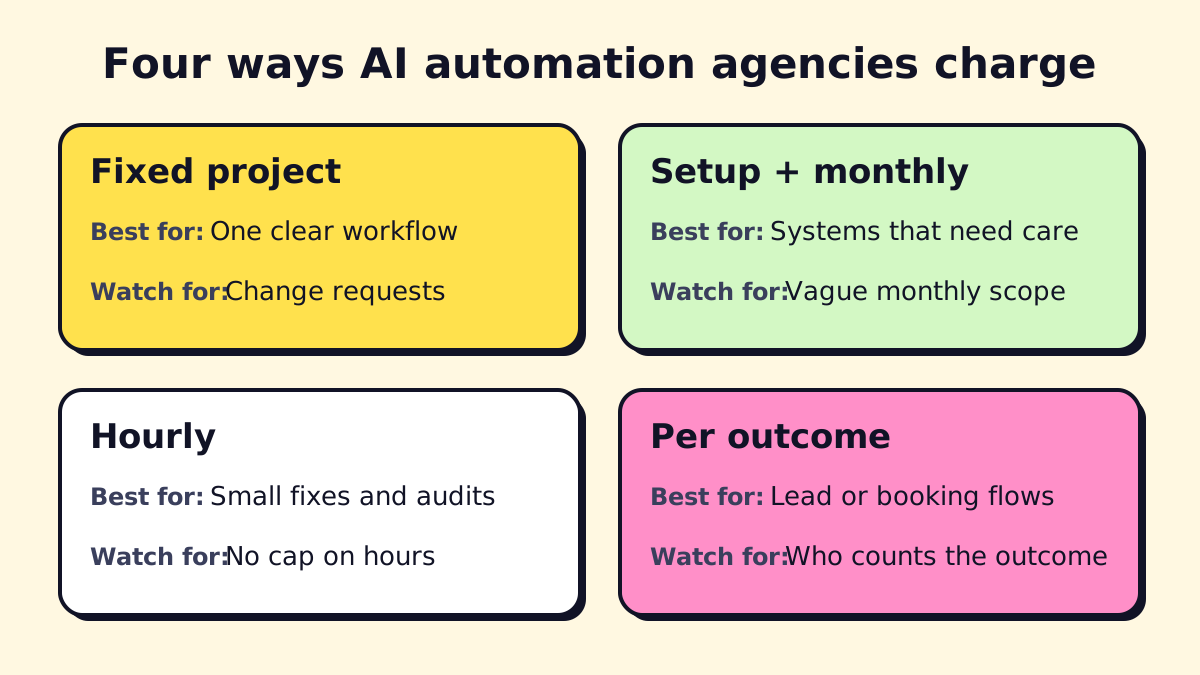
Pricing models compared
| Model | How it works | Good when | Watch for |
|---|---|---|---|
| Fixed project | One price for a defined scope | The workflow is clear | Change requests billed separately |
| Setup + monthly | Build fee, then a retainer | It touches customers and needs care | A retainer with no defined scope |
| Hourly | Pay for time | Small fixes, audits | No cap on hours |
| Per outcome | Fee per booked call or lead | Lead and booking flows | How outcomes are counted |
For most service businesses, setup plus a modest monthly fee is the most honest model. Automations break when a vendor changes an API, a form gets a new field, or your process changes. Someone has to watch them.
How to choose among AI automation companies
Step 1: Write down the job before you talk to anyone
One paragraph per task: what triggers it, who does it now, how long it takes, how often it happens, and what “done” looks like. This keeps sales calls on your problem instead of their demo.
Step 2: Shortlist 3 agencies that fit your size and industry
An agency that builds for clinics will know about patient privacy. One that builds for contractors will know your field-service software. Industry experience saves you from paying for their learning curve.
Step 3: Ask the right questions
- What would you build first, and why? A good answer picks one high-volume task, not five.
- Which tools will you use, and what will they cost me each month? You should get names and numbers.
- Whose accounts will it run in? Yours. If they leave, you keep everything.
- What happens when it breaks? Look for error alerts, logs and a response time.
- Where does a human step in? Anything customer-facing needs a fallback to a person.
- What data will the AI see, and where is it processed? Ask about model providers and data retention.
- Can I see something similar you’ve built? A screen share of a live workflow beats a case-study PDF.
- What do I get at handover? Documentation, credentials, a short training session.
Step 4: Compare proposals line by line
| Check | Proposal A | Proposal B |
|---|---|---|
| Scope written as tasks and outcomes | ||
| Monthly software costs listed | ||
| Built in your accounts | ||
| Error alerts and logging | ||
| Human fallback defined | ||
| Handover docs included | ||
| Exit terms |
Step 5: Start with a paid pilot
A two-to-six-week pilot on one workflow tells you more than any reference call. Agree on the baseline metric up front (missed calls, hours of data entry, response time).
What a good engagement looks like
Agencies differ in process, but a well-run small-business project usually follows this rhythm.
| Phase | Typical length | What you should see |
|---|---|---|
| Discovery | 1–2 calls, a few days | Process map, baseline numbers, written scope |
| Build | 1–4 weeks | Regular demos using your real examples |
| Test | 1–2 weeks | Edge cases tried, errors logged and fixed |
| Launch | A day | Switch-on with a person watching outputs |
| Hypercare | 2–4 weeks | Faster response to issues, tuning |
| Maintenance | Ongoing | Monitoring, monthly check-in, small changes |
Your side of the work is smaller but real: a named owner, access to the tools, 30–60 minutes a week for questions and testing, and examples of real cases (anonymized where needed). Projects stall most often because the client can’t find time to test, not because the build is hard.
What “done” should mean
Agree on this in writing before the build starts:
- The workflow handles a defined share of cases (for example, 80% of inbound leads) without manual work.
- Everything else lands with a person, with context, within a set time.
- Failures trigger an alert to a named person.
- You have a document explaining what it does, where it runs and how to pause it.
What AI automation is good at (and not)
AI automation is strong at reading, sorting and drafting: turning a voicemail into a job ticket, an invoice PDF into accounting entries, a vague web inquiry into a qualified lead. It is weaker at anything that needs exact math, negotiation, or judgment where a mistake is costly. A good agency will push back on those and suggest a human-in-the-loop design instead.
Red flags and green flags
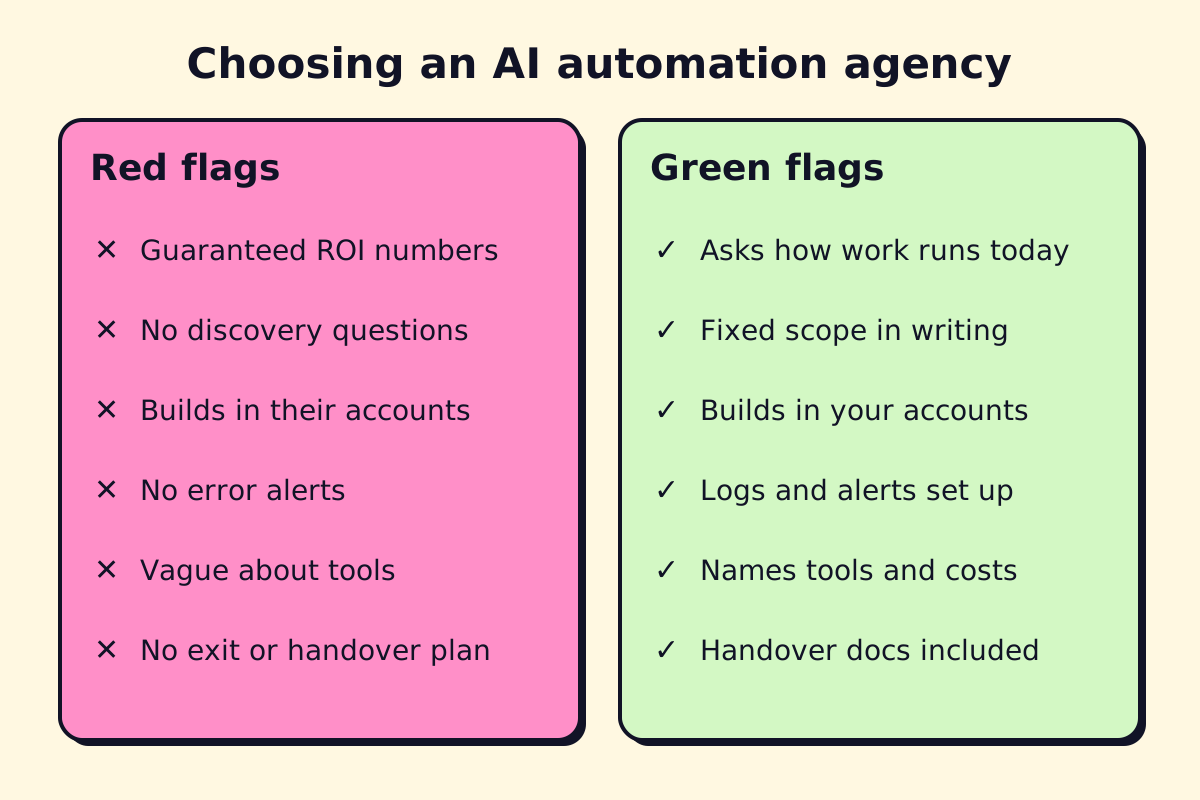
Red flags
- Guaranteed ROI or “save 40 hours a week” before seeing your numbers.
- No discovery questions; they jump straight to a demo.
- They build in their own accounts and “host it for you” with no export plan.
- No mention of error handling, logs or alerts.
- Vague answers about which AI model or platform they use.
- Long contracts with no exit or handover clause.
Green flags
- They ask how the work happens today, including the messy exceptions.
- Scope is written down as tasks with a measurable outcome.
- Everything runs in accounts you own, with their access as a user you can remove.
- Logs, alerts and a named person who responds.
- They tell you when a task isn’t worth automating.
Bespoke vs. no-code AI solutions
Most AI solutions for small business are built on no-code or low-code platforms with some custom code where needed. That keeps costs down and means another agency can take over later.
Fully bespoke builds (custom apps, self-hosted models, private AI) make sense when you have strict data rules, very high volume, or a workflow no platform supports. They cost more to build and maintain. “Private AI solutions” can also mean simpler things: using an AI provider’s business tier that doesn’t train on your data, or running n8n on your own server. Our generative AI integration guide explains those options.
| Approach | Build cost | Who can maintain it | Best for |
|---|---|---|---|
| No-code (Zapier, Make) | Low | Many people | Simple, low-volume flows |
| Low-code (n8n, Power Automate) | Medium | Technical generalists | Most SMB automations |
| Custom code | High | Developers | Unusual or high-volume needs |
AI automation for specific business types
- Clinics and dental offices: intake forms, appointment reminders, after-hours call handling. Privacy rules apply.
- Contractors and HVAC: missed-call text-back, job booking, quote follow-up.
- Law and accounting firms: document intake, client onboarding, deadline reminders.
- Property managers: maintenance requests, tenant FAQs, vendor dispatch.
- E-commerce and Shopify stores: order status replies, returns, inventory alerts.
Our guide to business process automation has more examples by department, plus a way to estimate ROI before you buy.
The AI agency business model, from the buyer’s side
Knowing how agencies make money helps you negotiate. Most earn from setup fees and recurring retainers. Some also earn referral commissions from software vendors. That’s normal, but it should be disclosed, because it can tilt recommendations toward one platform.
Many new agencies have launched since 2024, often after an online course. Some are excellent. Ask how long they have been building, and for what kinds of clients, without expecting a decade-long track record.
If you’re weighing options for your own business, opsmigo is happy to look at your task list and tell you honestly which items are worth automating first.
We build a free demo on your own services and hours.
FAQ
What is an AI automation agency?
An AI automation agency is a company that designs, builds and maintains automated workflows and AI agents for other businesses. Typical projects connect your phone, inbox, CRM and accounting tools, with an AI model handling the reading, sorting and drafting in between.
How much does an AI automation agency cost?
Published 2026 guides from Aibrify and IdeaProof put most small-business builds at about $3,000–$10,000, with monthly retainers around $500–$1,500. Simple single workflows can cost less and multi-system projects more.
What is AI automation?
AI automation is software that completes a task end to end, using an AI model for the steps that need judgment, such as reading an email, classifying a request or writing a reply. Classic automation follows fixed rules; AI automation can handle messy, unstructured inputs.
Should I use an agency or build automations myself?
If you have one or two simple workflows and someone who enjoys tools like Zapier, build them yourself. Hire help when the workflow touches customers, sensitive data or several systems, or when nobody has time to maintain it.
How do I start an AI automation agency?
Pick one industry, learn its daily workflows deeply, and get good at one stack such as n8n or Make plus an AI model. Build a few honest, measured projects before scaling, and price per outcome or per build, not per hour.