- An AI agent is software that takes a goal, decides its own next steps and uses tools (calendar, CRM, email) to get the job done, checking its work as it goes.
- Textbooks list five types of AI agents (simple reflex, model-based, goal-based, utility-based, learning). In business you will meet assistants, task agents, workflow agents and multi-agent systems.
- A chatbot answers. Automation follows fixed steps. An agent chooses the steps. Agentic AI means several agents and tools working together toward a bigger goal.
- Start with one narrow, repetitive job with clear rules and a human approval step. Broad 'do everything' agents are where most projects fail.
An AI agent is software that takes a goal, decides its own next steps and uses tools such as your calendar, CRM or email to get it done, checking the results as it goes. The main types of AI agents are the five classic ones from AI textbooks (simple reflex, model-based, goal-based, utility-based and learning agents) and, in day-to-day business, assistants, task agents, workflow agents and multi-agent systems.
This guide explains each type in plain language, shows how agents differ from chatbots, automation and “agentic AI”, and walks through use cases and real products you can try. It is written for owners and managers of service businesses who want to know what is real and what is marketing.
What is an AI agent?
The simplest definition of an AI agent: a system that perceives its situation, decides what to do and acts to reach a goal. That definition is decades old. What changed in the last few years is the “decides” part. Large language models (LLMs) can now read a messy email, figure out what the customer wants and choose which tool to use next.
A useful test comes from Anthropic’s engineering guide, Building effective agents. It separates workflows, where code follows a path you designed, from agents, where the model directs its own process and tool use. If a person or a fixed script decides every step, it is a workflow. If the model decides, it is an agent.
Here is what that looks like in a plumbing company:
- Workflow: a web form arrives, Zapier copies it into the CRM and sends a fixed text message.
- Agent: a customer texts “water under the sink again, can someone come Thursday?” The agent reads it, finds the customer record, checks Thursday’s open slots, offers two times, books the one the customer picks and logs a note for the technician.
How AI agents work
Every agent runs some version of the same loop.
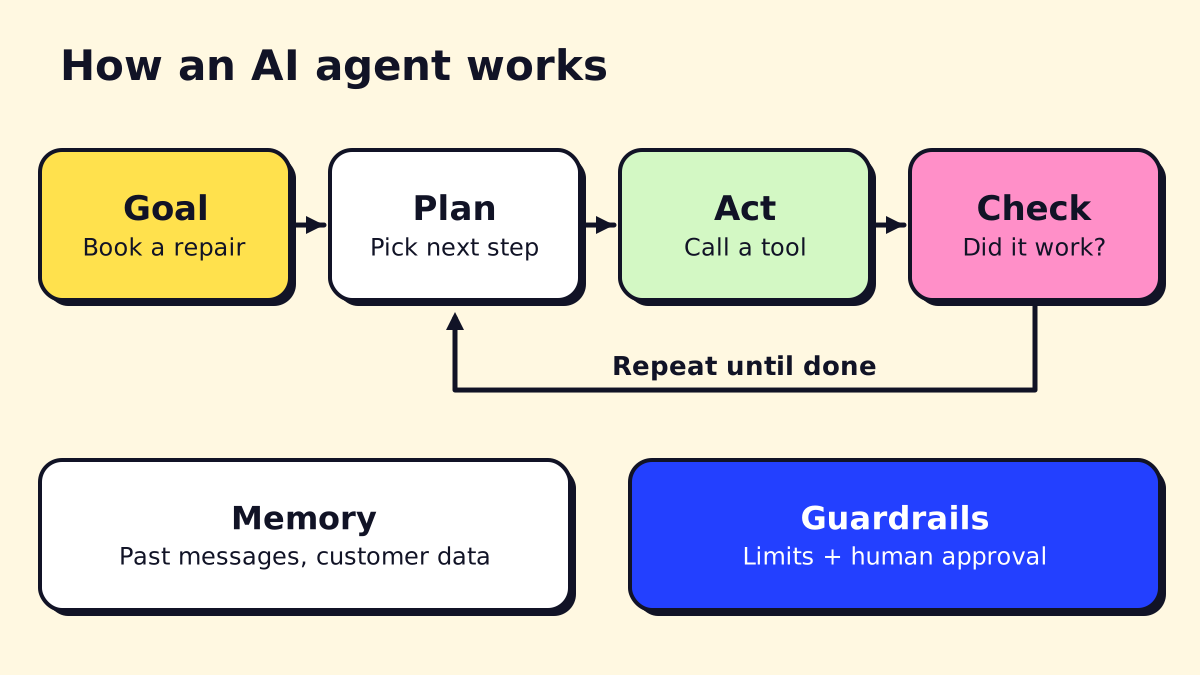 The agent loop: plan, act, check, repeat.
- Goal. A trigger gives the agent a job: a call, a chat message, an email, a new row in a spreadsheet.
- Plan. The model reads its instructions and the context and picks the next step.
- Act. It calls a tool: look up a customer, check a calendar, draft a reply, create an invoice.
- Check. It reads the tool’s result and decides whether the job is done, needs another step or needs a human.
Around that loop sit two things that matter as much as the model. Memory holds the conversation and facts the agent needs (customer history, your price list). Guardrails limit what it can do: which tools it may use, what needs human approval, what it must never say. We cover these parts in depth in our guide to AI agent architecture.
Autonomous AI agents: how much autonomy is real?
“Autonomous AI agents” sounds like software that runs your business while you sleep. In practice autonomy is a dial, not a switch, and most useful business agents sit in the middle.
| Autonomy level | What the agent does alone | Example |
|---|---|---|
| Suggests | Drafts, a human sends | Drafts replies to client emails for review |
| Acts within limits | Takes low-risk actions, escalates the rest | Books appointments, hands billing disputes to staff |
| Acts broadly | Plans and runs multi-step jobs with few checks | Researches leads, writes and sends outreach |
General-purpose autonomous agents exist. Manus, which Meta acquired at the end of 2025 (TechRadar), and OpenAI’s agent mode in ChatGPT can browse websites, fill in forms and produce reports with little input. They are impressive for research and one-off tasks. For customer-facing work, where a wrong answer costs you a client, we recommend the “acts within limits” level with clear escalation rules.
Gartner gives the reason for caution: it predicts that over 40% of agentic AI projects will be canceled by the end of 2027 because of rising costs, unclear business value or weak risk controls. It also warns about “agent washing”, where vendors rebrand ordinary chatbots and automation as agents.
Types of AI agents
There are two ways to sort agents. Computer science textbooks group them by how they decide. Businesses group them by the job they do. Both are useful.
The five classic types of AI agents
These come from the standard AI textbook by Stuart Russell and Peter Norvig, and IBM’s overview of AI agent types uses the same list.
| Type | How it decides | Everyday example |
|---|---|---|
| Simple reflex agent | If X happens, do Y. No memory. | A thermostat, a keyword auto-reply |
| Model-based reflex agent | Keeps an internal picture of the world | A robot vacuum that remembers which rooms it cleaned |
| Goal-based agent | Picks actions that move toward a goal | A route planner finding the way to an address |
| Utility-based agent | Picks the best option by scoring trade-offs | A scheduler balancing travel time, urgency and technician skills |
| Learning agent | Improves from feedback over time | A spam filter that learns from what you mark as spam |
LLM-based business agents are mostly goal-based agents with some utility-based behaviour (choosing the “best” slot or reply). They do not usually learn on their own after launch; they improve when someone updates their instructions, knowledge or examples.
Practical types of AI agents for business
When you shop for an agent or talk to a developer, you will hear these categories instead:
- AI assistants and copilots. Help one person inside their tools: Microsoft 365 Copilot drafting a proposal in Word, Claude summarising a contract. The human stays in charge of every step.
- Customer-facing agents. Answer calls, chats, WhatsApp or SMS, book appointments and qualify leads. An AI receptionist is the most common example (see our guide to AI customer service).
- Task agents. Do one back-office job end to end: process invoices, chase unpaid bills, update the CRM after every call.
- Workflow agents. Sit inside an automation platform like n8n, Make or Zapier and make decisions at specific steps, such as classifying an email before it gets routed.
- Research and browser agents. Browse the web and use websites like a person would. Useful for lead research and competitor checks, slower and less predictable for daily operations.
- Coding agents. Write and change software. Claude Code and OpenAI Codex are the best-known.
- Multi-agent systems. Several specialised agents coordinated by an “orchestrator” agent, for example intake, scheduling and billing agents sharing one customer conversation.
AI agents vs agentic AI vs chatbots vs automation
These four terms get mixed up constantly. The easiest way to separate them is by who decides the next step.
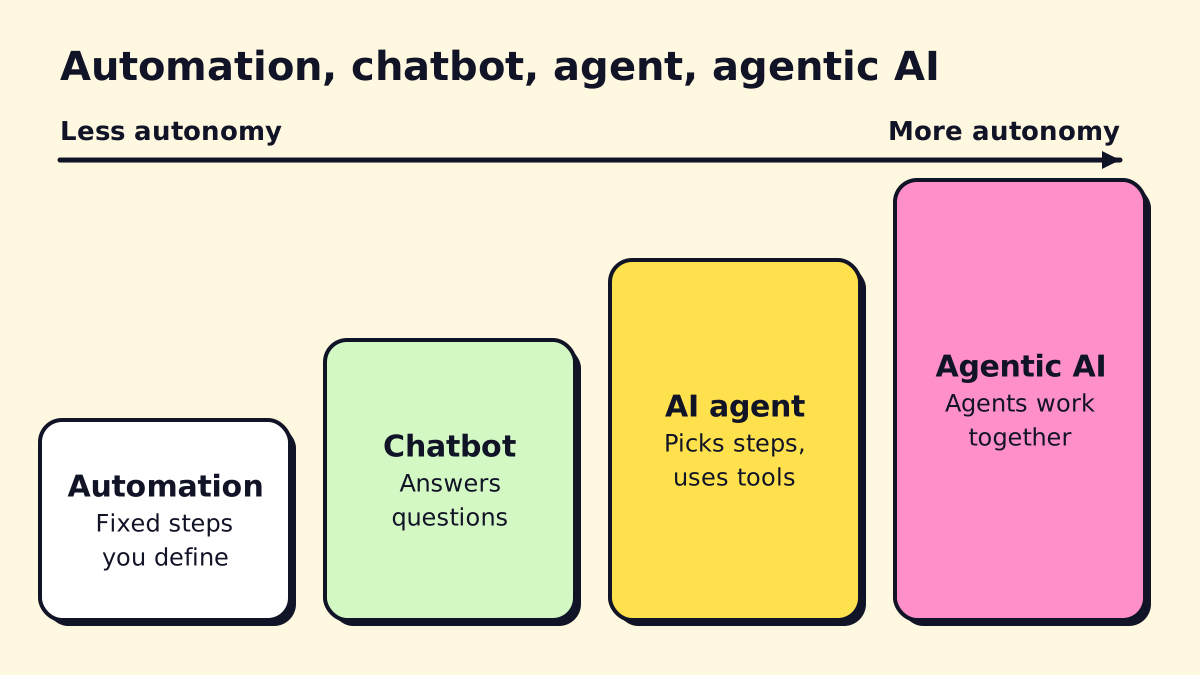 More autonomy means more capability and more need for guardrails.
| Who decides the steps | Takes actions? | Best for | |
|---|---|---|---|
| Rule-based automation | You, in advance | Yes, fixed ones | Predictable, repeated processes |
| Chatbot | Script or model, per message | Rarely | Answering FAQs |
| AI agent | The model, within limits | Yes, through tools | Jobs with variety and judgment |
| Agentic AI | Several agents plus an orchestrator | Yes, across systems | Larger multi-step processes |
AI agents vs agentic AI
This is the comparison people search for most. An AI agent is a thing; agentic AI is an approach. One AI agent might book appointments. An agentic AI system might take a new client from first enquiry to signed contract: one agent qualifies the lead, another prepares a quote, a third schedules the kickoff, and an orchestrator keeps track. Agentic systems are more powerful and also harder to test, cost more to run and fail in more ways.
AI agent vs AI assistant
An AI assistant responds to you: you ask, it answers or drafts, you decide what to do. An agent acts for you: you give it a goal and it takes the steps. The line is blurry because assistants keep gaining agent features. ChatGPT, Claude and Copilot all now take actions in connected apps when you let them.
AI agent vs LLM
An LLM is the language engine (GPT, Claude, Gemini, Llama). On its own it only produces text. An agent is the LLM plus instructions, memory, tools and a loop. Same engine, different car.
AI agents vs automation
Classic automation (and its older cousin, robotic process automation) is cheaper and more predictable when every case looks the same. Agents earn their cost when inputs vary: free-text emails, phone calls, scanned documents. Many good systems combine both, with workflow automation doing the fixed steps and an agent handling the judgment calls.
AI agent use cases for service businesses
These are the use cases where we see agents pay off for small and mid-sized businesses, sorted by department.
Customer service and front desk
- Answer calls and chats 24/7, book and reschedule appointments, take messages with full details.
- An AI support agent that resolves common questions (hours, pricing, order status) and passes the rest to staff with a summary. Helpdesks sell this built in: Zendesk AI agents charge $1.50 per automated resolution on a committed plan or $2.00 pay-as-you-go, with 5 to 10 resolutions per agent included each month (as of November 2026).
Sales and lead handling
- Reply to new leads within a minute, ask qualifying questions, book a call.
- Enrich leads with company data and draft personalised follow-ups. More in our guide to AI for sales and lead generation.
HR
- AI agents for HR answer policy questions (“how many vacation days do I have left?”), screen applications against must-have criteria, schedule interviews and run onboarding checklists. Keep humans on hiring decisions; see AI for HR for the legal side.
Finance and admin
- Read invoices and receipts, match them to purchase orders, chase late payments with polite reminders, prepare month-end summaries.
Industry examples
- Insurance agencies: collect quote details by chat, pre-fill carrier forms, send renewal reminders. ChatGPT is also handy for insurance and real estate agents as an assistant for drafting emails and listing descriptions.
- Clinics and dental offices: booking, intake forms and reminders, with HIPAA rules applied. See AI agents in healthcare.
- Property managers: triage maintenance requests, dispatch vendors, answer tenant questions.
AI agents in action: real examples you can try
Most businesses do not need to build from scratch. These are well-known agents and agent platforms as of November 2026. Our comparison of the best AI agents covers prices and trade-offs.
- Claude AI agents. Anthropic’s Claude can act as an agent in several forms: Claude Cowork for desktop work, Claude Code for software, and the Claude Agent SDK for developers who want to build their own.
- OpenAI agents. ChatGPT’s agent mode and workspace agents for business teams, plus the open-source OpenAI Agents SDK for developers.
- Microsoft Copilot Studio. Build agents that work inside Microsoft 365, Teams and Dynamics.
- Salesforce Agentforce, ServiceNow AI Agents and Zendesk AI agents. Agents built into the platforms many companies already run.
- n8n, Make and Zapier. Automation platforms with AI agent steps, good for connecting many small-business apps.
Free AI agents: what you can use without paying
If you want to experiment before spending money, these options are free (as of November 2026):
- Zapier Agents has a free plan with 400 activities per month (Zapier Agents pricing).
- n8n Community Edition is free to self-host on your own server; you pay only for hosting and model usage.
- OpenAI Agents SDK and Claude Agent SDK are free open-source libraries. You pay per use for the model behind them.
- The free tiers of ChatGPT, Claude and Gemini let you test prompts and simple agent behaviour before building anything.
Free is fine for testing. For anything touching customer data, check where data is stored, who can see it and whether the vendor will sign the agreements your industry needs.
Risks and limits to know before you deploy
- Wrong answers said confidently. Give the agent your real price list and policies, and tell it to escalate when it does not know.
- Too much access. AI agent authentication and permissions matter: give each agent its own account with only the access it needs, never an owner’s login. A booking agent does not need to issue refunds.
- Invisible failures. Without logs you will not know the agent told 30 callers the wrong hours. Teams use agent observability tools (tracing, transcripts, alerts) to review what the agent did and why.
- Cost creep. Agents that loop many times per task use more model tokens. Set limits and review the bill monthly.
- Compliance. Health, legal and financial data come with rules (HIPAA, privacy laws, record keeping). Read our guide to AI governance and responsible AI before rolling out.
How to get started with AI agents
- Pick one job that is repetitive, rule-based and costs you real time or lost leads (missed calls are the classic one).
- Write down the rules a new employee would need: what to say, what to never say, when to hand off.
- Try an off-the-shelf option first in the tools you already pay for.
- Build or hire when off-the-shelf tools cannot connect to your systems or follow your process. Our step-by-step guide on how to build an AI agent covers both no-code and code routes, and our AI agent development services guide explains costs if you would rather hire.
If you want a second opinion on which job to hand to an agent first, opsmigo can map your processes and tell you honestly whether an agent, plain automation or nothing at all is the right fit.
We build a free demo on your own services and hours.
FAQ
What is the definition of an AI agent?
An AI agent is a software system that pursues a goal on someone's behalf: it reads its situation, decides what to do next, takes actions with tools such as apps and APIs, and adjusts based on the results. Most modern agents use a large language model to do the deciding.
What is the difference between an AI agent and agentic AI?
An AI agent is one system doing one job, like booking appointments. Agentic AI is the broader approach where one or more agents plan multi-step work, coordinate with each other and act with little supervision. Every agentic AI system contains agents, but a single agent is not a full agentic system.
Is ChatGPT an AI agent?
Plain ChatGPT chat is an AI assistant: it answers when asked. When it browses, runs code or takes actions in connected apps to finish a task, it is acting as an agent. The same model can power both.
Are there free AI agents?
Yes, with limits. Zapier Agents has a free plan with 400 activities a month, n8n's Community Edition is free to self-host, and the OpenAI Agents SDK and Claude Agent SDK are free open-source code (you pay only for model usage).
What is an AI agent vs an LLM?
An LLM (large language model) is the brain that reads and writes text. An agent wraps that model with instructions, memory, tools and a loop that lets it act, check results and try again. The LLM alone cannot send an email or update your CRM.
Can AI agents replace employees?
They can take over repetitive, rule-based parts of jobs, like answering routine questions, booking, data entry and follow-ups. They still need people to set rules, handle exceptions and approve anything risky.