- Most small businesses need four AI marketing tools at most: a writing assistant, a design tool, an email platform with built-in AI, and a social scheduler.
- The free tiers of ChatGPT, Claude, Canva, Mailchimp, Klaviyo and Buffer are enough to test a full workflow before paying.
- AI copy sounds generic when you give it generic input. Feed it your customer questions, reviews and past winners, and keep a person editing.
- Fake AI reviews and testimonials are illegal under the FTC's 2024 rule, and email still has to follow CAN-SPAM in the US and CASL in Canada.
The AI marketing tools that matter for a small business fit into four jobs: a writing assistant for strategy and copy (ChatGPT, Claude or Gemini), a design tool with AI features (Canva or Adobe Express), an email and CRM platform with built-in AI (HubSpot, Mailchimp or Klaviyo), and a social scheduler (Buffer or Meta Business Suite). Add automation glue such as Zapier or n8n when you need these to talk to each other. You can test all of it on free plans before paying.
This guide covers the best AI tools for marketing by job, free options, ChatGPT prompts for marketing, how to use AI for email, content and social media, and what to ask an AI marketing agency.
AI marketing tools by job
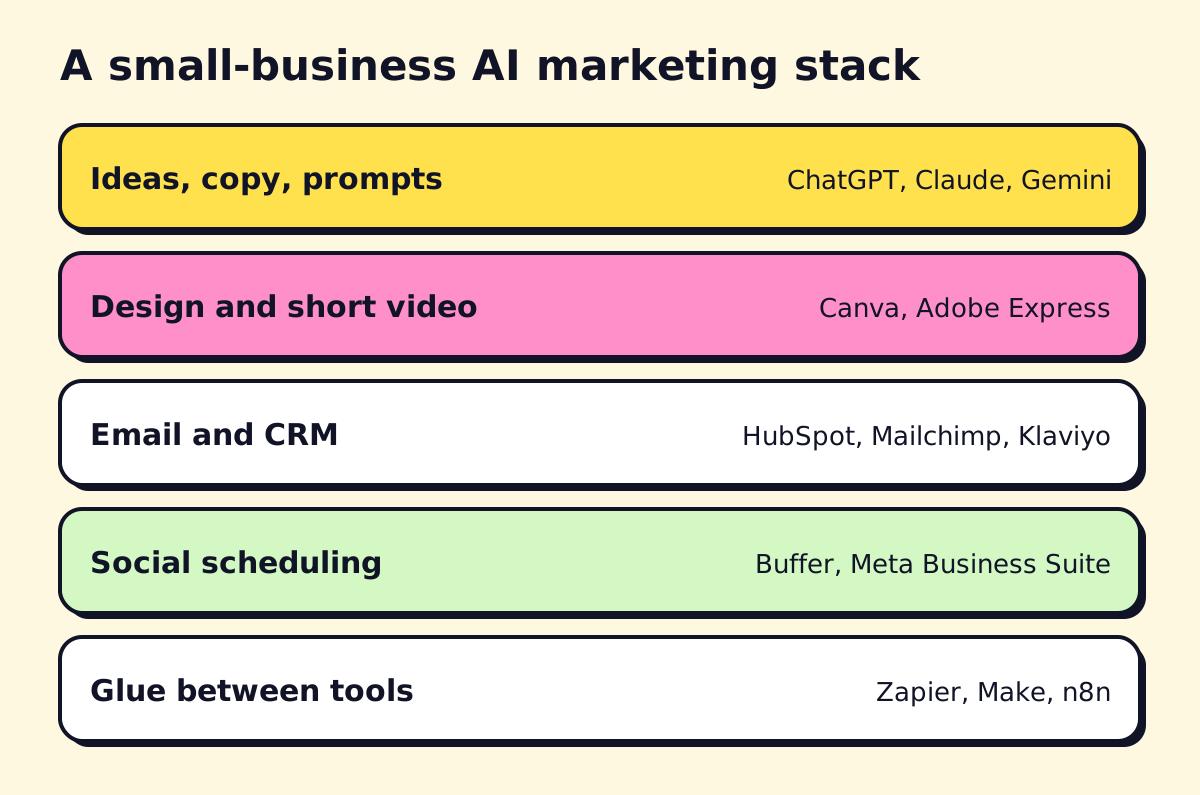 Pick one tool per layer. Most businesses don’t need more.
| Job | Tools | Free option | Paid entry point (Nov 2026) |
|---|---|---|---|
| Strategy, copy, prompts | ChatGPT, Claude, Gemini | Free tiers of all three | ChatGPT Plus $20/mo (OpenAI); Claude Pro $20/mo or $17/mo annually (Claude) |
| Design and short video | Canva, Adobe Express | Canva Free | Canva Pro (check current price on Canva) |
| Email and CRM | HubSpot, Mailchimp, Klaviyo | Mailchimp Free (250 contacts); Klaviyo Free (250 profiles, 500 sends/mo) | HubSpot Marketing Hub Starter, listed at $20 per seat/mo (HubSpot) |
| Social scheduling | Buffer, Meta Business Suite | Buffer Free (3 channels) | Buffer Essentials $5 per channel/mo (Buffer) |
| Glue between tools | Zapier, Make, n8n | Free tiers | Zapier Professional $29.99/mo billed monthly (Zapier) |
Free plan limits are from each vendor’s pricing page: Mailchimp and Klaviyo.
Best AI tools for marketing, by business type
- Local service business (clinic, contractor, salon): ChatGPT or Claude, Canva, your booking or CRM tool’s email, Google Business Profile. Spend your effort on reviews and fast replies.
- Ecommerce: Klaviyo or Shopify Email for flows, an AI assistant for product content, Canva for ads. See our AI chatbot for ecommerce guide for support.
- B2B or professional services: HubSpot (CRM plus email), an AI assistant for content, LinkedIn. Pair with AI for sales and lead generation.
Free AI tools for marketing
You can run a complete small-business marketing workflow at no cost while you learn what works:
- ChatGPT, Claude or Gemini (free) for ideas, outlines and drafts.
- Canva Free for social graphics and simple video, with its AI writing and image features.
- Mailchimp or Klaviyo Free for a newsletter to a small list.
- Buffer Free to schedule posts on up to three channels.
- Google Business Profile for local posts and reviews.
The limits show up quickly: small contact caps, no automated flows on some free email plans, and usage caps on free AI. Upgrade the tool that’s limiting you, not all of them at once.
ChatGPT for marketing: prompts that work
Generic prompts produce generic marketing. The fix is context: who the customer is, what they ask you, what has worked before, and how you sound. Save this context once (ChatGPT Projects or custom instructions, Claude Projects) and reuse it.
Brand context (save once)
We are [business] in [city]. We sell [service] to [customer type].
Customers usually come to us because [top 3 reasons]. Their most common
questions are [list]. Our tone is [plain, warm, direct]. Words we never
use: [list]. Here are 3 examples of our best-performing posts/emails: [paste].
Marketing strategy for a quarter
Using our brand context, propose a 90-day marketing plan with a budget
of [$]. Pick no more than 3 channels and explain why. For each, give
the goal, one metric, weekly tasks and what to stop doing.
Content calendar
Create a 4-week content calendar from these customer questions: [list].
For each week: one blog or video topic, two social posts, one email.
Each piece should answer one real question.
Ad copy variations
Write 5 Google Ads headlines (max 30 characters) and 3 descriptions
(max 90 characters) for [service] in [city]. Include the main benefit
and a clear call to action. No superlatives we can't prove.
Repurpose one piece into many
Turn this blog post into: a 150-word email, 3 LinkedIn posts,
5 Instagram captions, and a 45-second video script. Keep our tone.
[paste]
Customer research from reviews
Here are 50 customer reviews: [paste]. Group them into themes, quote
the exact phrases customers use, and suggest 5 headlines that use
their words, not ours.
AI for content marketing
AI can speed up content marketing a lot, but the content still has to be useful. Google’s position is that it rewards helpful content however it’s produced, and that content made mainly to manipulate rankings breaks its spam policies (Google Search Central).
A workflow that works for small teams:
- Start from real questions. Sales calls, support emails and reviews are the best topic list.
- AI drafts the outline. You add what only you know: prices, process, examples, opinions.
- AI writes a first draft from your outline and notes.
- A person edits for accuracy, voice and anything the AI made up.
- AI repurposes the final piece into email and social posts.
AI content automation can then handle the hand-offs: a finished post in your CMS triggers social drafts, an email draft and a task to review them. Keep a person approving before anything is published.
AI for product marketing and ecommerce product content
For stores with many products, AI is very good at turning structured product data (materials, sizes, specs) into titles, descriptions and alt text in a consistent format. Feed it the spec sheet, not just the product name, and spot-check a sample of every batch for invented features.
AI for email marketing
Email platforms have built AI into the places that used to take the most time:
- Writing: subject lines, preview text and body drafts in your platform’s editor
- Segmentation: suggested segments based on purchase or engagement
- Timing: send-time optimization per subscriber
- Flows: templates for welcome, abandoned cart and win-back sequences
ChatGPT prompts for email marketing
Write a 3-email welcome series for new subscribers to [business].
Email 1: what to expect and one useful tip. Email 2: our most common
customer problem and how we solve it. Email 3: a clear offer.
Under 150 words each, one link each, plain text style.
The flows matter more than the copy. Our guide to marketing automation for small business covers which five flows to set up first and what they cost.
AI for social media marketing
Using AI for social media marketing works best for repurposing and planning, not for replacing your presence.
- Draft captions and hooks from your blog posts, reviews and photos
- Write short video scripts and on-screen text
- Plan a month of posts in one sitting, then schedule them
- Draft replies to common comments and DMs for a person to send
ChatGPT prompts for social media marketing
Write 10 Instagram captions for a [business] using these photos'
descriptions: [list]. Each under 125 characters before the "more" cut,
one question to invite comments, no more than 3 hashtags.
Post consistently and reply to people yourself. Fully automated replies on social tend to read as automated.
AI marketing for law firms, accountants and other professional services
Professional services have extra rules. Lawyers must follow their state’s advertising rules (based on ABA Model Rule 7.1 on false or misleading communications), and accountants have their own professional standards. Practical guidance:
- Use AI for educational content, FAQs and newsletters, not for promises about results.
- Have a licensed person review anything that could read as advice.
- Never publish AI-written testimonials or reviews.
Our AI for lawyers guide covers the ethics side for law firms in detail.
Using AI for affiliate marketing
AI helps with keyword research, comparison tables and content planning for affiliate sites. Two rules still apply: affiliate links need clear disclosure under FTC endorsement rules, and reviews must reflect real experience with the product.
Rules that apply to AI marketing
- Fake reviews. The FTC’s rule on consumer reviews and testimonials, in force since October 21, 2024, bans fake reviews, including AI-generated ones attributed to people who don’t exist (FTC).
- Email. CAN-SPAM in the US requires accurate headers, a physical address and a working unsubscribe. Canada’s CASL requires consent before you send commercial email.
- Claims. You need evidence for performance claims, whether a person or an AI wrote them.
Hiring an AI marketing agency or consultant
AI digital marketing agencies, AI content agencies and AI marketing consultants range from content mills using ChatGPT to firms that build real systems. Questions that separate them:
- What will you build, not just produce? Look for workflows, flows and dashboards, not just a monthly post count.
- Who edits the AI output? There should be a named editor and a review step.
- How will you measure results? Leads, booked calls or revenue, not impressions.
- Who owns the accounts? Your email platform, ad accounts and content should be in your name.
- What happens if we stop? You should keep everything that was built.
opsmigo focuses on the systems side: lead capture, CRM and email automation, and AI agents that follow up. If you want the tools above connected into one working flow, we can map it with you. For a broader look at AI across the business, see AI tools for small business.
We build a free demo on your own services and hours.
FAQ
What is the best AI tool for marketing?
For most small businesses, a general assistant such as ChatGPT or Claude does the most work: strategy, copy, emails and repurposing. Pair it with the AI features already in your email platform and design tool before buying a specialist product.
Are there free AI tools for marketing?
Yes. ChatGPT, Claude and Gemini have free tiers, Canva has a free plan with AI features, Mailchimp and Klaviyo have free email plans for small lists, and Buffer's free plan covers three social channels.
How will AI affect email marketing and marketing automation?
It's making setup faster: AI drafts emails, suggests segments and subject lines, and picks send times. The fundamentals don't change. You still need permission to email people, a clear offer and flows triggered by what customers do.
Should I hire an AI marketing agency?
Hire one if you need a strategy and a working system set up, not just more content. Ask to see the workflows they'll build, who edits the AI output, and who owns the accounts and data when the contract ends.
Can I use AI for affiliate marketing?
Yes, for research, comparison drafts and content planning. The FTC still requires clear disclosure of affiliate links, and reviews must reflect real experience with the product.